Table of contents
- What Is Banh Chung Bo Dau?
- The History of Bo Dau Village Craft
- The Three Quality Factors That Define Bo Dau Banh Chung
- Ingredients
- How Bo Dau Banh Chung Is Made
- Banh Chung in Vietnamese Culture
- How to Eat Banh Chung Bo Dau
- Where to Buy Banh Chung Bo Dau
- Price Reference
- Nutritional Value
- Frequently Asked Questions About Banh Chung Bo Dau
- Conclusion
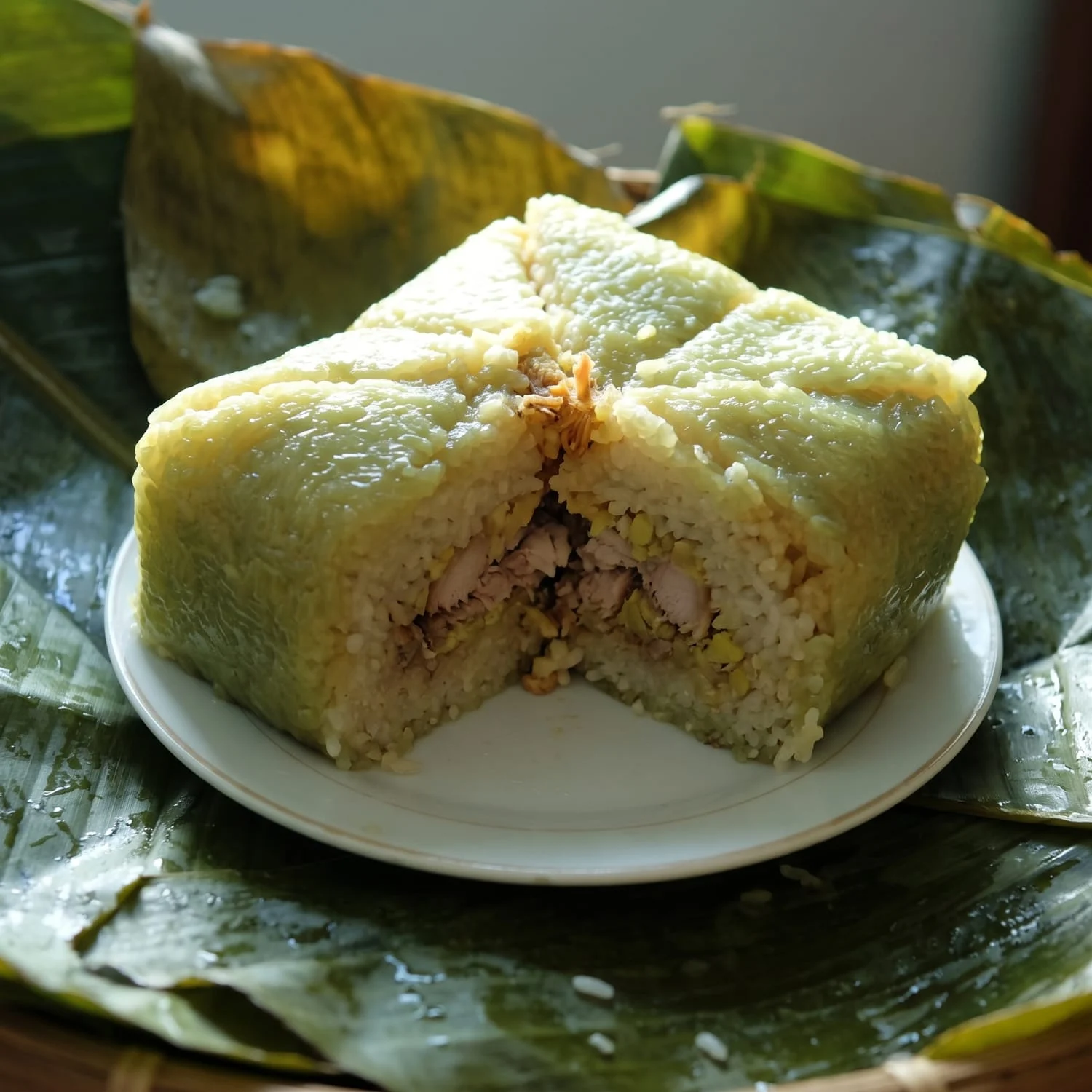
On National Highway 3 between Hanoi and Thai Nguyen, there is a stretch of road where drivers naturally slow down: the section through Co Lung commune, where both sides of the highway are lined with small stalls stacked high with deep-green banh chung, from early morning until late evening, year-round. That is Bo Dau. I – Kelly Thuy – have stopped there many times, and each time the same thing holds: the cake feels heavy and firm in the hand, the dong leaves are still deep green when opened, the pork belly is soft without being mushy, the glutinous rice is evenly cooked from surface to centre. When people in Hanoi plan what to buy for Tet, Bo Dau is often the first name they mention.
— Kelly Thuy
What Is Banh Chung Bo Dau?
At its core, banh chung Bo Dau is the classic northern Vietnamese square sticky rice cake – the recipe is not fundamentally different from banh chung made anywhere else. What creates its reputation and superior quality is the quality of each individual ingredient and the technique accumulated over generations by the people of Co Lung village. There is no secret formula; there is precision, provenance and practice.
| Quick Facts | Details |
|---|---|
| Vietnamese name | Bánh chưng Bờ Đậu |
| English name | Banh Chung Bo Dau · Thai Nguyen Tet Sticky Rice Cake |
| Cake type | Square traditional banh chung (north Vietnamese variant) |
| Location | Bo Dau village, Co Lung commune, Phu Luong district, Thai Nguyen |
| Distance from Hanoi | ~50–55km north on National Highway 3 |
| Defining ingredients | Dinh Hoa glutinous rice + Na Ri dong leaves (Bac Kan) + mountain spring water |
| Boiling time | 8–10 hours |
| Peak season | Tet (January–February); sold year-round |
The History of Bo Dau Village Craft
Bo Dau village sits in Co Lung commune, Phu Luong district – one of the highland districts in Thai Nguyen province with long settlement history. The banh chung-making tradition here is not recent; it has been passed down through many generations, shaped by the village’s geographic advantages: proximity to mountain streams, access to Dinh Hoa’s famous glutinous rice growing area, and trade routes connecting to Na Ri district (Bac Kan) for high-quality forest dong leaves.
The location on National Highway 3 – the main artery between Hanoi and the northeastern provinces – was historically a strategic advantage. Travellers passing through stopped to buy; word spread with each passing vehicle; and the reputation of Bo Dau banh chung grew over decades into one of the strongest craft food brands in northern Vietnam.
Today, Bo Dau is a recognised food heritage site in Thai Nguyen, with multiple family-run operations producing banh chung year-round and significantly scaling up production for the Tet season.
The Three Quality Factors That Define Bo Dau Banh Chung
1. Dinh Hoa Glutinous Rice
Dinh Hoa is a highland district in western Thai Nguyen province, known for a local glutinous rice variety grown in cool highland conditions with characteristic hillside soil. Dinh Hoa glutinous rice has plump, opaque white grains that cook into an unusually sticky, fragrant result – noticeably different from commercially grown glutinous rice raised in lowland paddies. This rice is the primary determinant of the cake’s stickiness and natural fragrance after boiling.
2. Na Ri Forest Dong Leaves (Bac Kan)
Dong leaves are the standard wrapper for banh chung throughout northern Vietnam, but not all dong leaves are equivalent. Forest dong leaves from Na Ri district, Bac Kan province – which borders Thai Nguyen – are visibly superior: larger, thicker, more deeply green and more pliable than cultivated dong leaves. After 8–10 hours of boiling, Na Ri dong leaves retain their colour instead of fading, do not tear, and create the characteristic deep green exterior that marks Bo Dau banh chung. Their mild herbal fragrance also infuses the outer rice layer during long boiling – a dimension that farmed dong leaves do not provide.
3. Mountain Spring Water
The Phu Luong area has mountain streams flowing from limestone hills – clean, low in suspended particles, lightly mineralised and untreated with chemicals. Bo Dau villagers have traditionally used this spring water rather than treated tap water. According to long-term makers in the village, spring water helps the glutinous rice cook more evenly and deeply, keeps the dong leaf colour more vibrant after boiling, and gives the finished cake a clean, naturally sweet flavour that treated tap water does not produce.
Ingredients
| Ingredient | Quantity (~4–6 cakes) | Notes |
|---|---|---|
| Glutinous rice (Dinh Hoa preferred) | ~1.5–2kg | Soak 8–12 hours; rinse and drain before wrapping. Dinh Hoa variety: plump grains, stickier and more fragrant when cooked |
| Peeled split mung beans | ~500–600g | Soak until soft, steam until cooked through but not mushy; season with a little salt while hot |
| Pork belly | ~400–500g | Sliced 1–1.5cm thick; marinate with salt, ground pepper and minced dried shallots for at least 1 hour |
| Na Ri forest dong leaves | 20–25 large leaves | Rinse clean; wipe completely dry before use (wet leaves cause mould). Select leaves that are large, even, unbroken |
| Bamboo tying strips | Sufficient quantity | Split bamboo or natural twine; tie firm enough that no gap opens during boiling |
| Water for boiling | Enough to completely submerge cakes | Mountain spring water or clean filtered water; avoid tap water with strong chlorine odour |
On the pork belly marinade: Bo Dau tradition uses only salt, pepper and dried shallots – no sugar, fish sauce or five-spice added to the pork filling. This keeps the pork flavour clean and natural, unlike some regional variants that add sweetness to the filling.
How Bo Dau Banh Chung Is Made
Step 1 – Prepare ingredients (the day before)
Soak glutinous rice overnight (8–12 hours). Soak mung beans 4–6 hours, steam until soft, season lightly with salt and cool. Marinate pork belly slices with salt, pepper and minced dried shallots, ideally overnight in the refrigerator. Rinse dong leaves clean and wipe each one completely dry – any moisture left on the leaves promotes mould during storage.
Step 2 – Wrap the cakes
Layer 2–3 dong leaves overlapping in opposing directions to form a square base. Lay down the glutinous rice base layer (~1cm deep), add the mung bean layer in the centre, place pork belly on top of the mung beans, cover with more mung beans, then finish with a top rice layer. Fold the dong leaves in tightly from all four sides to form a neat, firm square, then tie with bamboo strips in 2–3 secure loops both horizontally and vertically. Tight wrapping is the most important technical skill: a loose cake deforms in the pot, cooks unevenly and has a starchier texture.
Step 3 – Boil for 8–10 hours
Place the wrapped cakes in a large pot and fill completely with water (several centimetres above the cakes). Bring to a boil, reduce to a steady medium simmer and maintain for 8–10 hours continuously. When the water level drops, add boiling water (not cold) to keep the cakes fully submerged. Do not reduce the cooking time: insufficient boiling produces starchy, undercooked centres and a cake that falls apart when cut.
I asked an elderly woman at Bo Dau: “What’s the most important secret to good banh chung?” She didn’t answer with a recipe or an ingredient. She pointed to the pot of cakes bubbling on the fire and said: “Boil it for enough hours. There’s no shortcut.” That is a constraint that no technology or modern technique changes.
— Kelly Thuy, field notes, Bo Dau village, Thai Nguyen
Step 4 – Press and finish
Remove the cakes immediately when done and stack them in layers of 2–3. Place a flat board on top and weight it down heavily – traditionally with heavy stones, practically with any heavy flat object. Press for 4–6 hours until excess water drains out completely and the cakes are firm, flat and neatly squared. Properly pressed cakes cut cleanly in straight lines and keep significantly longer than unpressed ones.
Banh Chung in Vietnamese Culture
Banh chung is not only food – it is a traditional Vietnamese rice cake made from the same ingredients, served during the Vietnamese lunar new year (Tet) as a symbol for the harmony between the earth and heaven. According to the book Lĩnh Nam chích quái published in 1695, the creation of bánh chưng was credited to Lang Liêu, a prince of the last Sixth Hùng Dynasty.
Liêu wrapped them in green leaves from the forest, forming one round cake (bánh dầy) symbolizing the sky, and one square cake (bánh chưng) symbolizing the earth. The square shape, the green dong leaf exterior, the layered filling of grain, legume and meat – all carry specific symbolic meaning about the earth’s abundance and the filial gratitude of children to ancestors.
In this cultural context, Bo Dau banh chung is not a regional variant of the classic – it is a refined, quality-focused expression of the classic: same cultural meaning, superior ingredients, and craft knowledge sharpened over generations.
| Banh chung (North) | Banh tet (South/Central) | |
|---|---|---|
| Shape | Square, wrapped in dong leaves | Cylindrical, wrapped in banana leaves |
| Symbolism | Represents the earth (square = earth in ancient Vietnamese cosmology) | Same core symbolism; regional adaptation of shape |
| Region | North and North-Central Vietnam | Central and South Vietnam |
| Common filling variants | Classic mung bean + pork belly; some sweet variants | More filling variety: mung bean, peanut, sweet filling, banana |
| Common ground | Same core ingredients (glutinous rice, mung beans, pork), same Tet cultural significance, same long boiling technique | |
How to Eat Banh Chung Bo Dau
Freshly boiled (warm)
Cut along the cake with a bamboo tie or thread rather than a knife (which sticks to the glutinous rice). Slice into 4–6 pieces. Warm banh chung has its most delicate, sticky texture. Eat with pickled shallots – their mild acidity is the perfect counterpoint to the fatty richness of the pork and glutinous rice.
Pan-fried (cold cake)
Slice cold banh chung into 1–1.5cm thick pieces and pan-fry in a lightly oiled or dry non-stick pan until both sides are golden-brown and slightly crispy. The contrast of crispy exterior and soft, warm interior is completely different from the fresh cake, and widely considered its own distinct pleasure.
What to eat it with
- Pickled shallots / dua hanh – the non-negotiable classic Tet pairing; the most traditional accompaniment in northern Vietnam
- Vietnamese steamed pork sausage (cha lua) – for a full Tet meal
- Good fish sauce – the simplest accompaniment; brings out the rice flavour
- Pickled mustard greens – cooling and refreshing against the cake’s richness
Where to Buy Banh Chung Bo Dau
At the village – Phu Luong, Thai Nguyen
- Bo Dau village, Co Lung commune, Phu Luong district – on National Highway 3, approximately 50–55km north of Hanoi. Family-run stalls line the roadside and sell directly year-round; peak production during Tet season (January–February). Cakes sold both warm (freshly boiled) and at ambient temperature.
- Thai Nguyen city – markets and specialty food shops in the city carry Bo Dau banh chung.
Beyond Thai Nguyen
- Hanoi – specialty food shops and some supermarkets carry Bo Dau banh chung, particularly around Tet.
- Online (Shopee, Tiki, Lazada) – available but verify provenance carefully; many products labelled “banh chung Bo Dau” do not originate from Co Lung village. Choose sellers with a verifiable address in Co Lung, Phu Luong, Thai Nguyen and genuine buyer reviews.
Price Reference
| Context | Approximate price (VND) | Notes |
|---|---|---|
| Direct from Bo Dau village | ~35,000–70,000 per cake | Depending on size (~400g small, ~800g–1kg large); best price and freshest product |
| Thai Nguyen / Hanoi specialty shops | ~50,000–100,000 per cake | Transport and retail margin added |
| Online (regular season) | ~60,000–120,000 per cake + shipping | Order in advance during Tet; verify provenance |
| Tet season (Jan–Feb) | +20–30% above standard prices | High demand; pre-order at least 1–2 weeks in advance |
Nutritional Value
The figures below are estimates based on the primary ingredients. No independently verified nutritional analysis of Bo Dau banh chung has been published. Nutritional values vary significantly with the ratio of glutinous rice, mung beans and pork belly in each cake.
| Nutrient | Estimated value / serving (1/4 cake, ~150–180g) |
|---|---|
| Energy | ~280–350 kcal |
| Carbohydrates | ~40–50g (primarily from glutinous rice – high glycaemic index starch) |
| Protein | ~8–12g (from mung beans and pork belly) |
| Total fat | ~10–15g (from pork belly) |
| From mung beans | Dietary fibre, plant protein, B vitamins, potassium |
Banh chung is a starchy, moderately high-calorie food with significant fat from the pork belly. Appropriate as a main meal component rather than a snack. People managing blood glucose should note that glutinous rice has a higher glycaemic index than regular rice.
Frequently Asked Questions About Banh Chung Bo Dau
What is banh chung?
Banh chung is Vietnam’s iconic square Tet sticky rice cake: glutinous rice, mung beans and pork belly marinated with pepper and salt, wrapped in dong leaves and boiled for 8–10 hours. The square shape symbolises the earth. It is one of the most culturally significant foods in Vietnamese cuisine, associated with the story of Prince Lang Lieu and the Hung Dynasty.
What makes Bo Dau banh chung special?
Dinh Hoa glutinous rice (fragrant and sticky), Na Ri forest dong leaves from Bac Kan (larger, thicker, more aromatic than farmed leaves), mountain spring water for boiling, and multi-generation craft expertise in Co Lung village. Together these produce a cake that is denser, more evenly cooked and longer-lasting than standard banh chung.
Where is Bo Dau village?
Co Lung commune, Phu Luong district, Thai Nguyen province, on National Highway 3 approximately 50–55km north of Hanoi. Roadside stalls selling stacks of green banh chung make it easy to spot.
How long does it keep?
5–7 days at cool ambient temperature; 2–3 weeks refrigerated; 1–3 months frozen (steam or re-boil to reheat). Properly pressed Bo Dau banh chung keeps longer than standard banh chung.
What do you eat it with?
Pickled shallots (dua hanh) are the classic northern Vietnamese Tet pairing. Also with Vietnamese pork sausage (cha lua), pickled vegetables, or fish sauce. Cold leftover banh chung pan-fried until golden is another beloved way to eat it.
Is banh chung the same as banh tet?
Same basic ingredients (glutinous rice, mung beans, pork belly) and same Tet cultural significance, but different shape and regional distribution. Banh chung is square, wrapped in dong leaves, and predominates in northern Vietnam. Banh tet is cylindrical, wrapped in banana leaves, and predominates in central and southern Vietnam.
Conclusion
Banh chung Bo Dau answers the question of why the same basic recipe produces an unremarkable result in some hands and something genuinely worth seeking out in others. The answer is not a secret formula. It is Dinh Hoa glutinous rice selected for its plumpness, Na Ri dong leaves chosen for their size and thickness, spring water that has not been treated with chlorine, and wrapping hands that have been tying these same knots for decades without stopping.
If you travel National Highway 3 north of Hanoi, stop at Bo Dau. Buy a cake that is still warm. Eat it on the spot, without pickled shallots, without anything else. The flavour of Dinh Hoa glutinous rice and Na Ri dong leaves when the cake is freshly boiled is something that does not survive the journey back to the city intact.
Read more on FoodVietnamese:
- Banh chung – Cultural history and Tet significance (the broader story of banh chung in Vietnamese culture)
- Banh tet Tra Cuon – Tra Vinh (the southern cylindrical variant with natural plant dyes)
- Thit chua – Muong fermented pork, Phu Tho (another northern highlands specialty from a neighbouring province)
- Dinh Hoa glutinous rice – Thai Nguyen’s highland sticky rice

Related articles
Vietnamese Hot Pot (Lẩu): Types, How to Eat, Dipping Sauces
Vietnamese hot pot (lẩu) is a pot of seasoned broth kept simmering at the table, where diners cook…
Bun Thit Nuong: Vietnam’s Grilled Pork Noodle Salad, Not a Soup
Bun Thit Nuong is a Vietnamese grilled pork noodle salad — cold rice vermicelli piled with lemongrass-marinated grilled…
Is Vietnamese Food Spicy? Only If You Ask It to Be
Is Vietnamese food spicy? Not by default — most of the country’s best-known dishes, from phở to bánh…