Table of contents
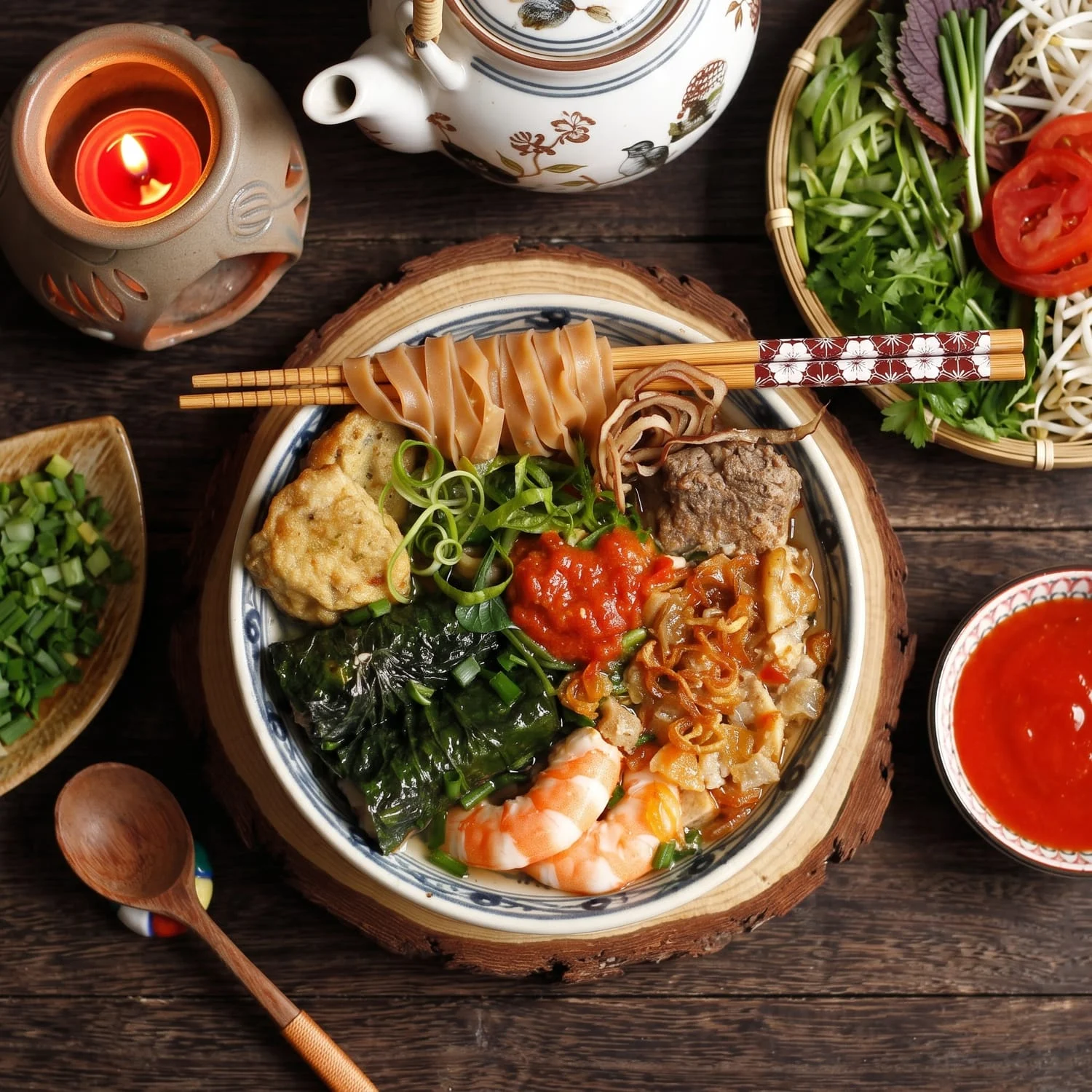
I – Kelly Thuy – arrived in Hai Phong on a cold winter morning. The first thing I did was not go to the waterfront but find a bowl of banh da cua. What struck me first was the colour: the red-brown noodles against the orange-gold broth from the crab roe and tomatoes, the green of morning glory, the dark betel-leaf rolls alongside. One spoonful of broth: the tamarind sourness, the sweet depth of freshwater crab, the shrimp paste umami – all at once. I understood immediately why people who grew up in Hai Phong say that no matter where they go in Vietnam, nothing satisfies the same way.
— Kelly Thuy
What Is Banh Da Cua?
Banh da cua is the staple in the cuisine of Hai Phong, a province in the Red River Delta area of Northern Vietnam. The essential ingredients in this dish include crab, pork wrapped in betel leaves (chả lá lốt), fish cakes, fresh vegetables, and, most importantly, banh da noodles. What makes it different from every other Vietnamese crab noodle dish is a combination of two elements that cannot be substituted: the wide reddish-brown banh da noodles, and a broth with a tamarind sourness rather than the fermented rice sourness used in bun rieu.
| Quick Facts | Details |
|---|---|
| Vietnamese name | Bánh đa cua |
| English name | Banh Da Cua · Hai Phong Crab Noodle Soup · Vietnamese Crab Red Rice Noodle Soup |
| Dish type | Noodle soup – Hai Phong port city signature dish |
| Origin | Cau Dat village, Le Chan district, Hai Phong |
| Signature noodle | Banh da do – wide (3–5mm), chewy, reddish-brown rice noodles |
| Broth base | Freshwater field crab + pork bones + tomatoes + shrimp paste + tamarind |
| Signature toppings | Cha la lot, fish cake, shrimp, crab roe, morning glory |
| International recognition | TasteAtlas “The World’s Best Soups” |
Origins
Banh da cua is a famous traditional dish in Hai Phong local cuisine, originating from Cau Dat village, Le Chan district. It was born when Northern fishermen struggled with the hardships of life at sea. The origin of Hai Phong banh da cua is believed to have appeared around the 10th century, when the people of Dat Cang used dipped banh da as a convenient dish on long journeys. Over time, that rustic flavour was combined with fragrant and sweet freshwater crab meat, creating a signature dish carrying the strong identity of Hai Phong cuisine.
Hai Phong’s identity as a major international trading port has always influenced its food culture: richer, more complex, with more layered flavours than the quieter inland cuisine of northern Vietnam. The four-dimensional broth of banh da cua – sour (tamarind), salty-umami (shrimp paste), sweet (bone and crab), aromatic-rich (crab roe) – reflects exactly this character.
Red noodle strands are not just a familiar food, but also a symbol of the familiar meals of the local people. The closeness between the dish and the life of Hai Phong people is vividly reflected through folk songs, proverbs, and folk melodies.
The Two Defining Elements
1. Banh da do noodles – The visual and textural signature
Unlike other kinds of rice noodles in Vietnamese cuisine, banh da noodles have a reddish colour that comes from the juice extract of gấc, a unique Vietnamese fruit. Banh da are wide, flat rice noodles that are naturally or traditionally coloured a deep reddish-brown (or sometimes dark grey) due to the use of a special type of rice and sometimes a touch of gấc fruit pigment or molasses during the drying process. These noodles have a chewier, heartier texture than most other Vietnamese rice noodles.
| Characteristic | Banh da do | Pho noodles | Bun (thin vermicelli) |
|---|---|---|---|
| Colour | Reddish-brown (distinctive) | White, slightly translucent | Bright white |
| Width | 3–5mm (wide, flat) | 3–4mm (flat) | 2–3mm (round, thin) |
| Texture | Notably chewy, toasted-rice note, holds texture in hot broth | Soft, silky | Soft, can go mushy |
| Colour source | Special rice + gac fruit pigment | Standard white rice | Standard white rice |
2. The four-dimensional broth
The broth of banh da cua Hai Phong is built from four flavour pillars that work simultaneously, not sequentially:
| Ingredient | Flavour contribution | Technical note |
|---|---|---|
| Freshwater field crab (cua dong) | Deep natural sweetness; distinctive northern Vietnamese freshwater-crab flavour | Pounded and filtered; crab protein coagulates into rieu pieces when heated gently |
| Pork bone stock | Round, stable base sweetness and body | Simmered 45–60 minutes minimum |
| Crab roe + tomato | Deep orange-gold colour; rich crab roe fragrance; tomato sweet-tartness and red colour | Sautéed in shallot oil first to develop aroma |
| Shrimp paste (mam tom) | The deep northern Vietnamese savoury-umami bass note – without it the broth lacks soul | Northern variety only; not interchangeable with southern variants |
| Tamarind juice | Clean fruit-acid sourness – the key differentiator from bun rieu (which uses fermented rice sourness) | Add gradually and taste; should support, not dominate, the crab sweetness |
Full Ingredient List
| Ingredient | Quantity (4 servings) | Notes |
|---|---|---|
| Red banh da noodles | ~400g | Soak 30 minutes in cold water; blanch in boiling water to order. Cannot be substituted with pho, bun or any other noodle without changing the character of the dish |
| Freshwater field crabs (cua dong) | ~500–600g | Pound thoroughly or blend; filter through a sieve for broth; crab roe reserved separately |
| Pork bones | ~300g | Blanch and simmer in fresh water for clean sweet stock |
| Tomatoes | 3–4 medium | Quartered; sautéed with shallots until coloured and soft |
| Tamarind juice | 2–3 tablespoons | The souring agent that distinguishes banh da cua from bun rieu; adjust to taste |
| Northern shrimp paste (mam tom) | 1–1.5 tablespoons | Northern Vietnamese variety; not interchangeable with southern mam ruoc |
| Cha la lot (betel-leaf pork rolls) | ~200g | Minced pork + wood-ear mushroom wrapped in betel leaves, pan-fried or grilled – essential; the betel leaf aroma is non-substitutable |
| Fish cake (cha ca) | ~150g, sliced | Hai Phong-style if available; adds a second protein layer with different texture |
| Fresh shrimp | ~150g, cooked and peeled | Whole or halved; adds sweetness and textural variety |
| Crab roe | From the crabs above | Sauté in shallot oil until deep orange – for colour, fragrance and richness |
| Morning glory (water spinach) | ~1 bunch | The traditional vegetable for this dish; or mixed fresh greens |
How to Make It
Step 1 – Simmer pork bone stock
Blanch pork bones in boiling water (discard that water to remove impurities). Cover with fresh cold water, bring to a boil, skim, reduce heat and simmer 45–60 minutes. Strain through a sieve for a clean stock.
Step 2 – Filter field crab broth (the critical technique)
Pound the cleaned field crabs completely or blend. Combine with approximately 1 litre of water, stir well, then strain through a sieve, discarding solids. Pour the filtered liquid into a pot and heat over low heat without stirring. As the temperature slowly rises, the crab protein coagulates and floats to the surface in firm pieces – these are the crab rieu. Skim them off gently with a ladle, keeping pieces intact. The rieu should be firm, not crumbled.
A banh da cua maker on Cau Dat Street explained: the rieu floats well or badly depending on heat. Too high – the rieu shatters and clouds the broth. Too low – it doesn’t form at all. The right heat is somewhere in between that only practised hands know how to hold. That’s not written in any recipe.
— Kelly Thuy, field notes, Hai Phong
Step 3 – Sauté crab roe and tomatoes
In a pan, heat shallot oil, add the crab roe and stir-fry until deep orange and fragrant. Add the quartered tomatoes and cook until softened. Transfer both to the pork bone stock pot.
Step 4 – Complete the broth
Add the filtered crab water to the stock pot (with tomatoes and roe already in). Add shrimp paste and tamarind juice. Bring to a gentle simmer. Taste carefully and adjust: the finished broth should have all four flavour dimensions present simultaneously – sweet (crab + bone), sour (tamarind), salty-umami (shrimp paste), aromatic-rich (crab roe).
Step 5 – Assemble the bowl
Blanch soaked red noodles in boiling water, drain into serving bowls. Arrange crab rieu, cha la lot, fish cake, cooked shrimp and crab roe on top. Ladle hot broth over. Add spring onions, herbs and fresh chilli. Serve with morning glory or fresh greens on the side.
Flavour and Texture Profile
| Layer | Description | Source |
|---|---|---|
| Deep sweet crab | The dominant flavour running through the broth – the specific sweetness of northern Vietnamese field crab, not sea crab | Freshwater cua dong filtered and simmered |
| Clean tamarind sourness | Mild, fruit-acid sourness that brightens the broth and cleans the palate without overpowering the crab | Tamarind juice added to broth |
| Shrimp paste umami depth | The bass note beneath everything – barely identifiable on its own but immediately missing if absent | Northern mam tom |
| Crab roe richness | A deep, aromatic-fatty dimension from the crab roe sautéed in shallot oil; the golden colour comes from here | Crab roe (from cua dong) |
| Betel leaf herbal-peppery | The distinctive aroma of la lot (betel leaf) in the cha la lot rolls – slightly bitter, peppery, aromatic; lifts the richness of the broth | Cha la lot (betel-leaf pork rolls) |
| Chewy noodle texture | The most notable textural contrast to Vietnamese noodle soups – the banh da noodles are substantially chewier and don’t soften to the same degree as pho or bun | Red banh da rice noodles |
Banh Da Cua vs Other Vietnamese Crab Noodle Dishes
| Dish | Noodle | Broth base | Souring agent | Signature toppings |
|---|---|---|---|---|
| Banh da cua (Hai Phong) | Red banh da, wide and chewy | Cua dong + pork bone + tomato | Tamarind | Cha la lot, fish cake, crab roe |
| Bun rieu cua (Hanoi) | White thin vermicelli | Cua dong + pork bone + tomato | Fermented rice (me) or vinegar | Fried tofu, blood jelly, pork ribs |
| Bun bo Hue | Round thick bun | Beef bone + lemongrass + shrimp paste | Not sour | Pork knuckle, Hue-style sausage, blood jelly |
How to Eat It
- Eat hot immediately – the tamarind flavour and noodle texture both deteriorate as the bowl cools
- Do not add fish sauce – the shrimp paste already provides salt and umami; adding fish sauce overloads the balance
- Morning glory raw or quickly blanched – Hai Phong style eats it crunchy, not fully cooked
- A dash of rice vinegar (not lime) for extra sourness – many Hai Phong stalls keep rice vinegar on the table, not lime
- Chilli fresh or as paste – traditional banh da cua is not heavily spiced; chilli is optional
Where to Eat It
In Hai Phong
- Cau Dat Street, Le Chan district – the neighbourhood most associated with the origin of the dish; multiple traditional stalls operating for decades, most busy from 6am until sold out by early afternoon.
- Tran Phu Street – central Hai Phong’s best-known thoroughfare for banh da cua, with established stalls that locals direct visitors toward. On cold winter nights, after attending language classes, walking along Tran Phu Street with the chilly northeastern wind – a crab noodle soup stall to warm up. Decades have passed, and that stall is still there.
- Traditional markets – Sat Market, Hang Market and An Dong Market all have morning banh da cua vendors who sell out before afternoon.
Outside Hai Phong
- Hanoi – Luong Dinh Cua, Linh Lang, and Kim Ma streets are famous for banh da eateries with authentic Hai Phong flavours, attracting many customers.
- Ho Chi Minh City – Areas like Bui Vien and Le Van Sy also have banh da cua eateries that bring the full flavour of home, serving customers in the southern city.
Price Reference
| Location | Approximate price (VND) | Notes |
|---|---|---|
| Street stalls / markets in Hai Phong | ~30,000–40,000 per bowl | Full toppings; local pricing |
| Restaurants in Hai Phong | ~40,000–60,000 per bowl | Larger portion; more comfortable setting |
| Authentic Hai Phong stalls in Hanoi | ~50,000–80,000 per bowl | Higher cost due to location and ingredient transport |
| Restaurants in Ho Chi Minh City | ~60,000–100,000 per bowl | Southern pricing; quality varies by restaurant |
Nutritional Value
Estimated based on primary ingredients. No independently verified nutritional analysis of banh da cua Hai Phong has been published.
| Nutrient | Estimated value / bowl (~400–450ml) |
|---|---|
| Energy | ~350–450 kcal |
| Carbohydrates | ~45–60g (from red rice noodles) |
| Protein | ~20–28g (from field crab + shrimp + cha la lot + fish cake) |
| Total fat | ~10–15g (from crab roe + cha la lot) |
| From field crab | High protein, calcium, zinc; cua dong is considered nutritionally valuable in northern Vietnamese traditional food knowledge |
| Sodium | Moderate-to-high (shrimp paste + seasoned broth); note for those monitoring sodium intake |
Frequently Asked Questions
What is banh da cua?
Hai Phong’s signature noodle soup: wide reddish-brown chewy rice noodles in a broth made from freshwater field crab, pork bones, tomatoes, shrimp paste and tamarind. Topped with betel-leaf pork rolls (cha la lot), fish cake, shrimp, crab roe and morning glory. Recognised by TasteAtlas as one of “The World’s Best Soups”.
What are banh da noodles?
Wide (3–5mm), flat rice noodles coloured reddish-brown by a special rice variety and/or gac fruit pigment. Chewier and heartier than pho noodles or thin vermicelli; hold their texture in hot broth without going mushy.
How is it different from bun rieu cua?
Same crab base, four key differences: (1) noodle: red banh da (wide) vs white bun (thin); (2) sourness: tamarind vs fermented rice/vinegar; (3) toppings: betel-leaf pork rolls + fish cakes vs fried tofu + blood jelly; (4) overall flavour: richer, more visually dramatic.
What is cha la lot?
Minced pork wrapped in betel leaf (la lot / Piper lolot) and pan-fried or grilled. The betel leaf contributes a distinctive peppery-herbal aroma that is one of the defining flavour notes of banh da cua. Cannot be substituted.
Can I find it outside Hai Phong?
Yes – there are authentic Hai Phong-style banh da cua restaurants in Hanoi (Luong Dinh Cua, Linh Lang, Kim Ma streets) and Ho Chi Minh City (Bui Vien, Le Van Sy areas). Quality is generally best at stalls with demonstrable Hai Phong provenance and high regular-customer traffic.
Conclusion
Banh da cua is what a port city’s food culture looks like when it is completely confident in itself: richer than its hinterland neighbours, more colourful, with a four-dimensional broth that reflects generations of a people who knew both freshwater crab from the paddies and the bold flavours of a trading crossroads. The reddish-brown noodles, the tamarind-sour broth, the betel-leaf pork rolls – none of these elements exist by accident.
If you are in Hai Phong, go to Cau Dat Street at 7am. Order a bowl with full toppings. Drink the first spoonful of broth before touching the noodles. That is the moment that explains why TasteAtlas put this on a list of the world’s best soups.
Read more on FoodVietnamese:
- Cha ruoi – Polychaete worm omelette, Hai Duong (another iconic northern Vietnamese coastal specialty)
- Bun rieu cua – Hanoi crab noodle soup (direct comparison: same crab base, completely different dish)
- Cha ca La Vong – Hanoi turmeric fish with dill (another internationally recognised northern Vietnamese dish)
- Hai Phong food guide – what to eat in Vietnam’s port city

Related articles
Vietnamese Hot Pot (Lẩu): Types, How to Eat, Dipping Sauces
Vietnamese hot pot (lẩu) is a pot of seasoned broth kept simmering at the table, where diners cook…
Bun Thit Nuong: Vietnam’s Grilled Pork Noodle Salad, Not a Soup
Bun Thit Nuong is a Vietnamese grilled pork noodle salad — cold rice vermicelli piled with lemongrass-marinated grilled…

Is Vietnamese Food Spicy? Only If You Ask It to Be
Is Vietnamese food spicy? Not by default — most of the country’s best-known dishes, from phở to bánh…