Table of contents
My first encounter with banh duc lac was at a morning market in Yen Dung, Bac Giang. The vendor had it laid out on banana leaves, cut into neat white squares, glossy with peanuts pressed into the surface. A small bowl of tuong ban sat beside it – dark amber-brown, smelling of fermented soybean, unlike anything else in the condiment world. I dipped a square in and ate it. Then immediately understood why people who grew up eating this say nothing tastes quite the same in the city.
What Is Banh Duc Lac?
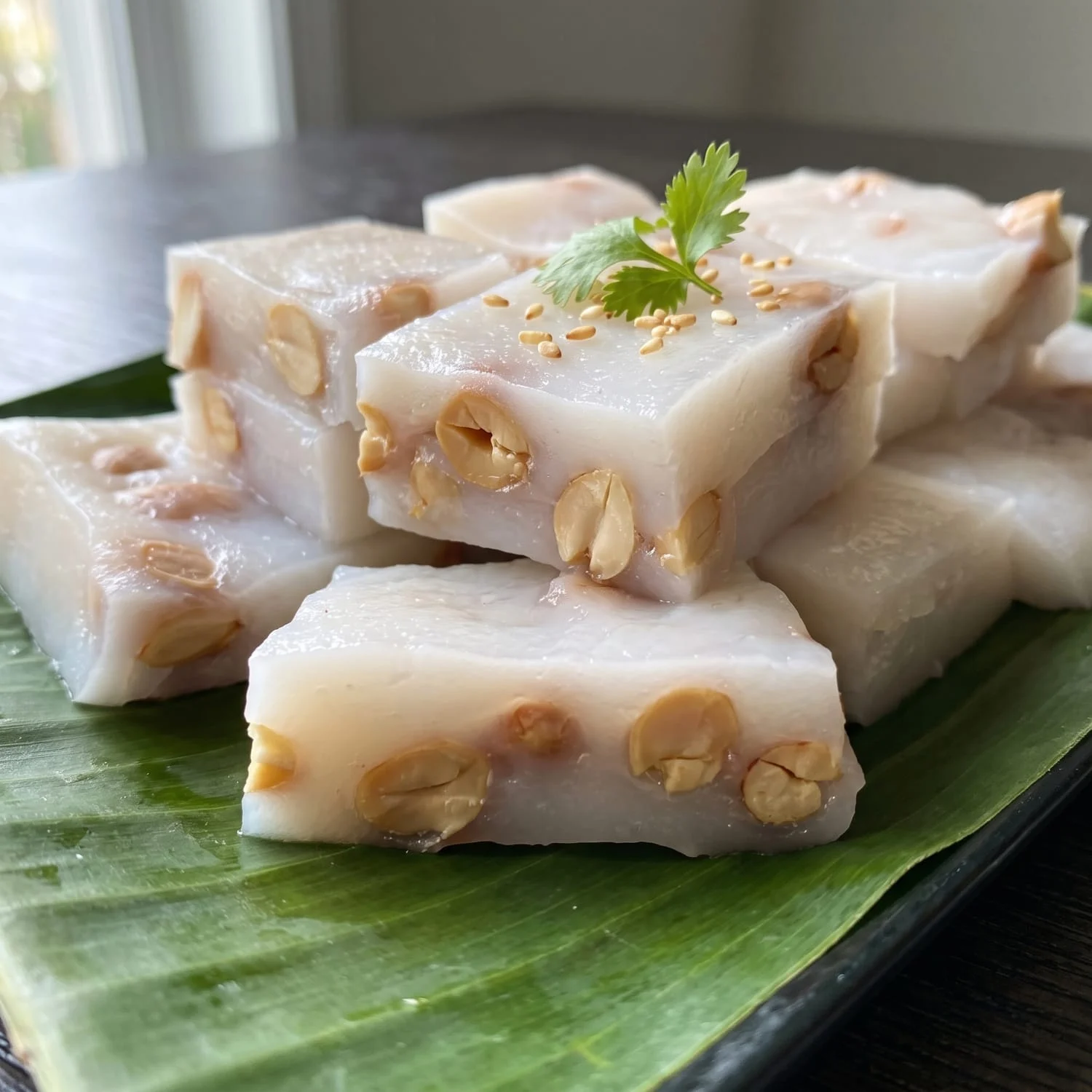
Banh duc cham tuong (steamed rice cake with fermented soy bean sauce) is another variety that truly showcases the rustic cuisine of Northern Vietnam – it comes in the form of a gelatinous block with peanut pieces that add extra rich flavour and some crunchiness to the soft, jelly-like banh duc. The thick traditional cake is made of rice flour stirred in clear limewater, kept cool after boiling, then cut into blocks; when eaten, the chewy texture blends with the scent of peanuts scattered inside and the strong taste of tuong ban.
Banh duc is one of the oldest and most elemental rice cakes in northern Vietnamese village food culture: no oven, no complex mould, minimal ingredients. What it demands is technique – specifically, the patience and physical endurance to stir continuously for 30–40 minutes over a hot fire without stopping.
| Quick Facts | Details |
|---|---|
| Vietnamese name | Bánh đúc lạc / Bánh đúc Đồng Quan |
| English name | Banh Duc Lac · Vietnamese Peanut Rice Cake |
| Cake type | Traditional northern Vietnamese cool rice cake |
| Village | Dong Quan village, Yen Dung district, Bac Giang province |
| Key ingredients | Non-glutinous rice flour + clear limewater + roasted peanuts |
| Texture | Soft, elastic, cool; matte-glossy white surface |
| Essential accompaniment | Tuong ban (fermented soybean paste) |
| Best time to eat | Morning or midday; eat fresh on the day |
Origins
Banh duc is among the most historically deep rice preparations in northern Vietnamese village cuisine. No specific date of origin is documented, but the simplicity of the ingredients (rice, water, fire) and the absence of any complex equipment suggest this is one of the oldest ways Vietnamese people processed rice into a different food format.
Dong Quan village in Yen Dung district, Bac Giang, established its local reputation for banh duc lac through consistent quality transmitted across generations and the strong tradition of pairing it specifically with tuong ban. The village’s position within Bac Giang province – a trading hub connecting several northern provinces – allowed the reputation of Dong Quan banh duc to spread through periodic market trade.
What distinguishes Dong Quan’s version is not a unique recipe (banh duc lac fundamentals are the same across northern Vietnam) but the insistence on pairing with tuong ban as a non-negotiable accompaniment – a combination that defines the flavour experience and cannot be approximated with other condiments.
The Two Essential Elements
Clear limewater – The technical ingredient
Banh duc lac is a traditional Vietnamese snack made with rice flour and peanuts, served with a savoury fermented soybean sauce. The recipe uses limewater to achieve the authentic flavour and texture. Clear limewater (nuoc voi trong) is the water settled above slaked lime (calcium hydroxide) – only the clear top layer is used, never the milky sediment.
Its role in banh duc is technical rather than flavour-based: limewater (nuoc voi trong) is used to create the perfect consistency. The mild alkalinity of the limewater modifies starch and protein molecules in the rice flour during cooking, producing the characteristic elastic, slightly translucent texture that distinguishes properly made banh duc from plain rice flour pudding. This is the same principle behind using wood ash water in Chinese zongzi and alkaline solution in many Asian noodles – a long-standing tradition of using mild alkali to alter the texture of starch-based foods.
Clear limewater ≠ cloudy lime suspension: only the clear water above the sediment is used. Including lime sediment produces a bitter taste. The solution should have a mild, clean alkaline smell – not overpowering.
Tuong ban – The essential dipping sauce
Tuong Ban is a fermented soybean dipping paste from Ban Yen Nhan Ward in Hung Yen Province. Made from soybeans and glutinous rice fermented over an extended period, tuong ban produces a thick, deep amber-brown paste with a complex savoury-sweet-umami flavour profile entirely distinct from fish sauce, soy sauce or chilli sauce.
| Characteristic | Tuong ban |
|---|---|
| Primary ingredients | Soybeans + glutinous rice + salt, long-term natural fermentation |
| Colour | Deep amber-brown; moderately thick paste |
| Flavour | Savoury-sweet, deep fermented umami – distinct from fish sauce, soy sauce or chilli paste |
| Most associated origin | Ban Yen Nhan village, Hung Yen province |
| Role with banh duc | Completes the mild-flavoured cake with depth and richness; cannot be substituted |
Banh duc lac has a clean, mild flavour on its own. Tuong ban has a deep, complex fermented richness. Banh duc lac – or Vietnamese peanut rice cake – is cherished for its chewy texture, nutty flavour, and unique pairing with fermented soy sauce (tương bần). The combination creates a balance that neither ingredient achieves alone: the cake provides the cool, elastic neutral base; the tuong ban provides the umami depth that makes each bite compelling.
Ingredients
| Ingredient | Quantity (~4–6 servings) | Notes |
|---|---|---|
| Non-glutinous rice flour | ~200g | Freshly ground from soaked rice gives the best result; good-quality packaged rice flour also works. Finer flour = smoother, glossier cake |
| Clear limewater (nuoc voi trong) | ~700–800ml | Top layer only, no lime sediment; ratio of flour to limewater approximately 1:3.5–4 depending on desired firmness |
| Salt | ~1/2 teaspoon | Lightly seasoned – the dominant flavour comes from the tuong ban dipping sauce, not from salt in the cake |
| Roasted shelled peanuts | ~50–70g | Roasted until golden-brown, skins removed; some stirred into the batter toward the end of cooking, some scattered on top after pouring |
| Tuong ban | Sufficient for dipping | The non-negotiable accompaniment; not substitutable with fish sauce, soy sauce or chilli sauce without losing the defining flavour of the dish |
How to Make It
Step 1 – Mix rice flour with clear limewater
Combine rice flour with clear limewater (top layer only, sediment discarded) and salt. Stir until completely smooth with no lumps. Rest for 15–20 minutes to allow the flour to fully hydrate and any air bubbles to settle.
Step 2 – Cook with continuous stirring (30–40 minutes)
Pour the mixture into a heavy-bottomed non-stick pot. Cook over low-medium heat. Stir continuously and without stopping using a wooden spoon or flat paddle, working from the bottom up and around the sides of the pot. Stopping – even briefly – causes the batter to stick and scorch on the bottom. Cook for 30–40 minutes until the mixture thickens noticeably, becomes slightly translucent, pulls away from the pan sides, and drops from the spoon in slow, heavy ribbons. Stir in most of the roasted peanuts (reserve some for topping).
A veteran banh duc maker in Dong Quan told me: “There’s no secret to good banh duc – you just have to stand there and stir. If your arms don’t get tired, the cake won’t be good.” That sounds simple. Forty minutes of continuous stirring over a summer morning fire is something not everyone sustains.
— Kelly Thuy, field notes, Yen Dung, Bac Giang
Step 3 – Pour into mould and cool at room temperature
Pour the hot mixture immediately into a lightly oiled tray or banana-leaf-lined container. Scatter the reserved roasted peanuts over the surface and press lightly so they adhere. Cool completely at ambient temperature – do not refrigerate immediately, as sudden cold causes condensation on the surface and weakens the texture. The cake sets firm enough to cut in 1–2 hours.
Step 4 – Cut and serve
Using a wet or lightly oiled knife, cut the cooled cake into square pieces approximately 3–4cm. Serve on a plate or banana leaf with a small bowl of tuong ban alongside. Eat cool – banh duc is a cold dish; reheating changes the texture irreversibly.
Flavour and Texture Profile
| Layer | Description | Source |
|---|---|---|
| Appearance | Glossy white with slight translucency; peanuts visible throughout and on surface | Rice flour + limewater alkalinity |
| Texture | Soft and elastic – not wobbly like plain pudding, not firm like mochi; somewhere between; pleasantly cool against the palate | Limewater-modified starch + correct flour-to-water ratio |
| Cake flavour | Clean and mild; the rice flavour is present but subtle; not sweet, not salty – a neutral canvas | Non-glutinous rice flour + minimal salt |
| Peanut note | Nutty, toasty, provides a small textural crunch against the smooth cake; fragrant when bitten | Roasted shelled peanuts |
| Tuong ban (when dipped) | Deep savoury-sweet fermented richness; thick, coating; the dominant flavour of the eating experience | Traditional fermented soybean paste |
| Overall | Cool mild + nutty crunch + deep fermented umami = simple but memorably balanced; the sum is greater than the parts | All three components together |
Banh Duc Variants Across Vietnam
| Variant | Key ingredients | Accompaniment | Region |
|---|---|---|---|
| Banh duc lac, Dong Quan (this article) | Rice flour + limewater + roasted peanuts | Tuong ban (fermented soybean paste) | Northern Vietnam (Bac Giang) |
| Banh duc nong (hot banh duc) | Rice flour + limewater (served hot, not cooled) | Minced pork, wood-ear mushrooms, fried shallots, fish sauce | Hanoi (modern street food) |
| Banh duc la dua (pandan) | Rice flour + coconut milk + pandan | Sweet syrup or coconut sauce | Southern Vietnam |
| Banh duc tom chay | Rice flour (plain or with coconut) | Dried shrimp floss, fish sauce | Southern Vietnam |
| Banh duc Hai Phong style | Rice flour + tapioca starch (cube-cut) | Minced pork, shrimp, crab broth | Hai Phong |
How to Eat It
Banh duc Dong Quan is best when:
- Eaten cool – not reheated; the cool elastic texture is the defining characteristic
- Dipped in tuong ban – not fish sauce, not soy sauce, not chilli sauce; only tuong ban creates the right balance
- Eaten for breakfast or as a midday snack – the most common consumption times in Yen Dung
- Eaten the same day it is made – banh duc does not keep well; best fresh
Where to Find It
- Yen Dung district market and village periodic markets, Bac Giang – banh duc vendors set up in the early morning; most are sold out by 10–11am. This is the primary and most authentic source.
- Bac Giang city – some morning food stalls and street vendors in the city centre sell banh duc lac with tuong ban.
- Important note: Banh duc is a fresh food with a soft structure – it cannot be transported long distances and does not keep beyond the same day. To eat the real Dong Quan version, you need to be there in the morning.
Nutritional Value
The figures below are estimates based on the primary ingredients. No independently verified nutritional analysis of banh duc Dong Quan has been published. The tuong ban dipping sauce adds protein from fermented soybeans and additional sodium.
| Nutrient | Estimated value / serving (~120–150g banh duc) |
|---|---|
| Energy | ~150–200 kcal (relatively low – primarily from rice starch) |
| Carbohydrates | ~30–40g (from non-glutinous rice flour) |
| Protein | ~3–5g (from rice flour and peanuts) |
| Total fat | ~4–7g (from roasted peanuts) |
| From tuong ban | Additional soybean protein; high sodium (fermented, salty condiment); beneficial fermented organisms |
Banh duc lac is a relatively low-calorie food, suitable as a light breakfast or snack. People managing sodium intake should monitor the amount of tuong ban used as a dipping sauce.
Frequently Asked Questions
What is banh duc lac?
A traditional northern Vietnamese cool rice cake: non-glutinous rice flour mixed with clear limewater, cooked while stirring continuously until thick and smooth, cooled into a glossy white elastic cake with roasted peanuts, eaten at room temperature dipped in tuong ban (fermented soybean paste). A specialty of Dong Quan village, Yen Dung district, Bac Giang province.
What is limewater and why is it in the recipe?
Clear limewater (nuoc voi trong) is the settled clear water above slaked lime (Ca(OH)₂). Its mild alkalinity modifies the starch and proteins in rice flour during cooking, producing the characteristic elastic, translucent texture of banh duc. Without limewater, the result is a softer, less chewy, less glossy cake.
What is tuong ban?
Tuong ban is a traditional northern Vietnamese fermented soybean paste, most closely associated with Ban Yen Nhan ward in Hung Yen province. Deep amber-brown, moderately thick, with a complex savoury-sweet-umami flavour from extended soybean fermentation. The essential dipping sauce for banh duc – not substitutable with fish sauce or soy sauce without changing the character of the dish.
How is northern banh duc different from southern banh duc?
Northern banh duc (this version) is savoury-neutral, made with limewater, eaten cool, dipped in tuong ban or fish sauce. Southern banh duc is typically sweet, cooked with coconut milk and pandan, served with sweet syrup. Two completely different preparations that share a name and a base technique.
How long does banh duc keep?
Best eaten on the day it is made. At ambient temperature: no more than 6–8 hours. Refrigerated: 1–2 days but texture changes and deteriorates. Cannot be frozen. It is fundamentally a fresh-daily food.
Can I make banh duc lac at home outside Vietnam?
Yes – non-glutinous rice flour is available at Asian grocery stores worldwide, and food-grade limewater can be made from calcium hydroxide (sold in Asian shops as “pickling lime” or “slaked lime”). The main challenge is sourcing authentic tuong ban; online Vietnamese grocery shops stock it. The technique requires patience but no special equipment.
Conclusion
Banh duc lac from Dong Quan village proves that memorable Vietnamese food is not always about complexity. Four ingredients: rice flour, limewater, roasted peanuts and fermented soybean paste. One technique: stir without stopping for forty minutes. One result: a cool, elastic white cake that has been the breakfast of choice at Yen Dung morning markets for generations.
If you visit Bac Giang, get to the Yen Dung morning market before 10am. Find the banh duc vendor. Order a portion with tuong ban. Sit somewhere nearby and eat it while it is still properly cool. That is all there is to it – and it is enough.
Read more on FoodVietnamese:
- Banh chung Bo Dau – Thai Nguyen (another northern village craft food specialty from a neighbouring province)
- Ca thinh Lap Thach – Vinh Phuc (another fermented food specialty of the northern midlands)
- Thit chua – Muong fermented pork, Phu Tho (fermented food from the same broader northern region)
- Tuong ban – Northern Vietnam’s fermented soybean paste

Related articles
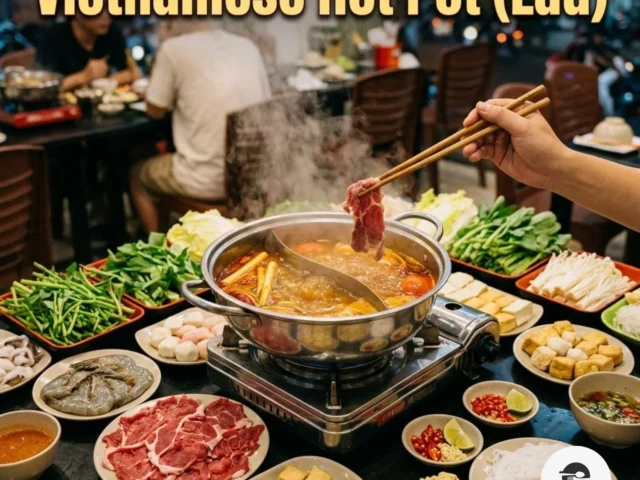
Vietnamese Hot Pot (Lẩu): Types, How to Eat, Dipping Sauces
Vietnamese hot pot (lẩu) is a pot of seasoned broth kept simmering at the table, where diners cook…
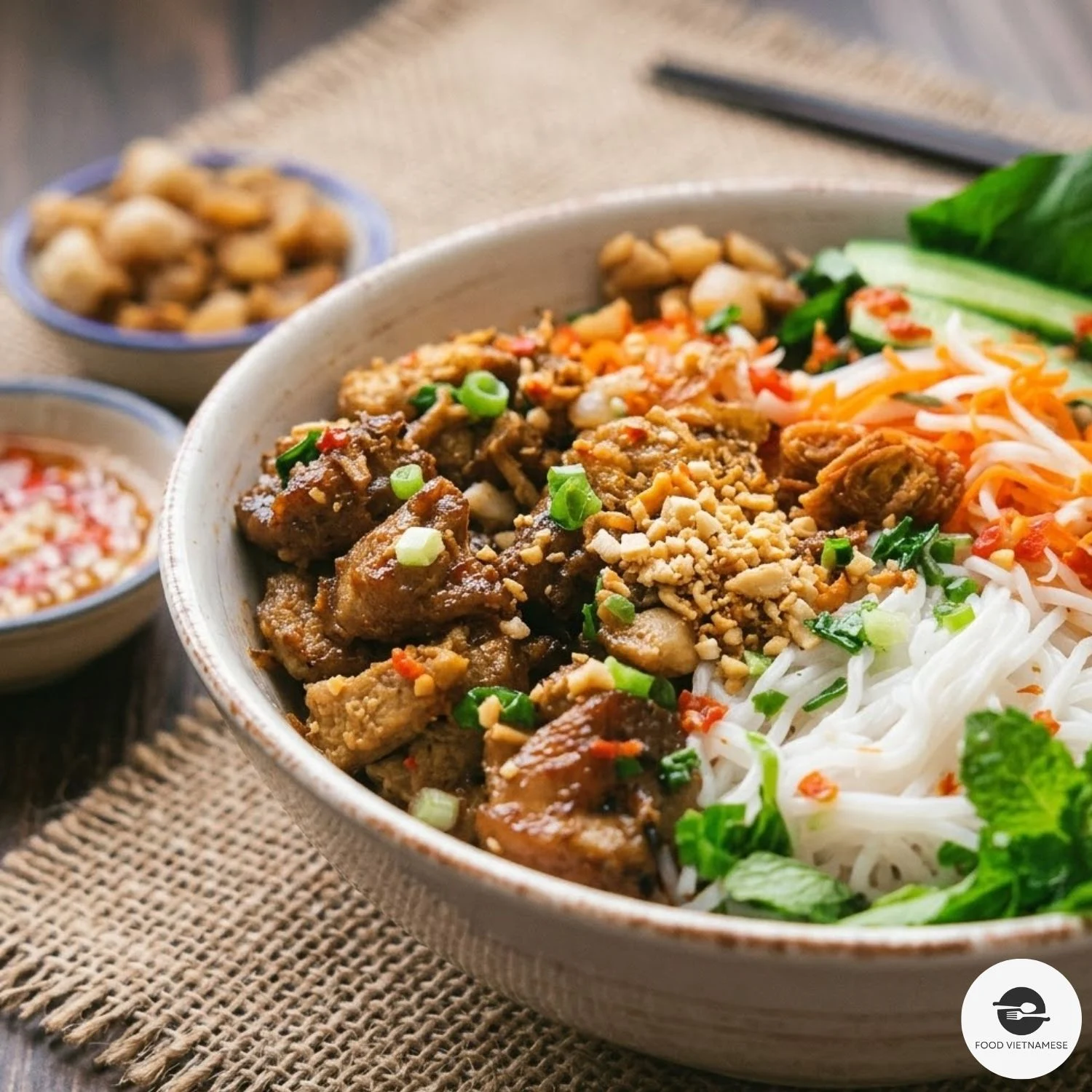
Bun Thit Nuong: Vietnam’s Grilled Pork Noodle Salad, Not a Soup
Bun Thit Nuong is a Vietnamese grilled pork noodle salad — cold rice vermicelli piled with lemongrass-marinated grilled…

Is Vietnamese Food Spicy? Only If You Ask It to Be
Is Vietnamese food spicy? Not by default — most of the country’s best-known dishes, from phở to bánh…