Table of contents
- What Is Cha Ca La Vong?
- History – From a Secret Gathering Place to a City Icon
- The Four-Ingredient Marinade
- The Two-Heat Technique – Why It Matters
- Ingredients
- Flavour and Texture Profile
- The Whipped Mam Tom – A Technique Worth Learning
- How to Eat It
- Where to Eat Cha Ca La Vong in Hanoi
- Price Reference
- Nutritional Value
- Frequently Asked Questions
- Conclusion
I – Kelly Thuy – have eaten cha ca at many places in Hanoi. But the first time I sat at a table at 14 Cha Ca Street, with a charcoal burner in the middle and a pan of oil already hot, and watched the server lower the turmeric-yellow grilled fish into the pan – the sizzle, the cloud of dill and spring onion aroma rising immediately from the table – nothing had prepared me for that. That smell belongs specifically to Hanoi.
— Kelly Thuy
What Is Cha Ca La Vong?
Cha Ca La Vong is a pan-fried and charcoal-grilled catfish dish – the name “cha ca” here does not mean fish cake (as “cha ca” sometimes refers to elsewhere in Vietnamese cuisine) but rather pan-fried fish fillets. It is prepared using a two-stage cooking technique that produces a result neither technique achieves alone: charcoal aroma from the first heat, crispy golden crust from the second. The marinade – turmeric, galangal, fermented rice and shrimp paste – is equally non-negotiable: remove any one element and the flavour profile shifts fundamentally.
| Quick Facts | Details |
|---|---|
| Vietnamese name | Chả cá Lã Vọng |
| English name | Cha Ca La Vong · Hanoi Turmeric Fish with Dill |
| Origin | Doan family, 14 Hang Son Street (now Cha Ca Street), Hanoi, ~1871 |
| Primary fish | Ca lang (hemibagrus catfish); ca qua (snakehead) also used |
| Marinade | Turmeric + galangal + me chua (fermented rice) + mam tom (shrimp paste) |
| Cooking technique | Two-heat: charcoal grill (heat 1) + tableside pan-fry (heat 2) |
| Served with | Rice vermicelli, fresh dill, spring onion, roasted peanuts, whipped mam tom |
| Defining experience | Tableside cooking – diners cook (or watch) their own fish in the pan at the table |
History – From a Secret Gathering Place to a City Icon
Among all Hanoian dishes, Cha Ca La Vong has one of the better-documented origin stories. The Doan family lived at 14 Hang Son Street in Hanoi’s Old Quarter and began preparing and serving their marinated grilled-then-fried catfish dish around 1871, during the early French colonial period in Hanoi.
According to historical accounts, in the earliest days the house served as a discreet meeting point for Vietnamese nationalists resisting the French occupation; the fish dish was prepared to feed those gatherings. Over time the food’s reputation spread through word of mouth, and the family opened a proper restaurant – one of the rare establishments in Hanoi of that era that served only a single dish.
Why “La Vong”?
At the entrance of the Doan family’s house stood a statue of La Vong (the Vietnamese name for Jiang Ziya / Khương Tử Nha), a figure from Chinese legend depicted as an old man fishing with great patience. Regular customers referred to the restaurant by the statue they saw at the door, and the name “Cha Ca La Vong” became the dish’s identity.
The dish’s cultural footprint grew large enough that Hang Son Street was officially renamed Cha Ca Street – one of very few streets in Vietnam named after a single food. The Doan family’s restaurant at number 14 continues to operate today, and – as has always been the case – serves only this one dish.
The Four-Ingredient Marinade
The flavour of Cha Ca La Vong comes from four marinade ingredients working together. None can be omitted or substituted without changing the dish fundamentally:
| Marinade ingredient | Technical role | Flavour contribution |
|---|---|---|
| Fresh turmeric | Curcumin creates the vivid golden-yellow colour; mild antimicrobial properties | The dish’s visual signature; warm, earthy aroma; very mild bitterness that disappears when cooked |
| Fresh galangal | Volatile oils deodorise the fish effectively; distinct from ginger in composition and aroma | Warm, spiced fragrance – deeper and more complex than ginger; essential for the “Hanoian” identity of the marinade |
| Me chua (fermented rice) | Lactic acid gently tenderises the fish protein; adds depth that vinegar cannot replicate | A clean, deep natural sourness that permeates the fish – not citric like lime, not sharp like vinegar |
| Mam tom (shrimp paste) | High umami; provides salt; functions both as marinade component and primary dipping condiment | The deep northern Vietnamese savoury-fermented base note that runs through the entire dish |
What is unusual about this marinade combination is that these four ingredients are rarely used together anywhere else in Vietnamese cooking. In Cha Ca La Vong, they create a flavour signature that is entirely its own: warm (turmeric + galangal) + natural sourness (me chua) + deep umami (mam tom). The combination cannot be simplified.
The Two-Heat Technique – Why It Matters
Heat 1 – Charcoal grilling (in the kitchen)
The marinated fish is grilled over medium charcoal before service until the surface firms up and turns deep golden-yellow from the turmeric. The interior remains slightly undercooked at this point – intentionally. The first heat achieves three things that the second heat cannot:
- A layer of charcoal-smoke fragrance on the surface of each piece
- A sealed exterior that prevents the fish from breaking apart when fried
- Even, beautiful golden colouring from the turmeric
Heat 2 – Tableside pan-frying (at the table)
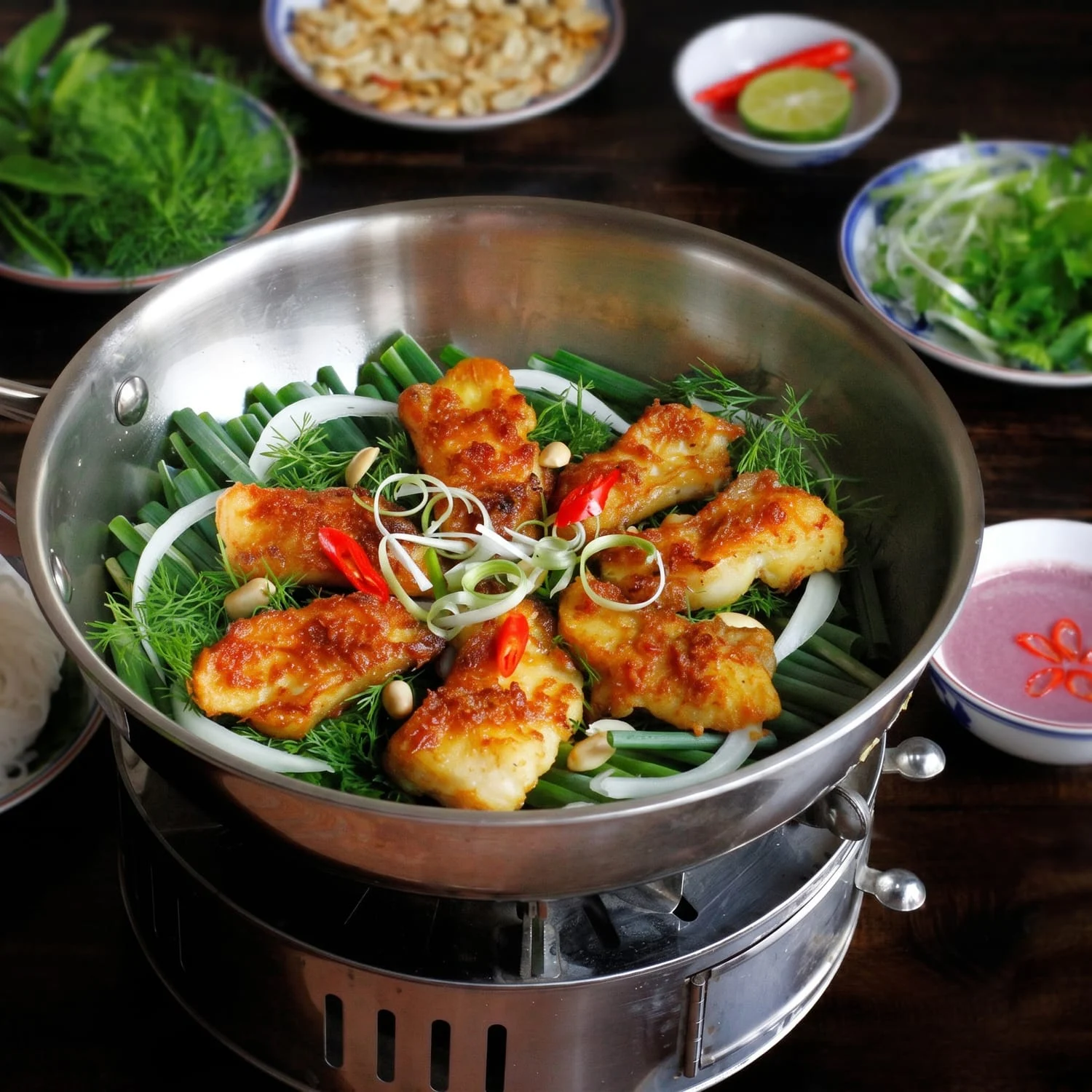
A pan of hot oil on a charcoal or spirit burner is placed directly on the dining table. The pre-grilled fish goes in and fries until the edges are crispy and golden. Just before the fish is done, the dill and spring onions go in – 30–60 seconds in the hot oil releases their aroma at full intensity. The second heat achieves what grilling cannot:
- Crispy golden edges – the signature texture of Cha Ca La Vong
- Completion of the interior (which heat 1 left slightly underdone)
- Dill and spring onion released into maximum fragrance in hot oil
- Tableside communal cooking – the social dimension of the dish
I once asked a server at 14 Cha Ca Street why they don’t simply fry the fish all the way in one go. She looked at me the way someone might look at a person asking why pho needs broth. “Grill first so the fish is fragrant. Fry after so the fish is crispy. Without one of them, it’s not Cha Ca La Vong anymore.” I had nothing to add.
— Kelly Thuy, field notes, Cha Ca Street, Hanoi
Ingredients
| Ingredient | Quantity (2–3 servings) | Notes |
|---|---|---|
| Ca lang (hemibagrus catfish) fillet | ~500g, cut 3–4cm thick | Firm-fleshed, minimal small bones, handles high heat well. Substitute: ca qua (snakehead) or ca basa (pangasius). Avoid thin cuts – they break apart in heat 2 |
| Fresh turmeric | ~30g | Pound and squeeze for juice; or 1–1.5 tsp turmeric powder (less aromatic). Never skip |
| Fresh galangal | ~20g | Pound and squeeze for juice. Do not substitute ginger – the aroma is distinctly different |
| Me chua (fermented rice) | ~2 tablespoons | Northern Vietnamese naturally soured fermented rice. Difficult to source outside northern Vietnam; reduce quantity if needed but do not remove entirely |
| Mam tom (northern shrimp paste) | ~1.5 tbsp (marinade) + more for dipping | Northern Vietnamese variety (dark purple, thick); not interchangeable with southern shrimp paste (mam ruoc) or fermented shrimp sauce |
| Fresh dill | ~1 large bunch | Leaves and tips only; essential – cannot be substituted with any other herb |
| Spring onions | ~1 bunch | Cut into 5–6cm sections |
| Roasted peanuts | ~50g | Skins removed, roughly crushed (not ground fine); adds crunch and nutty richness |
| Fresh rice vermicelli (bun tuoi) | ~300–400g | Hanoian-style fresh bun; not dried vermicelli |
Preparation Summary
Step 1 – Marinate: Combine turmeric juice, galangal juice, me chua and mam tom. Coat the fish and marinate for at least 2 hours (overnight preferred). Pat dry before grilling.
Step 2 – Heat 1 (charcoal grill): Grill over medium charcoal, turning, until the surface firms and turns deep golden. Inside still slightly underdone.
Step 3 – Heat 2 (tableside pan-fry): Fry in hot oil in the table-top pan until edges are crispy golden. Add dill and spring onions near the end, wilt 30–60 seconds.
Step 4 – Whip the mam tom: Add lime juice a little at a time to mam tom, whisking vigorously until foamy and pale pink. Add sugar and fresh chilli to taste.
Step 5 – Assemble at the table: Each diner builds their own bowl: vermicelli, fish, dill and spring onion, peanuts, mam tom to taste. Eat immediately.
Flavour and Texture Profile
| Layer | Description | Source |
|---|---|---|
| Turmeric-warm golden | The vivid yellow colour coats every surface; the warm earthy turmeric-galangal aroma dominates the first impression | Turmeric + galangal marinade |
| Faint smoke | A light charcoal fragrance in the background – present but not dominant; lifted when the fish is first bitten into | First-heat charcoal grilling |
| Crispy outside, moist inside | The signature two-heat texture: thin crispy golden edge giving way to moist, flaking interior | Two-heat technique |
| Dill explosion | The most immediate aroma at the table – dill in hot oil releases a bright, distinctive fragrance that defines the eating environment of the dish | Fresh dill wilted in the pan oil tableside |
| Whipped mam tom | Sharp, savoury-fermented, bright from lime; lighter than unwhisked shrimp paste; the dominant condiment of the eating experience | Mam tom whisked with lime juice |
| Peanut crunch | Rough-crushed roasted peanuts provide intermittent crunch and a mild nutty warmth between the stronger flavours | Roughly crushed roasted peanuts |
What sets Cha Ca La Vong apart from other Vietnamese fish dishes is the way the entire meal is assembled at the table, in real time, with the pan still cooking: each diner controls their own bowl, their own ratio of fish to dill to peanuts to mam tom. No two bites are identical. This is intentional – and it is why the tableside experience cannot be separated from the dish itself.
The Whipped Mam Tom – A Technique Worth Learning
Unwhisked mam tom placed directly on the table would be overwhelming – the fermented shrimp smell would dominate the entire room. Whisking with lime juice transforms it:
- Put 1–2 tablespoons of mam tom in a small bowl
- Add lime juice a small amount at a time (not all at once)
- Whisk or stir vigorously while adding – the paste will foam and turn from dark purple to pale pink
- Add a small pinch of sugar, sliced fresh chilli to taste
- The finished sauce should be foamy, pale pink, fragrant rather than pungent
This technique – adding acid gradually while aerating – works the same way as whisking cream or making vinaigrette. The aeration physically lightens the paste and the acid balances the fermented intensity. This is one of those techniques that is almost never written down in recipes but is essential to the experience of eating cha ca correctly.
How to Eat It
- Place a small amount of rice vermicelli in your bowl
- Use chopsticks to pick up fish directly from the pan while still hot
- Add dill and spring onion from the pan
- Scatter crushed peanuts
- Spoon whipped mam tom over – start with a small amount; it is strong, and adding more is easy
- Eat immediately; the fish loses its crispiness quickly and the mam tom becomes more pungent as it cools
Where to Eat Cha Ca La Vong in Hanoi
The original address
- Cha Ca La Vong Restaurant – 14 Cha Ca Street, Hoan Kiem district, Hanoi – The Doan family’s location since approximately 1871. The interior has changed little: low wooden tables, dark walls, charcoal burners. Only one dish is served. Advance reservations recommended, especially in peak tourism season.
Other reliable options
- Cha Ca Street (full length) – Several other cha ca restaurants have opened along the same street; quality varies. Ask locally or check recent reviews.
- Vua Cha Ca chain – 11 branches across Hanoi. Full traditional set (fish, vermicelli, dill, peanuts, mam tom, charcoal pan). No long wait for reservations; mid-range pricing.
- Traditional Hanoian restaurants in the Old Quarter and Ba Dinh district – Many include cha ca on their menu. Quality of the fish and the mam tom are the key things to check.
Price Reference
| Location | Approximate price (VND) | Notes |
|---|---|---|
| Cha Ca La Vong restaurant (14 Cha Ca St) | ~200,000–300,000 per person | Full set including fish, vermicelli, dill, peanuts, mam tom; advance booking recommended |
| Vua Cha Ca chain | ~150,000–220,000 per person | Full traditional set; multiple locations; no long reservation wait |
| Other Old Quarter cha ca restaurants | ~120,000–250,000 per person | Variable by location and fish quality |
Nutritional Value
Estimated based on primary ingredients. No independently verified nutritional analysis of Cha Ca La Vong has been published.
| Nutrient | Estimated value / serving (~200g fish + vermicelli + peanuts) |
|---|---|
| Energy | ~400–500 kcal |
| Protein | ~30–40g (ca lang is a lean, high-protein fish) |
| Total fat | ~15–20g (from pan-frying oil + peanuts) |
| Carbohydrates | ~40–55g (from rice vermicelli) |
| From turmeric | Curcumin – anti-inflammatory compound; small amounts but present |
| From mam tom | High sodium; fermented seafood protein; strong umami |
Frequently Asked Questions
What is Cha Ca La Vong?
Hanoi’s most iconic fish dish: ca lang (hemibagrus catfish) filleted and marinated in turmeric, galangal, fermented rice (me chua) and shrimp paste (mam tom), charcoal-grilled first then pan-fried tableside in the two-heat technique, served with rice vermicelli, fresh dill, spring onion, roasted peanuts and whipped mam tom dipping sauce. Served at 14 Cha Ca Street since approximately 1871.
What does “La Vong” mean?
La Vong (Lã Vọng) is the Vietnamese name for Jiang Ziya, a patient fisherman figure from Chinese legend. A statue of La Vong stood at the entrance of the Doan family’s house. Customers referred to the restaurant by the statue, and the name stuck. The street was later officially renamed Cha Ca Street.
What is the two-heat technique?
Heat 1: charcoal grilling before service – creates smoke fragrance and seals the outside. Heat 2: tableside pan-frying – creates crispy golden edges and finishes the interior. Both heats are required; neither achieves the full result alone.
What is me chua (fermented rice)?
Naturally fermented rice (plain cooked rice left to sour at ambient temperature) – a traditional northern Vietnamese souring ingredient. In the marinade it tenderises the fish and adds a clean lactic sourness that vinegar or lime cannot replicate.
What is mam tom and how is it whipped?
Northern Vietnamese fermented shrimp paste – thick, dark purple, powerful in aroma. For the dipping sauce: add lime juice gradually while whisking vigorously until foamy and pale pink, with sugar and chilli. Whisking transforms the paste from pungent and flat to bright and balanced.
What fish is used and can I substitute?
Ca lang (hemibagrus catfish) is the traditional choice: firm, minimal small bones, handles high heat well. Snakehead fish (ca qua in northern Vietnamese) is the most common substitute used by restaurants. Pangasius (ca basa) also works. Avoid delicate, thin fish that break apart during the second frying stage.
Is Cha Ca La Vong suitable for people who dislike strong-smelling seafood?
The mam tom dipping sauce has a pronounced fermented-seafood aroma. If you are sensitive to strong flavours, request a smaller portion of mam tom and use it sparingly – the fish itself has a much milder, turmeric-forward flavour. Some restaurants offer a fish sauce alternative for international diners, though this is not the traditional way.
Conclusion
Cha Ca La Vong is what Hanoi food culture looks like when a single family’s recipe becomes so embedded in a city’s identity that the street gets renamed after it. The dish is not complicated in concept – marinated fish, two heat sources, herbs, peanuts, shrimp paste – but every element is precise, and the tableside cooking turns the meal into something more than eating. You are not just a customer. You are a participant in something that has been happening at the same address since 1871.
If you visit Hanoi, go to Cha Ca Street. Sit at a table with a charcoal burner. Let the dill hit the hot oil. That is the moment the dish announces itself.
Read more on FoodVietnamese:
- Banh Duc Lac – Vietnamese Peanut Rice Cake, Bac Giang (northern Vietnamese traditional food from a neighbouring province)
- Banh Da Cua – Hai Phong crab noodle soup (another iconic northern Vietnamese dish)
- Bun Cha – Hanoi grilled pork noodles (Hanoi’s other most famous dish)
- Hanoi Old Quarter food map – 36 craft streets

Related articles
Vietnamese Hot Pot (Lẩu): Types, How to Eat, Dipping Sauces
Vietnamese hot pot (lẩu) is a pot of seasoned broth kept simmering at the table, where diners cook…
Bun Thit Nuong: Vietnam’s Grilled Pork Noodle Salad, Not a Soup
Bun Thit Nuong is a Vietnamese grilled pork noodle salad — cold rice vermicelli piled with lemongrass-marinated grilled…
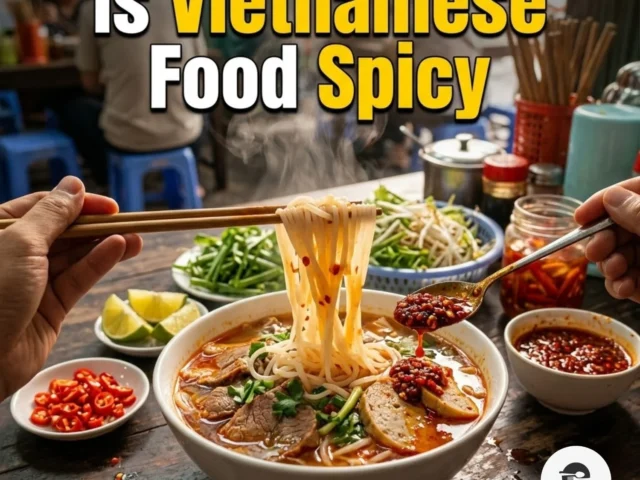
Is Vietnamese Food Spicy? Only If You Ask It to Be
Is Vietnamese food spicy? Not by default — most of the country’s best-known dishes, from phở to bánh…