Table of contents
- What Is Xoi Ngu Sac?
- Origins and Cultural Significance
- The Five Colours and Their Plant Sources
- Ingredients
- Traditional Preparation Method
- Nep Nuong – The Highland Sticky Rice
- Flavour and Texture
- How to Eat It
- Price Reference
- Where to Find Xoi Ngu Sac
- Nutritional Value
- Storage Tips
- Frequently Asked Questions About Xoi Ngu Sac
- Conclusion
When I first saw xoi ngu sac at a dawn market in Lai Chau, I assumed the colours had been added artificially. It was only when the vendor explained which plant produced which colour that I understood what I was looking at: a compressed archive of botanical knowledge – knowing exactly which leaf gives a stable colour under heat, which runs, which fades fastest, and how long to soak the rice for each one to penetrate evenly. The Thai and Tay communities of Northwest Vietnam have been doing this without written instructions for generations.

What Is Xoi Ngu Sac?
Xoi ngu sac (five-colour sticky rice) is highland glutinous rice naturally dyed in five distinct colours using plant-based extracts, steamed separately, and arranged together on a serving tray or plate without mixing the colours. The defining characteristic is that every colour originates from plants foraged or grown in the surrounding forests and gardens – no synthetic food colouring, no commercial dye. The rice variety – nep nuong, grown on hillside dry fields in the Northwest highlands – provides the fragrant, firm-sticky base that absorbs and holds the natural dyes better than lowland varieties.
| Quick Facts | Details |
|---|---|
| Vietnamese name | Xôi ngũ sắc / Xôi 5 màu |
| English equivalent | Five-colour sticky rice |
| Dish type | Sticky rice – festive specialty |
| Ethnic origin | Thai and Tay ethnic people |
| Primary province | Lai Chau (also Dien Bien, Yen Bai, Son La…) |
| Key ingredients | Nep nuong (highland sticky rice) + 4 natural plant dyes |
| Five colours | Red, yellow, purple, green, white |
| Occasions | Festivals, weddings, village ceremonies, Tết (Lunar New Year) |
| Key characteristic | 100% natural plant-based colours; zero artificial colouring |
Origins and Cultural Significance
Xoi ngu sac grew from the ritual food traditions of the Thai and Tay people in the Northwest highlands, where glutinous rice is not only a daily staple but a sacred offering in important ceremonies. The practice of dyeing the rice with forest plants reflects a deep, practical knowledge of local botany – knowing which leaves give colours that survive heat, which pigments bond with starch, and which fade too quickly to be worth using.
The five colours together are believed to carry auspicious symbolic meaning, though specific interpretations vary between communities. At Thai weddings, xoi ngu sac is an essential offering, signifying respect and abundance for the couple and their guests. At spring festivals and village blessing ceremonies, the full five-colour tray represents harmony, completeness, and gratitude to the natural world.
While the dish exists across several Northwest provinces – Dien Bien, Yen Bai, Son La – Lai Chau is most frequently cited in connection with it, partly due to the large Thai community there and partly because of the province’s rich availability of the specific dye plants, particularly la cam and the locally named red leaves, in their highland forests.
The Five Colours and Their Plant Sources
This is the most distinctive aspect of xoi ngu sac. Each colour is extracted from a different plant, prepared by boiling or pressing to obtain the dye water, which is then used to soak the raw rice before steaming.
| Colour | Plant source | Extraction method | Notes |
|---|---|---|---|
| 🔴 Red | Locally named “la com do” (red rice leaves) – a folk plant name | Boil leaves in water for 15–20 minutes, strain and cool | “La com do” is a regional folk name that may refer to different plant species depending on the local area; the scientific name is not confirmed in verified sources and is not added here |
| 🟡 Yellow | Fresh turmeric (Curcuma longa) | Blend or grate fresh turmeric, press out the juice; or simmer grated turmeric in water and strain | Turmeric (curcumin) is the most familiar and reliable dye among the five; produces a stable, bright yellow that holds well through steaming |
| 🟣 Purple | La cam leaves (Peristrophe roxburghiana) | Boil leaves in water for 15–20 minutes, strain and cool; more leaves = deeper purple | La cam has an established scientific name and is widely used across Vietnamese highland cuisines for natural purple colouring in rice, cakes and beverages; anthocyanin content creates the purple colour |
| 🟢 Green | Fresh ginger leaves or pandan leaves (Pandanus amaryllifolius) | Blend or press leaves, filter juice through cloth | Verified sources indicate either ginger leaves or pandan leaves may be used for green – likely depending on local availability. The two plants produce different green shades and different aromatic contributions to the rice |
| ⚪ White | Plain highland sticky rice (no dye) | Soak in plain water | The natural off-white/ivory colour of nep nuong; provides visual contrast and represents the pure base flavour of the rice itself |
Note on “la com do”: This is a folk name (literally “red rice leaves”) commonly used in Northwest Vietnamese food culture documentation. The specific botanical species it refers to may vary by locality. This article uses the verified folk name without adding an unconfirmed scientific name.

Ingredients
Nep Nuong – The Essential Rice Base
Nep nuong is not interchangeable with ordinary sticky rice in this dish. Grown on un-irrigated hillside fields in the Northwest highlands at altitude, harvested once a year, nep nuong produces larger, more aromatic grains with a firmer, longer-lasting stickiness when steamed. It also absorbs the natural plant dyes more evenly and holds the colour better than lowland varieties. Using nep nuong is considered the baseline requirement for authentic xoi ngu sac.
| Ingredient | Quantity (~4–6 servings) | Selection notes |
|---|---|---|
| Highland sticky rice (nep nuong) | ~500g total, divided into 5 equal portions (~100g each) | Look for nep nuong with clear Northwest Vietnam provenance; lowland sticky rice can be substituted but flavour and texture differ noticeably |
| “La com do” (red plant leaves) | A handful of fresh leaves (enough to dye 100g of rice) | Available at highland markets in Lai Chau, Dien Bien; not widely available outside the Northwest |
| Fresh turmeric | 1–2 small rhizomes (or pure turmeric powder) | Fresh turmeric produces a brighter, more vibrant yellow than powder; pure turmeric powder is an acceptable substitute |
| La cam leaves (fresh) | A handful (more = deeper purple) | Sold at highland markets; also available online as dried leaves or la cam powder – both work for dyeing |
| Fresh ginger leaves or pandan leaves | 5–7 leaves | Use whichever is locally available; pandan (sold at most Vietnamese supermarkets) is generally easier to find outside the Northwest |
Traditional Preparation Method
Step 1 – Extract the four dye waters
Prepare each colour separately, allowing all dye waters to cool to room temperature before using:
- Red: Wash la com do leaves, simmer in water for 15–20 minutes, strain and cool.
- Yellow: Grate or blend fresh turmeric and press out the juice; or simmer grated turmeric in water and strain. Alternatively, dissolve pure turmeric powder in warm water.
- Purple: Wash la cam leaves, simmer in water for 15–20 minutes, strain and cool. Adjust the amount of leaves for lighter or deeper purple.
- Green: Blend fresh ginger leaves or pandan leaves and press the juice through a cloth or fine strainer.
Step 2 – Soak the rice in each dye
Rinse the glutinous rice and divide into five equal portions. Submerge four portions in their respective cooled dye waters; keep the fifth in plain water. Soak for at least 6–8 hours, preferably overnight (8–12 hours), so the dye penetrates through to the centre of each grain rather than just colouring the surface. Inadequate soaking time results in pale, uneven colour after steaming.
Step 3 – Drain and steam each colour separately
Drain each coloured portion thoroughly. Steam each colour in a separate compartment to prevent the dyes from bleeding into each other. Traditional households use a wooden steaming vessel (chõ) that keeps portions apart naturally, or steam each colour in succession. Steam for 30–40 minutes until the grains are translucent, fully cooked, and evenly sticky.
Step 4 – Arrange and serve
Scoop each colour onto a large serving plate or tray, positioning the five portions side by side so all colours are clearly distinct. Traditional arrangements include wedge patterns, petal formations, or simple adjacent mounds. The visual presentation is integral to the dish – the five-colour display is as important as the flavour.
What few people realise when they look at a plate of xoi ngu sac: the purple from la cam starts fading within a few hours of air exposure. That is why it is always made on the morning of the occasion, not the day before. The older women in Lai Chau describe it this way: the sticky rice must be eaten “while it is still alive” – meaning while it still holds its colour as it did the moment it came off the steamer.
— Kelly Thuy, field notes, Lai Chau

Nep Nuong – The Highland Sticky Rice
Nep nuong is integral to xoi ngu sac not by rule but by flavour reality. Grown on un-irrigated red-soil highland fields at altitude, harvested once a year, its grains are larger, rounder and more fragrant than paddy-grown sticky rice. The difference is clear after steaming: nep nuong has a higher, more sustained stickiness, a distinct natural sweetness, and holds the natural dyes more evenly through the grain.
| Characteristic | Nep nuong (highland) | Standard lowland sticky rice |
|---|---|---|
| Growing method | Hillside dry field (nương rẫy), 1 harvest per year | Irrigated paddy, 2–3 harvests per year |
| Grain size | Larger, rounder, natural ivory colour | Smaller, more uniform |
| Aroma | Distinct natural fragrance, clear after steaming | Milder |
| Stickiness | High, remains sticky longer after steaming | Sticky when freshly steamed, firms up sooner |
| Dye absorption | More even and deeper dye penetration | May show uneven dye distribution |
Flavour and Texture
Xoi ngu sac is neither sweet nor savoury – this is an important difference from many other sticky rice preparations. Its flavour comes purely from the nep nuong itself and the faint aromas carried by the dye plants:
| Colour | Aroma / flavour note | Texture |
|---|---|---|
| White | Pure nep nuong – fragrant, subtly sweet, lightly nutty | Sticky, firm-tender, individual grains distinct |
| Yellow (turmeric) | Faint turmeric warmth, nearly neutral on the palate | Same as white; colour is the primary addition |
| Purple (la cam) | No significant flavour from la cam; rice fragrance dominates | Sticky, colour ranges from light to deep purple |
| Green (pandan/ginger leaf) | Pandan: pleasant light floral-vanilla note. Ginger leaf: subtle, less distinct | Sticky, natural green |
| Red (la com do) | Rice fragrance dominant; red is primarily visual | Same sticky texture as other colours |
The experience of eating xoi ngu sac is visual first, then tactile, then flavour. The five colours displayed together are the initial and lasting impression. The texture of properly steamed nep nuong – sticky but not gummy, each grain plump and distinct – is what gives experienced eaters a reference point for quality.
How to Eat It
Xoi ngu sac serves as the starchy centrepiece of a meal or ceremony and requires no dipping sauce when served at festivals – the natural flavour of nep nuong is the point. Diners typically take a portion of their chosen colour or sample each one in turn.
In everyday meal contexts (outside a ceremonial setting), xoi ngu sac pairs naturally with:
- Grilled or roasted dishes from Thai ethnic cooking – pa pinh top (mac khen grilled fish), grilled chicken, or any lightly seasoned protein
- Toasted sesame salt (muối vừng) – the simplest accompaniment, highlighting the sweet nuttiness of the rice
- Steamed or blanched highland vegetables with a simple dipping sauce
Best eaten within 1–2 hours of steaming. Natural plant colours – particularly the la cam purple – fade noticeably after a few hours of air exposure, and the rice begins to firm up. For this reason, xoi ngu sac is always prepared on the morning of the occasion in traditional practice.
Price Reference
| Purchase context | Approximate price (VND) | Notes |
|---|---|---|
| Morning market, Lai Chau or Dien Bien city | ~20,000–40,000 VND per portion (~200–300g) | Sold as breakfast; typically gone by 9am |
| Ceremonial tray (ordered in advance) | ~100,000–250,000 VND per tray | Serves 4–8 people; must be pre-ordered from a local maker |
| La cam leaves (dried) – for home dyeing | ~30,000–80,000 VND / 50–100g pack | Available online; reusable across multiple batches |
| Nep nuong (highland sticky rice) for home cooking | ~25,000–50,000 VND / kg | Available at Northwest specialty food shops and online; check for clear origin labelling |
Where to Find Xoi Ngu Sac
In Lai Chau and the Northwest highlands
- Lai Chau city morning market – the most convenient spot; stalls sell xoi ngu sac as a breakfast item, usually available only until 8–9am.
- Highland periodic markets in Sin Ho, Phong Tho, and Tam Duong districts (Lai Chau) – Thai and Tay vendors sell home-made xoi ngu sac alongside other local specialties.
- Dien Bien and Yen Bai – neighbouring provinces with large Thai and Tay communities; xoi ngu sac is similarly available at morning markets.
Outside the Northwest
- Hanoi – some Northwest Vietnamese specialty food shops and ethnic minority food stalls carry xoi ngu sac, though sourcing genuine nep nuong varies.
- Make it at home – straightforward with la cam leaves (sold dried online), turmeric, pandan leaves (available at Asian supermarkets), and nep nuong from specialty online retailers. A very accessible project for anyone interested in natural food dyes.

Nutritional Value
The figures below are estimates based on the composition of the main ingredient (steamed highland glutinous rice). The natural plant dye waters contribute negligible energy or macronutrients to the finished dish. No independently verified laboratory nutritional analysis of xoi ngu sac has been published. For clinical or dietary purposes, consult a registered dietitian.
| Nutrient | Estimated value / serving (~150g steamed sticky rice) |
|---|---|
| Energy | ~200–240 kcal |
| Carbohydrates | ~42–50g (primarily starch – the main energy source) |
| Protein | ~4–5g |
| Total fat | ~0.5–1g (very low – no added oil or fat in preparation) |
| Dietary fibre | Low (glutinous rice has less fibre than non-glutinous rice) |
| From natural dyes | Curcumin (turmeric – antioxidant), anthocyanins (la cam), chlorophyll (green leaves) – present in trace amounts with negligible nutritional significance at normal serving sizes |
Sticky rice (glutinous rice) is primarily a starch energy source with modest protein and very little fat. It has a higher glycaemic index (GI) than non-glutinous rice varieties. People managing blood sugar levels should bear this in mind. The natural dye plants contribute interesting phytonutrients (curcumin, anthocyanins) but at the concentrations present in a normal serving, the nutritional impact is minimal.
Storage Tips
- Eat within 1–2 hours of steaming for the best flavour and colour.
- If storing, wrap tightly and refrigerate for up to 1 day. Reheat by steaming or microwaving with a small cup of water added to the container to create steam.
- Colours will fade over time, especially the la cam purple – this is natural and expected with plant-based dyes, not a sign of spoilage.
- Dried la cam leaves keep in an airtight container in a cool, dark place for several months.
- Uncooked nep nuong stores in an airtight bag in a cool, dry place for 6–12 months.
Frequently Asked Questions About Xoi Ngu Sac
What is xoi ngu sac?
Xoi ngu sac (xôi ngũ sắc) is five-colour sticky rice from Northwest Vietnam, traditionally made by the Thai and Tay ethnic communities of Lai Chau, Dien Bien, and Yen Bai provinces. Highland glutinous rice (nep nuong) is naturally dyed in five colours using plant extracts, steamed separately, and displayed together. All colours are 100% natural – no artificial food colouring is used.
Where do the five colours come from?
Red from locally named “la com do” plant leaves; yellow from turmeric (Curcuma longa); purple from la cam leaves (Peristrophe roxburghiana); green from ginger leaves or pandan leaves; white from undyed highland sticky rice. All are natural plant sources.
What type of rice is used?
Nep nuong – highland glutinous rice grown on hillside dry fields in the Northwest, harvested once a year. It has larger, more fragrant grains than lowland sticky rice and holds natural dyes more evenly. It is the authentic base ingredient; lowland sticky rice can be substituted but flavour and texture will differ.
Why do the colours fade?
Natural plant pigments – especially the anthocyanins in la cam (purple) – are sensitive to air exposure and begin to fade within a few hours. This is an inherent property of vegetable dyes, not a sign of spoilage. Traditional practice is to make xoi ngu sac on the morning of the occasion and eat it fresh.
Is it sweet?
No – xoi ngu sac is neither sweet nor savoury in itself. The flavour comes from the natural sweetness and fragrance of nep nuong. Sweetness or saltiness can be added through accompaniments if desired, but the dish itself is intentionally neutral so the natural rice flavour is the focus.
Can I make xoi ngu sac at home?
Yes – it is accessible to home cooks. La cam leaves are available dried online; turmeric and pandan are easy to source; the main challenge is finding genuine nep nuong, which is available from Vietnamese specialty food retailers online. The overnight soaking step is essential – do not skip it or shorten it significantly.
Conclusion
Xoi ngu sac is beautiful not because someone decorated it, but because the people who make it understand the forest in a way that most of us have lost. The Thai and Tay communities of Northwest Vietnam did not need a chemistry textbook to know that la cam contains anthocyanins that bond with starch under heat, or that turmeric’s curcumin is heat-stable while some other natural pigments are not. They learned it by doing it, season after season, and encoded that knowledge into a dish that looks like art and tastes like the highlands.
If you travel to Lai Chau – wake up early. Find the morning market before the fog lifts. Look for the tray with five colours. Eat it while it is still alive.
Read more on FoodVietnamese:
- Pa Pinh Top – Mac khen grilled fish of Dien Bien (the grilled fish traditionally served alongside sticky rice in Thai ethnic meals)
- Trau gac bep – Smoked buffalo of Meo Vac, Ha Giang (another highland specialty where nep nuong features in the meal)
- Banh la ngai – Mugwort rice cake of Son La (another highland dish using natural leaf dyes in sticky rice)
- La cam – Vietnam’s natural purple dye plant

Related articles
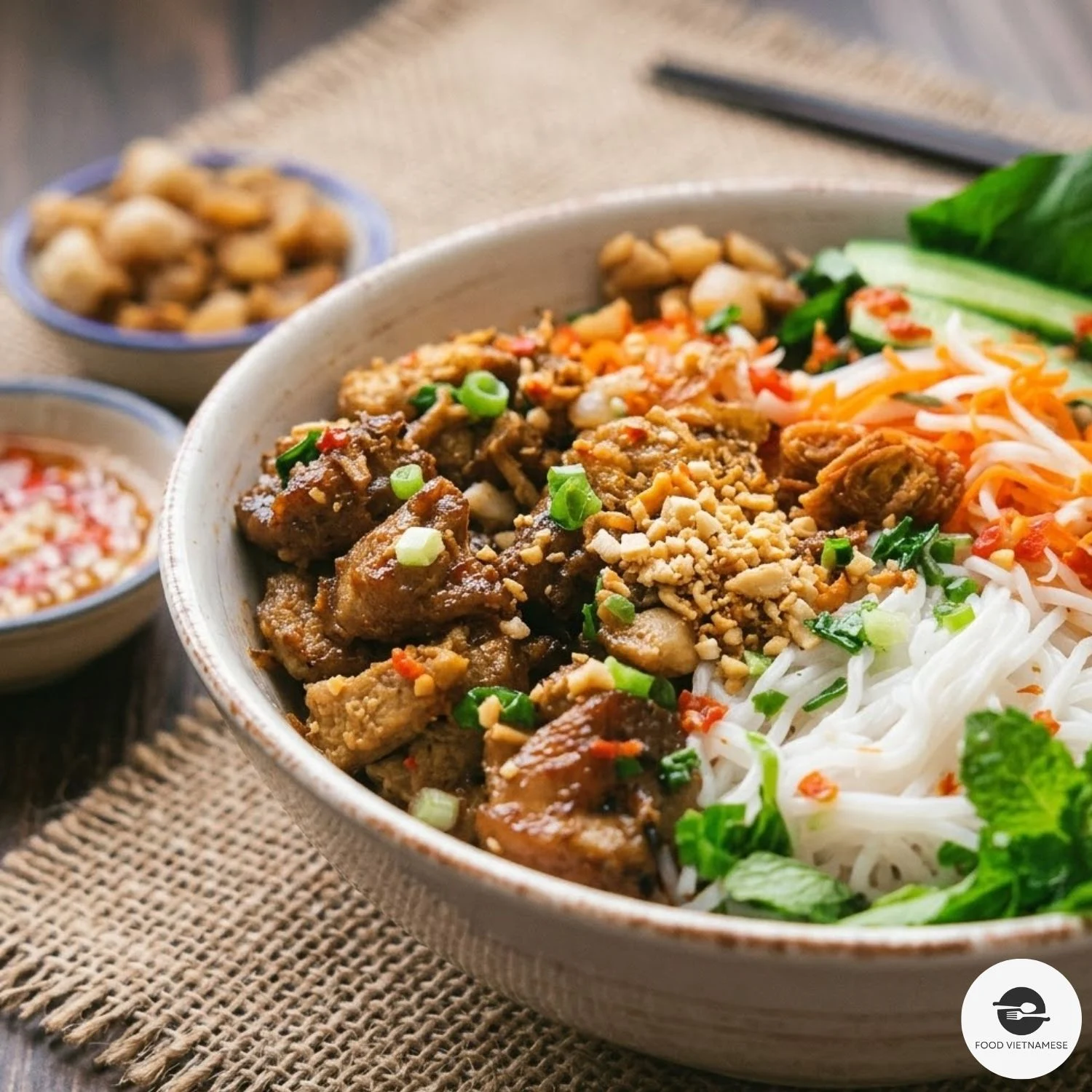
Bun Thit Nuong: Vietnam’s Grilled Pork Noodle Salad, Not a Soup
Bun Thit Nuong is a Vietnamese grilled pork noodle salad — cold rice vermicelli piled with lemongrass-marinated grilled…
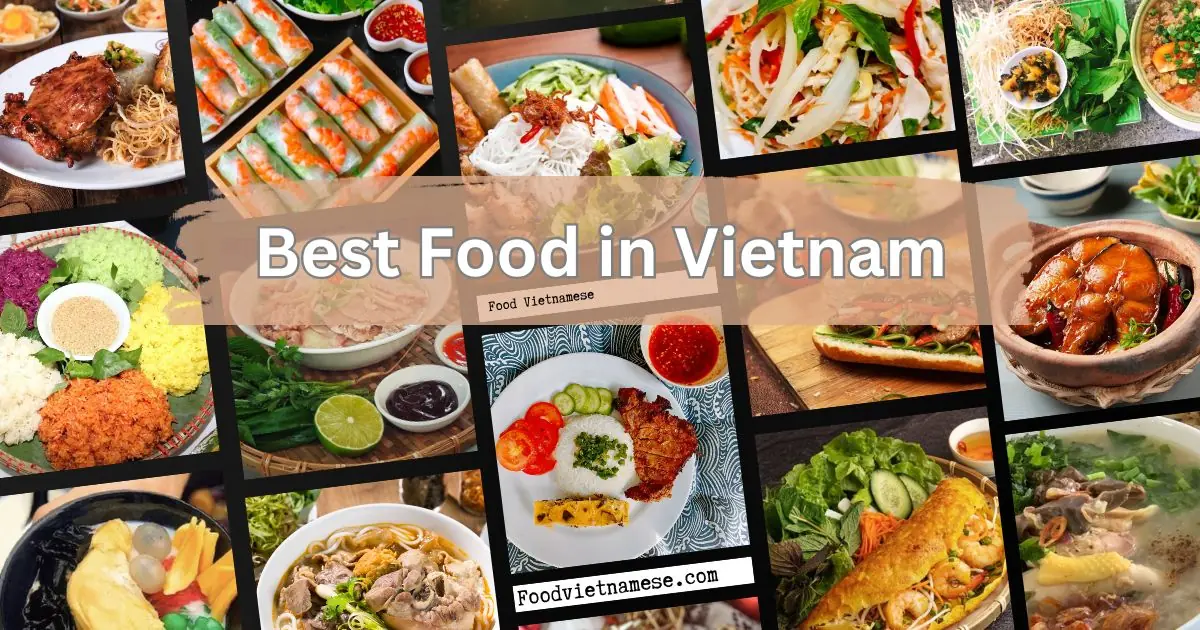
Best Vietnam Food: 15 Must-Try Dishes
Best Vietnam food is defined by one core principle: maximum flavor from the freshest possible ingredients. Vietnamese cuisine balances…
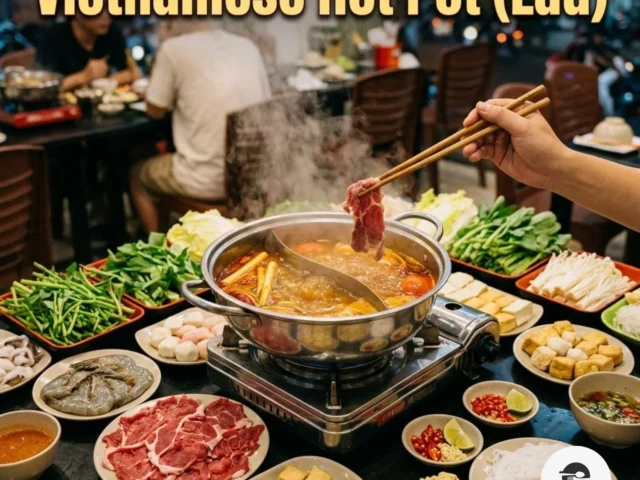
Vietnamese Hot Pot (Lẩu): Types, How to Eat, Dipping Sauces
Vietnamese hot pot (lẩu) is a pot of seasoned broth kept simmering at the table, where diners cook…