Table of contents
- A Cake Named After a Floating Plant
- Ingredients (Makes About 20-25 Small Cakes)
- Getting a Smooth Surface: Where Most Attempts Go Wrong
- Making Tôm Chấy (Shrimp Floss)
- Banh Beo Across Vietnam: Four Distinct Versions
- How to Eat Banh Beo
- Storage Notes
- A Tray of Saucers, One at a Time
- Another Taste of Hue’s Refined Table
- Banh Beo Calories and Nutrition
- Frequently Asked Questions
- Sources & References
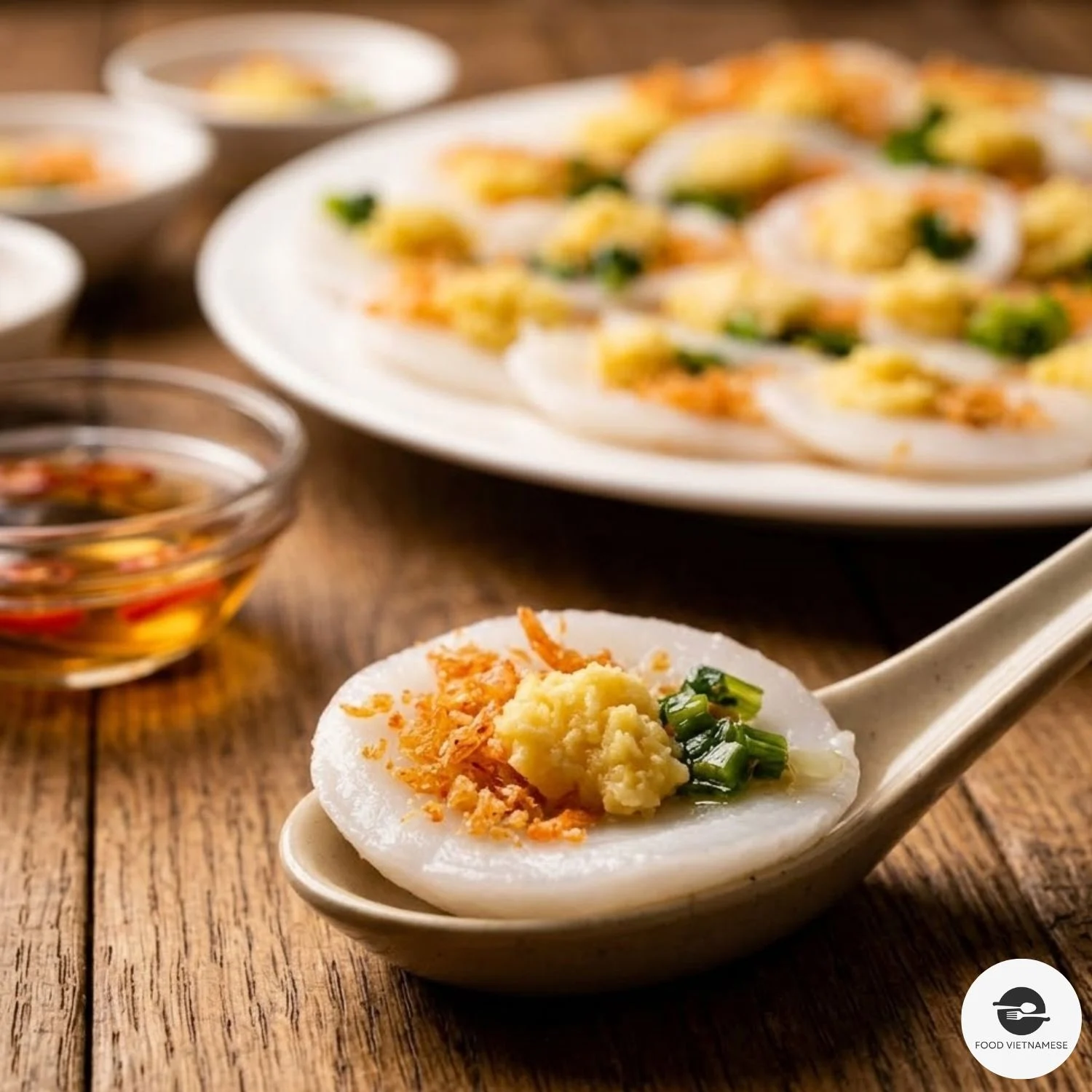
Banh Beo is a Vietnamese steamed rice cake from Hue — a thin batter of rice flour and tapioca starch steamed in small individual saucers until it sets into a delicate, slightly springy disc with a small dimple in the center, then topped with shrimp floss, crispy pork fat, and scallion oil, and finished with a light fish sauce dip. The name translates to something close to “water fern cake”: the round shape with its telltale center dimple mirrors the tiny floating fern common on Vietnamese rivers and ponds. Once served to the royal court during the Nguyễn dynasty, it’s now one of the most recognizable street snacks of central Vietnam — and one of the easiest dishes to get slightly wrong on the first try, usually at the steaming step.
A Cake Named After a Floating Plant
“Bánh” simply means cake; “bèo” refers to a small, round-leaved aquatic plant — a type of duckweed or water fern — that drifts across the surface of rivers and ponds throughout Vietnam. The steamed rice cake’s shape, particularly the shallow dimple that forms in the center as it sets in its little saucer, closely resembles the plant’s leaf. Wikipedia notes that “fern-shaped cake” is technically a more accurate rendering than the commonly used “water fern cake,” since the cake is named for its resemblance to the plant’s leaf shape rather than being made from the plant itself.
Banh Beo traces its roots to Hue, the former imperial capital of Vietnam, where it’s said to have been served to the royal family and court during the Nguyễn dynasty. That royal association is still visible in how the dish is presented: small, elegant, individually portioned servings — a far cry from the generously piled plates typical of most Vietnamese street food. Traditional shops that keep to the original one-cake-per-saucer format often add “Chén” (meaning “small bowl”) to the name — Bánh Bèo Chén — specifically to signal they’re serving it the old way.
Ingredients (Makes About 20-25 Small Cakes)
| Ingredient | Amount | Notes |
|---|---|---|
| Rice flour | 200g | The primary base of the batter |
| Tapioca starch | 2-3 tbsp | Not optional — tapioca starch is what gives the cake its characteristic slight chew and translucent sheen; rice flour alone produces a duller, denser texture |
| Water | Approx. 600-700ml | Mixed gradually into the flour; the batter should be thin, closer to a crepe batter than a pancake batter |
| Salt, oil | A pinch, 1 tsp | Seasons the batter lightly and helps prevent sticking |
| Shrimp | 200-250g, small or medium | Steamed, peeled, and processed into shrimp floss (tôm chấy) — see technique below |
| Pork belly or pork fat | 50-100g | Rendered and crisped into small golden bits (tóp mỡ), scattered on top for crunch |
| Scallions | 3-4 stalks | Finely chopped, cooked briefly in hot oil for scallion oil (mỡ hành) |
| Fish sauce, sugar, lime, chili | To taste | Combined for the dipping sauce — kept light and slightly sweet rather than sharply acidic |
Getting a Smooth Surface: Where Most Attempts Go Wrong
Two things determine whether the cakes come out smooth and delicate or rough and pitted. First, the batter needs to rest — at least an hour, sometimes longer — before steaming. This resting period lets the rice starch fully absorb the water, which is what produces the cake’s characteristic soft, slightly springy texture rather than a gummy or grainy one. Skipping this step is one of the most common reasons home versions come out uneven.
Second, and more commonly the culprit for a pitted, bubbled surface: steaming too long or at too aggressive a heat. Small ceramic saucers or ramekins are stacked into a steamer, pre-warmed for a couple of minutes, then filled with a thin layer of batter and steamed gently — typically just 5 to 10 minutes depending on saucer size. High heat or over-steaming causes the thin batter to bubble violently as it sets, leaving a rough, cratered surface once cooled instead of the smooth, glassy finish a well-made cake should have. Gentle, moderate steam and a close eye on timing matter more here than in almost any other Vietnamese steamed dish.
Making Tôm Chấy (Shrimp Floss)
Steam or briefly poach the shrimp until just cooked through, then peel. Grind or pound the shrimp coarsely — not into a smooth paste, but into a rough, textured crumble. Season lightly with salt and a touch of annatto oil for color, then dry-sauté the mixture in a pan with no added oil over medium-low heat, stirring frequently, until it separates into fine, fluffy, slightly dry strands. This dry-roasting step is what turns simple ground shrimp into the light, airy floss that defines the dish’s texture — rushing it or using too much oil results in a wetter, clumpier topping that lacks the right texture contrast against the soft cake underneath.
Banh Beo Across Vietnam: Four Distinct Versions
Banh Beo is often assumed to be one fixed recipe, but it changes meaningfully as it moves outside Hue.
| Region | Topping Style | Notable Difference |
|---|---|---|
| Hue (original) | Dry shrimp floss, crispy pork fat, scallion oil | Smallest cakes, most delicate, served in individual tiny saucers — the classic “Bánh Bèo Chén” format |
| Da Nang / Quang Nam | Thick savory topping of pork, shrimp, and wood ear mushroom, cooked into a sauce and ladled on | Known as the “wet” version (bánh bèo nhân ướt) — the topping is a cooked filling rather than dry, separate garnishes |
| Northern Vietnam | Relies more heavily on pork | Generally less shrimp-forward than the Hue original |
| Southern Vietnam | Adds mashed mung bean paste to the toppings | Noticeably sweeter profile; typically served on larger shared plates rather than individual saucers |
How to Eat Banh Beo
Served the traditional way, each cake arrives in its own tiny saucer. Pour a small amount of the dipping sauce directly into the saucer, then use a spoon or the flat edge of chopsticks to scrape the cake up from its dish rather than lifting it out whole — the cakes are too delicate to pick up cleanly with fingers or a fork. Diners typically work through several saucers one at a time rather than transferring everything to a single plate, and etiquette generally holds that you finish one cake before starting the next rather than mixing several at once.
Storage Notes
- Plain steamed cakes: Keep refrigerated in an airtight container for up to 3 days; store toppings separately for the best texture
- Reheating: Steam for 3-5 minutes for the best texture recovery, or microwave briefly with a damp paper towel over the cakes
- Batter: Uncooked batter can be frozen for up to a month; the steamed cakes themselves don’t freeze well
A Tray of Saucers, One at a Time
At a stall tucked into a side street near the Perfume River, I watched a woman pull tray after tray of tiny ceramic saucers from a bamboo steamer, checking each batch by pressing a fingertip lightly into the center of one cake before deciding whether to pull the whole tray. When I asked what she was checking for, she said the surface should give slightly and spring back — if it didn’t spring back, the batch needed a minute more; if it looked at all bubbled, she’d already know the heat had run too hot before she even touched it. She’d clearly done this thousands of times, but she still checked every single tray, no exceptions, which told me more about the margin for error in this dish than anything she actually said.
Banh Beo Calories and Nutrition
| Serving | Calories |
|---|---|
| 1 piece (small, plain topping) | ~54 kcal |
| 1 piece (larger, full toppings) | ~120 kcal |
| 1 standard plate (~8-10 pieces with toppings and sauce) | ~358 kcal |
Per-piece values cross-referenced from Cindy Lam Cuisine and Foodaciously recipe data; plate-level figure from FoodVietnamese.com’s nutrition database. Banh Beo is naturally gluten-free (rice flour and tapioca starch base), moderate in calories due to the steamed preparation, though fish sauce and fried toppings contribute meaningfully to sodium and fat.
Frequently Asked Questions
What is Banh Beo?
A Vietnamese steamed rice cake from Hue, made from rice flour and tapioca starch batter steamed in small saucers, topped with shrimp floss, pork fat, and scallion oil, served with fish sauce dip. The name means roughly “water fern cake,” after the dish’s resemblance to a floating aquatic plant.
Why does the surface of Banh Beo sometimes turn pitted or rough?
Almost always caused by steaming too long or at too high heat, which makes the batter bubble unevenly. Rest the batter at least an hour before steaming and use gentle, moderate steam for 5-10 minutes.
What is the difference between Hue-style and Quang Nam-style Banh Beo?
Hue-style is smaller and more delicate, with dry shrimp floss and pork fat toppings in individual saucers. Quang Nam/Da Nang-style is the “wet” version, with a cooked pork-shrimp-mushroom sauce ladled over the cake instead of dry toppings.
Is Banh Beo the same throughout Vietnam?
No. Northern versions lean more on pork; Southern versions add mung bean paste for a sweeter profile and are served on larger shared plates rather than individual saucers.
How many calories are in Banh Beo?
Roughly 54-120 kcal per piece depending on size and topping. A standard plate of 8-10 pieces contains approximately 358 kcal.
Sources & References
- Wikipedia – Bánh bèo. en.wikipedia.org/wiki/B%C3%A1nh_b%C3%A8o
- Vicky Pham – Vietnamese Steamed Savory Rice Cakes with Mung Bean Paste & Dried Shrimp (Banh Beo). vickypham.com
- Helen’s Recipes – Banh beo – Savoury Rice Cake (Water Fern Cake). helenrecipes.com
- Keep Up Cooking – Vietnamese Banh Beo – Steamed Rice Cake Recipe. keepupcooking.com
- VietFoodNet – How To Make Banh Beo – Vietnamese Steamed Rice Cakes. vietfoodnet.com
- Vietnamese Food Recipes – Vietnamese Steamed Rice Cakes (Bánh Bèo). vietnamesefoodrecipes.com
- Cooking Therapy – Banh Beo, nutrition data. cooking-therapy.com
- Cindy Lam Cuisine – Vietnamese Steamed Rice Cakes | Bánh Bèo, nutrition data. cindylamcuisine.com
- Foodaciously – Bánh Bèo Recipe, nutrition data. foodaciously.com

Related articles
Bun Thit Nuong: Vietnam’s Grilled Pork Noodle Salad, Not a Soup
Bun Thit Nuong is a Vietnamese grilled pork noodle salad — cold rice vermicelli piled with lemongrass-marinated grilled…
Best Vietnam Food: 15 Must-Try Dishes
Best Vietnam food is defined by one core principle: maximum flavor from the freshest possible ingredients. Vietnamese cuisine balances…
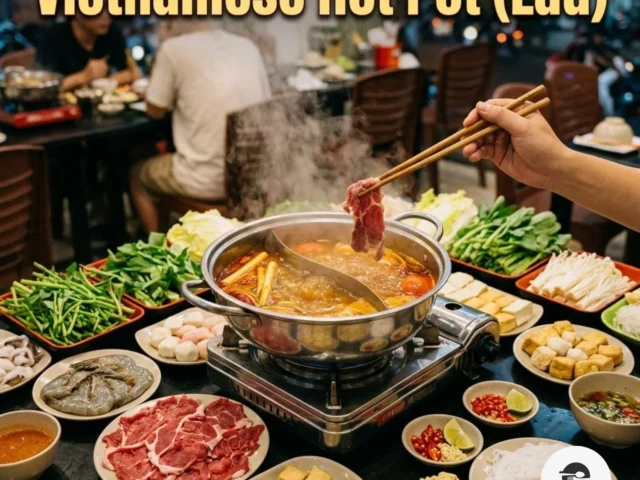
Vietnamese Hot Pot (Lẩu): Types, How to Eat, Dipping Sauces
Vietnamese hot pot (lẩu) is a pot of seasoned broth kept simmering at the table, where diners cook…