Table of contents
- Two Competing Stories Behind the Name
- Where Banh Khot Actually Comes From
- What Goes Into Banh Khot
- The Mold That Makes the Dish
- Banh Khot vs. Banh Xeo: Same Batter, Different Texture
- Banh Khot vs. Banh Can: Cousins From Different Coasts
- Banh Khot vs. Banh Xeo vs. Banh Can at a Glance
- How to Eat Banh Khot
- Banh Khot Calories and Nutrition
- Watching the Mold Work
- Where to Eat Banh Khot in Vung Tau
- Frequently Asked Questions
- Sources & References
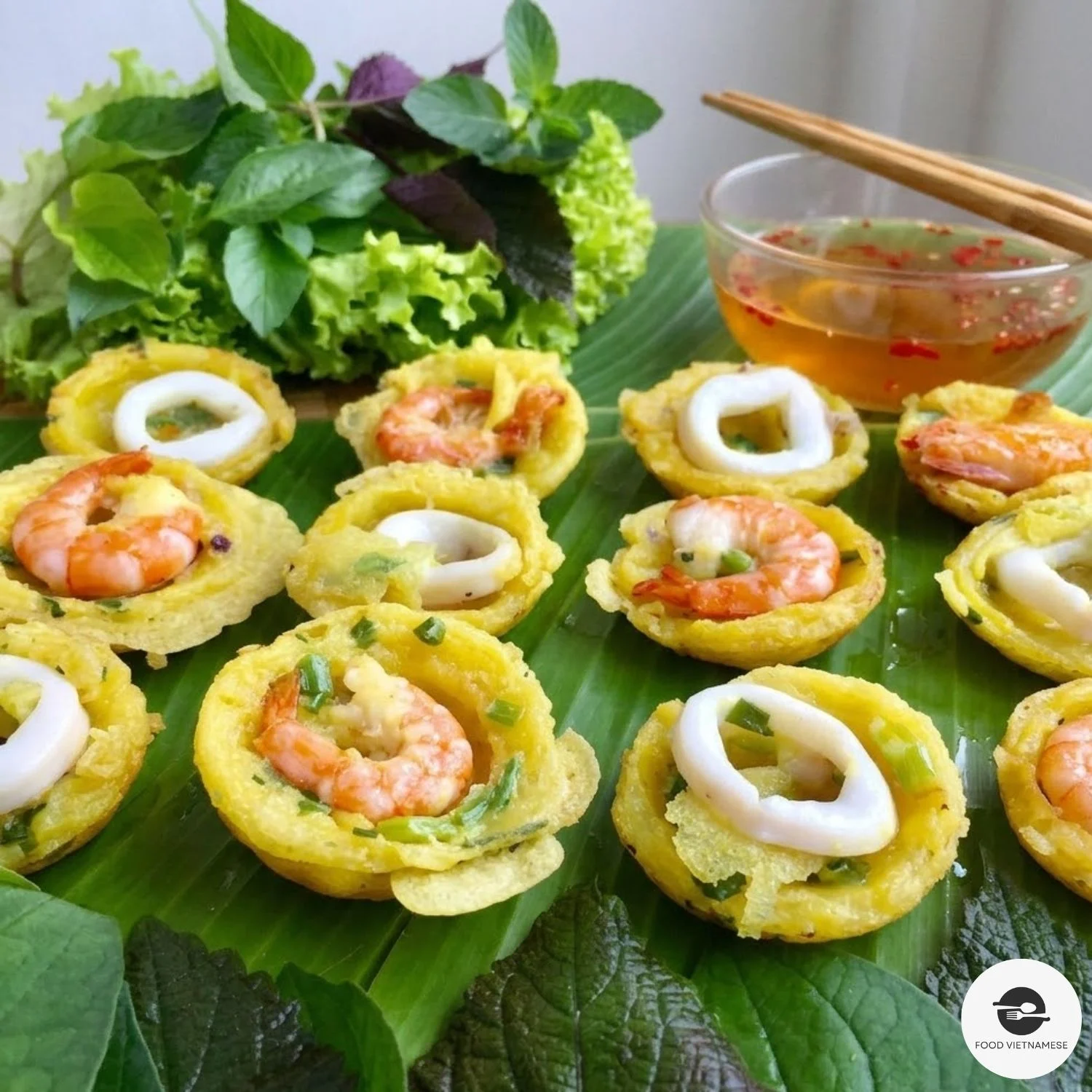
Banh Khot is a Vietnamese mini savory pancake from the coastal city of Vung Tau — a rice flour and coconut milk batter poured into individual wells of a cast-iron mold, topped with a whole shrimp, and cooked until the edges crisp into lace while the center stays soft and custardy. Diners wrap each hot cake in lettuce with fresh herbs and dip it into a sweet-sour fish sauce. It’s often described as Banh Xeo’s little sibling — same batter concept, completely different texture, thanks to a mold that turns one big crepe into a dozen crispy-edged coins.
Two Competing Stories Behind the Name
Ask around Vung Tau why the dish is called khọt, and you’ll get more than one answer with equal confidence behind each. The explanation cited most often traces the word to sound: when a vendor pries a finished cake loose from the mold with a metal spoon, the spoon striking the iron makes a short, sharp “khọt” — a knock, not unlike tapping a hollow drum. Vendors repeat this motion dozens of times per batch, and over generations the sound apparently became the name.
A second explanation, favored by some home cooks and food writers, points instead to the moment the batter hits the hot oil in the mold — a quick sizzling “khọt” rather than the spoon’s knock. Neither theory has been definitively confirmed over the other, and Vietnamese food writers who’ve researched the dish generally present both without picking a winner. What’s consistent across every source is that the name imitates a sound from the cooking process itself, whichever specific sound it originally referred to.
Where Banh Khot Actually Comes From
Banh Khot’s geographic origin carries its own layer of disagreement, and it connects directly to a related dish: Banh Can. According to accounts from longtime Banh Khot cooks, the dish traces back to Binh Thuan, Ninh Thuan, and Khanh Hoa provinces along Vietnam’s south-central coast — the same region that produces Banh Can. As people from that area migrated south toward Vung Tau, they brought the basic mini-pancake concept with them and adapted it to local tastes and ingredients: coconut milk was added for richness, fresh shrimp (abundant along Vung Tau’s coast) replaced or supplemented the simpler toppings, and the clay mold traditionally used for Banh Can gave way to cast iron.
A second, less specific account simply credits Vung Tau as the dish’s origin outright, citing the city’s seafood abundance as the reason shrimp became the defining topping. A third, vaguer thread of stories points toward the wider Mekong Delta. What all versions agree on is Banh Khot’s association with scarcity: several sources describe the dish’s early form as a plain flour cake with no filling at all, eaten by families who couldn’t afford meat or seafood — the shrimp-topped version most people know today came later, as the dish moved from survival food to a specialty worth traveling for.
What Goes Into Banh Khot
| Component | Description | Role |
|---|---|---|
| Rice flour batter | Rice flour, water, coconut milk, and turmeric powder for color, sometimes with a splash of soda water or beer for extra crispness | The base — coconut milk is what separates Banh Khot’s rich, creamy interior from Banh Can’s plainer batter |
| Shrimp | A whole small shrimp pressed into the center of each pancake before cooking | The defining topping — traditionally small school prawns with shell on, though larger peeled shrimp are common in home recipes |
| Mung bean (optional) | Steamed and lightly mashed, added alongside or instead of shrimp in some versions | Adds a soft, slightly sweet layer under the topping |
| Scallion oil | Chopped scallions cooked briefly in hot oil | Drizzled over the finished cakes for aroma and a glossy finish |
| Fresh herbs and lettuce | Lettuce, mint, Thai basil, perilla, fish mint, and sometimes mustard greens, varying by vendor | Wrapped around each cake before dipping — the same herb family used with Bun Cha and Pho |
| Fish sauce dip | Sweet-sour nuoc cham, often supplemented with shredded carrot, daikon, and sliced chili | Balances the richness of the coconut milk and fried edges |
The Mold That Makes the Dish
Banh Khot is entirely a function of its cookware. The mold is a heavy cast-iron pan with a grid of small round wells, each roughly the diameter of a large coin — similar in concept to the takoyaki and æbleskiver pans used in Japanese and Danish cooking, though all three traditions appear to have developed independently, with no evidence that one directly influenced another. Each well is filled with a small pool of oil, heated until shimmering, then filled with batter and topped with a shrimp. The pan sits over a flame, sometimes covered briefly to trap steam and help the centers set without overcooking the crisping edges.
That combination — a thin ring of hot oil around the base of each well, direct contact with cast iron on all sides, and just enough batter to coat rather than fill — is what produces the lacy, deeply crisp rim that defines a well-made Banh Khot. A home cook can buy the same mold at Vietnamese kitchen supply shops for roughly 50,000–100,000 VND (about $2–4), and the identical pan design is used for Banh Can with clay instead of iron.
Banh Khot vs. Banh Xeo: Same Batter, Different Texture
The two dishes are close enough that most Vung Tau restaurants serve them on the same menu, sometimes on the same platter. The batter and toppings are nearly identical — rice flour, turmeric, coconut milk, shrimp, pork, bean sprouts in some versions. What changes everything is the cooking vessel.
| Feature | Banh Khot | Banh Xeo |
|---|---|---|
| Cooking vessel | Cast-iron mold, multiple small round wells | Single flat pan |
| Size | Bite-sized, coin-sized individual cakes | One large crepe, 20–30cm across |
| Texture | Crispy lace rim, soft custardy center | Thin and evenly lacy throughout, folded in half |
| Serving format | Platter of many small pieces | One large folded crepe, cut or torn to share |
| Eating method | Wrap whole piece in lettuce, dip | Tear a portion, wrap in lettuce and rice paper, dip |
For the full breakdown of Banh Xeo’s regional versions and how to get the batter properly crisp, see Banh Xeo Recipe.
Banh Khot vs. Banh Can: Cousins From Different Coasts
This comparison confuses even some Vietnamese diners on first glance — same mold shape, same round wells, same general size. But Banh Can, the specialty of Dalat and Vietnam’s Central Highlands, diverges from Banh Khot in nearly every ingredient and technique that matters.
| Feature | Banh Khot | Banh Can |
|---|---|---|
| Region | Vung Tau (southeast coast) | Dalat, Central Highlands |
| Mold material | Cast iron | Clay |
| Batter | Rice flour + coconut milk (rich, creamy) | Rice flour + water only (plain, firmer) |
| Topping | Whole shrimp | Cracked quail egg or chicken egg |
| Richness source | Coconut milk in the batter itself | The runny egg yolk on top |
| Typical eating method | Wrapped in lettuce, dipped in fish sauce | Can be eaten plain, or dipped, yolk running over the plate |
Banh Khot vs. Banh Xeo vs. Banh Can at a Glance
| Feature | Banh Khot | Banh Xeo | Banh Can |
|---|---|---|---|
| Region | Vung Tau | Central & Southern Vietnam | Dalat |
| Mold | Cast-iron, multi-well | Single flat pan | Clay, multi-well |
| Fat in batter | Coconut milk | Coconut milk | None — water only |
| Size | Bite-sized | Large, single crepe | Bite-sized |
| Signature topping | Shrimp | Shrimp, pork, bean sprouts | Quail egg |
How to Eat Banh Khot
Take a piece straight from the platter while it’s still hot enough to hear the edges crackle. Wrap it in a lettuce leaf along with a sprig of mint, Thai basil, or perilla — the same herb combination that shows up with Bun Cha and Pho — then dip the whole wrapped bundle into the fish sauce, ideally getting a bit of the shredded carrot and daikon in each dip. Eating it unwrapped, straight from the platter, works too and is common when the pancakes are shared casually among a table rather than eaten formally.
Banh Khot Calories and Nutrition
Because each piece is small, per-piece calorie counts stay modest even though the batter includes coconut milk and each well is cooked in a pool of oil.
| Serving | Calories | Protein | Fat | Carbs |
|---|---|---|---|---|
| 1 piece (Cooking Therapy) | 81 kcal | 1g | 4g | 10g |
| 1 piece (The Food Wonder, MyFitnessPal) | ~55 kcal | — | — | — |
| Typical restaurant serving (8–10 pieces) | ~500–700 kcal | — | — | — |
Per-piece values vary by recipe, oil quantity, and toppings used. Values are approximate and drawn from Cooking Therapy, The Food Wonder, and MyFitnessPal recipe data. A full plate ordered at a restaurant is closer to a meal than a snack once fish sauce and herb wraps are factored in.
Watching the Mold Work
At a stall near Bãi Trước in Vung Tau, I watched the same woman fill a full tray of wells — maybe twenty of them — in under a minute, cracking a shrimp into each one a beat after the batter hit the oil, moving down the rows without looking up. When she finally lifted the first batch out with a thin metal spoon, the sound really was a knock — sharp, quick, almost mechanical, nothing like the softer sizzle the batter had made going in. I asked if that was where the name came from. She shrugged and said she’d always assumed so, though her grandmother apparently told it the other way. Neither of us settled anything, but the platter she handed over settled the more important question fast.
Where to Eat Banh Khot in Vung Tau
| Location | Address | Notes |
|---|---|---|
| Bánh Khọt Cô Ba Vũng Tàu | 1 Hoang Hoa Tham Street | One of the most established names in the city; offers multiple toppings including shrimp, minced meat, and fish balls |
| Bánh Khọt Gốc Vú Sữa | 14 Nguyen Truong To Street | Long-running local favorite, named for the star apple tree that once stood outside |
| Bánh Khọt Bà Hai | 42 Tran Dong Street | Family-run, known among residents rather than tourists |
| Bánh Khọt Miền Đông | 59 Ba Trieu Street, Vung Tau | A popular stop with visitors, straightforward menu focused on the classic shrimp version |
Frequently Asked Questions
What is Banh Khot?
A Vietnamese mini savory pancake from Vung Tau made from rice flour and coconut milk batter, cooked in a cast-iron mold with small round wells, topped with shrimp, and served wrapped in lettuce with fish sauce for dipping.
Why is it called Banh Khot?
Two theories exist, neither definitively confirmed: the sound of a spoon knocking against the iron mold when removing each cake, or the sizzling sound the batter makes hitting hot oil. Both explanations remain in common use.
What is the difference between Banh Khot and Banh Xeo?
Nearly identical batter and toppings, but Banh Xeo is one large thin crepe cooked in a flat pan, while Banh Khot is poured into a multi-well mold, producing small cakes with crispy edges and soft centers — a texture contrast the single large Banh Xeo crepe doesn’t have.
What is the difference between Banh Khot and Banh Can?
Banh Khot (Vung Tau) uses a coconut milk batter in a cast-iron mold topped with shrimp. Banh Can (Dalat) uses a plain water-based batter in a clay mold topped with a quail egg. Different regions, different molds, different richness sources.
How many calories are in Banh Khot?
Roughly 55–80 kcal per piece. A typical restaurant serving of 8–10 pieces totals approximately 500–700 kcal, before dipping sauce.
Sources & References
- Vietnam Tourism – Banh Khot and Banh Can: Vietnam’s Crispy Mini Pancakes, Compared. vietnamtourism.com
- i Tour Vietnam – Banh Khot – The Mini Rice Pancakes. itourvn.com
- Adventure Journey – Bánh Khọt Vũng Tàu: Recipe of Vietnamese Crispy Pancake. adventure-journey.com
- Pho Dai Nam – A Bite-Sized History: Unveiling the Delights of Banh Khot. phodainam.com
- Keep Up Cooking – Vietnamese Mini Savory Pancakes (Bánh Khọt). keepupcooking.com
- Seniworld – Banh Khot Guide: Crispy Vietnamese Mini Pancakes to Try, restaurant listings. seniworld.com
- Cooking Therapy – Banh Khot (Vietnamese Mini Pancakes), nutrition data. cooking-therapy.com
- The Food Wonder – What Is Banh Khot?, nutrition data. thefoodwonder.com

Related articles
Bun Thit Nuong: Vietnam’s Grilled Pork Noodle Salad, Not a Soup
Bun Thit Nuong is a Vietnamese grilled pork noodle salad — cold rice vermicelli piled with lemongrass-marinated grilled…
Best Vietnam Food: 15 Must-Try Dishes
Best Vietnam food is defined by one core principle: maximum flavor from the freshest possible ingredients. Vietnamese cuisine balances…
Vietnamese Hot Pot (Lẩu): Types, How to Eat, Dipping Sauces
Vietnamese hot pot (lẩu) is a pot of seasoned broth kept simmering at the table, where diners cook…