Table of contents
- What Is Banh La Ngai?
- Ching Ming Festival and the Cultural Meaning of Banh La Ngai
- Mugwort in Banh La Ngai
- Ingredients
- Traditional Making Process
- Flavour and Texture Profile
- Mugwort Rice Cakes Across Asia – A Cultural Parallel
- How to Eat Banh La Ngai
- Where to Find Banh La Ngai
- Making Banh La Ngai at Home
- Nutritional Value
- Storage Tips
- Frequently Asked Questions About Banh La Ngai
- Conclusion
Some foods are not really about flavour – they are about a moment in the year, a community ritual, a connection to the land and to ancestors. Banh la ngai is that kind of food. The Tay people of Son La do not make it at any time of year; only at Ching Ming, when families gather to tend the graves of ancestors, when mugwort grows green along the hillsides, when the pounding of a mortar can be heard from many houses at once. The green of the cake is the green of that specific spring season. You cannot separate the food from the occasion that produces it.

What Is Banh La Ngai?
Banh la ngai is a sticky rice cake in which mugwort leaves are pounded directly into hot steamed glutinous rice, producing a smooth, elastic green dough that wraps a sweet filling. In technique, it is a flavoured and coloured variant of bánh giầy – Vietnam’s traditional pounded sticky rice cake – with the mugwort integrated into the dough itself rather than used as an outer wrapping or a filling component. The result is a cake whose green colour, herbal fragrance and sweetly balanced filling are entirely inseparable from the festival context that prompted its creation.
| Quick Facts | Details |
|---|---|
| Vietnamese name | Bánh lá ngải / Bánh ngải / Bánh giầy ngải |
| English name | Banh La Ngai · Vietnamese Mugwort Sticky Rice Cake |
| Cake type | Pounded sticky rice festival cake |
| Ethnic origin | Tay ethnic people |
| Primary province | Son La (also Lang Son, Bac Kan, Cao Bang and other Tay-populated highland provinces) |
| Festival occasion | Ching Ming / Tết Thanh Minh (approx. 4–5 April solar calendar) |
| Casing | Steamed glutinous rice + boiled mugwort leaves pounded together |
| Filling | Brown/palm sugar + roasted peanuts and/or black sesame and/or dried coconut |
| Colour | Vivid natural green from the mugwort |
Ching Ming Festival and the Cultural Meaning of Banh La Ngai
Ching Ming (清明節; Vietnamese: Tết Thanh Minh) is one of the most important traditional observances in Tay, Nung and other Sinicised ethnic minority cultures of northern Vietnam – falling around 4–5 April in the solar calendar, the same date as the Chinese Qingming Festival. It is a day for visiting and tending family graves, sweeping tombs, burning incense and making offerings to ancestors.
In Tay culture in Son La, banh la ngai is an essential offering for Ching Ming. The cake is made from mugwort – which grows green and lush at exactly this time of year – symbolising the renewal of spring and the living family’s devotion to those who have passed. The green of the cake is not decorative: it is seasonal, intentional and meaningful.
The convergence of Ching Ming and mugwort’s spring growth is not coincidence but encoded ecological knowledge: mugwort’s young spring leaves are at their most aromatic and their most manageable in terms of bitterness – this is the moment to harvest them, and it happens to be exactly when the ancestral offerings are prepared. The food calendar and the natural calendar are the same calendar.

Mugwort in Banh La Ngai
Mugwort (Artemisia spp.) is a perennial herbaceous plant that grows wild and in cultivation throughout the highland provinces of northern Vietnam. Its leaves have a distinctive aroma – faintly reminiscent of mint and camphor but warmer and more complex – and a mild bitter taste. In traditional medicine it is used for stomach complaints, menstrual pain and circulation; in food it appears in egg omelettes, chicken soups and festival cakes.
In banh la ngai, the technical challenge is to reduce the bitterness while preserving the colour and aroma. This requires pre-boiling the leaves correctly before they are pounded into the rice.
Note on botanical naming: Mugwort belongs to the genus Artemisia, family Asteraceae. Multiple Artemisia species are used in culinary contexts across East and Southeast Asia. The specific local species used by Tay communities in Son La has not been confirmed to species level in the verified sources for this article; “Artemisia spp.” is the accurate designation.
| Characteristic | Mugwort in banh la ngai |
|---|---|
| Vietnamese name | Ngải cứu (also: ngải diệp, thuốc cứu) |
| Genus | Artemisia spp., family Asteraceae |
| Part used | Fresh leaves (medium age – not too young, not too old) |
| Best harvest time | March–April (Ching Ming season) – young spring leaves, most aromatic |
| Flavour profile | Faint mint/camphor-like aroma; mild bitter taste (pre-treatment required) |
| Pre-treatment required | Boil in salted water for 15–20 minutes to reduce bitterness; squeeze very dry |
| Function in cake | Natural green colour; distinctive gentle herbal fragrance; no artificial colouring |
Ingredients
| Ingredient | Quantity (~20–25 cakes) | Notes |
|---|---|---|
| Glutinous rice | ~500g / 1.1 lb | Soak for 6–8 hours before steaming; highland nep nuong gives superior fragrance and stickiness but regular glutinous rice works |
| Fresh mugwort leaves | ~150–200g picked leaves | Medium-age leaves preferred (young = less colour and aroma; old = more bitter and fibrous). Ching Ming season leaves are optimal |
| Brown sugar / palm sugar / unrefined cane sugar | ~150–200g | Traditional palm sugar (đường phên) gives the deepest sweetness and a warm amber colour; raw cane or brown sugar are usable substitutes |
| Roasted peanuts | ~80–100g (if using this variant) | Skin removed, roughly pounded; used alone or in combination |
| Roasted black sesame seeds | ~50–70g (if using this variant) | Adds a different aromatic dimension; some families use sesame alone, others combine with peanuts |
| Dried grated coconut | ~50–70g (if using this variant) | Used in some local variants; adds tropical richness |
| Salt + cooking oil | Pinch / a little | Salt for boiling mugwort; oil for greasing hands during shaping |
Note on the filling: The verified source describes the filling as “brown sugar + peanuts / black sesame / dried coconut” with “/” indicating these are variants depending on family and locality – not all three used simultaneously in a single cake. This article presents the options accurately without asserting one fixed recipe.
Traditional Making Process
Step 1 – Pre-treat the mugwort leaves (the decisive step)
Rinse the mugwort leaves thoroughly. Bring a pot of water to a boil with a pinch of salt. Add the mugwort and boil for 15–20 minutes until the leaves are soft, dark green and the bitterness has dissipated into the cooking water. Drain, rinse under cold water to stop cooking and preserve colour, then squeeze out every drop of moisture. Chop finely or blend to a rough paste.
This is the step where banh la ngai is most often made incorrectly: insufficient boiling leaves too much bitterness; insufficient draining makes the dough wet, pale and structurally weak. Experienced makers know by colour and by squeezing feel when the leaves are ready.
Step 2 – Steam the glutinous rice
Steam the soaked and drained glutinous rice until fully cooked – evenly sticky, holding together without being wet or undercooked in the centre.
Step 3 – Pound rice and mugwort together (the labour-intensive step)
While the rice is still hot, transfer it to a heavy stone or wooden mortar. Add the prepared mugwort and pound vigorously and continuously – typically two or three people take turns – until the rice and mugwort are fully integrated into a smooth, uniformly green, elastic dough. The dough is ready when it stretches without breaking immediately and has no visible rice grain texture remaining. This is the pounding technique of bánh giầy extended with the addition of the herb.
In Son La, the sound of mortars pounding on Ching Ming morning is part of the village soundscape for Tay communities. The whole household participates: older women oversee the mugwort boiling and know by feel when the leaves are ready; men take turns at the mortar; children wait to be given a piece of warm dough to shape. It is not about the cake – it is about making the cake together.
— Kelly Thuy, field notes, Son La
Step 4 – Make the filling and shape the cakes
Combine palm sugar (broken into small pieces) with the chosen nut/seed component to form a sweet, textured filling. Lightly oil your palms. Take a portion of warm green dough, flatten it in your palm to a round disc. Place a spoonful of filling in the centre, fold the dough up and around it, press shut, and shape into a flat round or oval. Rest each finished cake on a piece of banana leaf or dong leaf to prevent sticking.

Flavour and Texture Profile
| Layer | Description | Source |
|---|---|---|
| Casing colour | Deep, vivid natural green – unmistakeably plant-based, not artificial | Mugwort pounded directly into the rice |
| Casing aroma | Faint herbal note – somewhere between mint and hay, warm and gentle; present but never overpowering | Artemisia essential oils retained after boiling |
| Casing texture | Elastic, smooth, gently chewy when warm; firms up significantly as it cools | Pounded glutinous rice |
| Filling sweetness | Rich, deep sweetness from the palm/brown sugar – not white-sugar sweet but complex, slightly caramelised | Brown/palm sugar |
| Filling texture | Slightly sandy from the sugar + crunchy-nutty from peanuts or fragrant from sesame or tropical-sweet from coconut | The nut/seed component |
| Overall impression | Herbal-green casing + deep sweet filling = a balance of refreshing and rich; not cloying, not bland | Both components together |
The most notable thing about tasting banh la ngai for the first time without prior knowledge: the mugwort flavour in the casing is so gentle that most people cannot identify it. They simply notice that this sticky rice cake has a quality that plain banh giay doesn’t have – a herbal depth that makes the sweetness of the filling land differently.
Mugwort Rice Cakes Across Asia – A Cultural Parallel
Banh la ngai is not unique in its category – mugwort pounded into glutinous rice is a culinary technique found independently across East and Southeast Asia:
| Name | Country / region | Key features |
|---|---|---|
| Banh la ngai / Banh ngai | Vietnam (Tay ethnic) | Sticky rice + mugwort; brown sugar + peanut/sesame/coconut filling; Ching Ming festival |
| Kusa mochi / Yomogi mochi (草餅) | Japan | Mochi + yomogi (Artemisia princeps); sweet red bean (anko) filling; spring festivals including Hina-matsuri and Higanshuu |
| Ssuk tteok (쑥떡) | Korea | Glutinous rice cake + ssuk (Artemisia spp.); various fillings; Chuseok and spring festivals |
| Ai guo / Ai cao (艾粿) | China (Hakka, Cantonese) | Rice flour + mugwort; mung bean, peanut or sesame filling; Ching Ming and spring festivals |
The shared thread across all four traditions: mugwort cakes are almost universally associated with spring ancestor festivals – and particularly with Ching Ming or its equivalents. This is not cultural diffusion but ecological convergence: mugwort’s spring growth cycle aligns with the ancestral reverence calendar in multiple independent cultures. The plant grows when the graves need tending, and the cakes that incorporate it are the ones placed on the offerings.
This parallel context is offered as cultural background. It does not imply that banh la ngai “derives from” Japanese or Chinese equivalents – these traditions developed independently from the same widely distributed plant.
How to Eat Banh La Ngai
Banh la ngai is best eaten warm, freshly made – when the casing is at its most elastic and the mugwort aroma is clearest. As it cools, the dough firms and stiffens considerably. If the cakes have been refrigerated or set aside, reheat by steaming for 3–5 minutes before eating.
- Eaten on its own as a snack or dessert – the most common way. The filling provides enough sweetness and the casing enough substance that no accompaniment is needed.
- With hot green tea – the classic Ching Ming pairing in Tay culture; the slight bitterness of tea complements the sweet filling and herbal casing.
- As a ceremonial offering at the grave or family altar, before being shared among the living.
Banh la ngai is not an everyday food. Its meaning is partly inseparable from the occasion that produces it. Outside Ching Ming, the same recipe produces a green rice cake – but the full cultural experience requires the festival context.
Where to Find Banh La Ngai
During Ching Ming season (March–April)
- Son La town market and provincial periodic markets – the highest concentration of banh la ngai vendors coincides with the approach of Ching Ming; Tay vendors sell alongside other seasonal specialties.
- Lang Son – a significant Tay community with well-documented banh ngai production (covered by Nhan Dan Online).
- Bac Kan, Cao Bang, Ha Giang – other highland provinces with large Tay populations; local variants of banh ngai available at periodic markets.
Outside the festival season
- Considerably harder to find commercially. Pre-ordering from traditional makers in any of the above provinces is the most reliable approach.
- Some traditional food shops and highland specialty stores in Hanoi carry it seasonally or by special order.
- Making at home is the most practical option outside festival season – mugwort is sold year-round at vegetable markets; the main challenge is the pounding step, which can be approximated with a stand mixer.

Making Banh La Ngai at Home
Banh la ngai is one of the more accessible traditional Vietnamese highland cakes to make at home, as all ingredients can be sourced from Vietnamese grocery stores and most Asian supermarkets.
If you don’t have a mortar
A stand mixer fitted with a dough hook can substitute for the mortar and pestle. Add hot steamed rice and pre-prepared mugwort to the bowl and knead on low speed until fully integrated and smooth. The texture won’t be identical to hand-pounded but is acceptable for home production. Avoid using a blender – it makes the dough too wet and loses the characteristic elastic texture.
Key tips for the mugwort step
- Choose medium-age leaves: young leaves have less colour and aroma; old leaves are more bitter and fibrous.
- Boil for the full 15–20 minutes – do not abbreviate this step or the bitterness will ruin the cake.
- Squeeze the leaves completely dry before pounding – residual moisture makes the dough wet and pale.
- Pound or mix while the rice is still hot – once it cools the dough stiffens and the herbs don’t integrate evenly.
Nutritional Value
The figures below are estimates based on the main ingredients (steamed glutinous rice + sugar + peanuts/sesame/coconut). The mugwort leaves contribute herbal compounds (terpenes, flavonoids) in small quantities that have no significant macronutrient impact at normal serving sizes. No independently verified nutritional analysis of banh la ngai has been published.
| Nutrient | Estimated value / cake (~50–60g) |
|---|---|
| Energy | ~120–160 kcal (depends on sugar and filling quantity) |
| Carbohydrates | ~22–28g (mainly from sticky rice and sugar) |
| Protein | ~2–4g (from rice and peanuts/sesame) |
| Total fat | ~3–6g (from peanuts, sesame or coconut in the filling) |
| From mugwort | Herbal compounds present in trace amounts; no significant macronutrient contribution at normal serving |
Banh la ngai is a moderately sweet starchy cake, appropriate as a snack or dessert. People managing blood sugar should note that both glutinous rice and sugar have a higher glycaemic index than non-glutinous alternatives.
Storage Tips
- Eat on the day, while warm – the optimal eating window for texture and aroma.
- Refrigerator: wrap each cake individually, keep for 2–3 days. Reheat by steaming 3–5 minutes before eating.
- Freezer: up to 1–2 weeks. Thaw overnight in the refrigerator, then reheat by steaming.
- Do not leave at room temperature for more than 4–6 hours – the sugar filling softens and may cause the casing to collapse.
Frequently Asked Questions About Banh La Ngai
What is banh la ngai?
Banh la ngai is a traditional mugwort sticky rice cake made by the Tay ethnic people of Son La and other northern highland provinces of Vietnam. Steamed glutinous rice is pounded together with pre-boiled mugwort leaves into a smooth green dough, shaped around a filling of brown sugar with roasted peanuts, black sesame or dried coconut. Made for the Ching Ming ancestral festival.
What is it similar to in other Asian cuisines?
The closest equivalents are Japanese kusa mochi / yomogi mochi (mugwort mochi, spring festival), Korean ssuk tteok (mugwort rice cake, Chuseok and spring festivals), and Chinese ai guo / ai cao (Hakka/Cantonese mugwort rice cake, Ching Ming). All use the same technique of incorporating mugwort into pounded glutinous rice, and all are associated with spring and ancestral observances.
Why is the cake green?
The green colour comes from mugwort leaves pounded directly into the rice – no artificial colouring. The chlorophyll and natural pigments in the mugwort give the dough its distinctive vivid green, which fades slightly as the cake cools and ages.
Why must the mugwort be boiled first?
Raw mugwort has a strong bitter taste from natural terpene compounds. Boiling for 15–20 minutes in salted water significantly reduces these compounds, leaving only the herb’s fragrant aromatic quality. The leaves also need to be thoroughly squeezed dry to prevent the dough from becoming soggy.
When is banh la ngai made?
Primarily for Ching Ming / Tết Thanh Minh (around 4–5 April solar calendar), when Tay families visit ancestral graves. Outside this festival period it is rarely sold commercially and is mainly made on request or at home.
Can I make it at home?
Yes – mugwort is available year-round at Vietnamese vegetable markets and some Asian grocery stores. The main challenges are the pounding step (approximated with a stand mixer) and getting the mugwort pre-treatment right. The recipe is straightforward once those two elements are managed.
Conclusion
Banh la ngai is a cake that could only exist at the intersection of a specific plant’s growth cycle, a community’s ancestral calendar, and the particular knowledge of how to turn a bitter herb into something beautiful and edible. The Tay people of Son La did not invent it to be creative; they made it because this is what spring tastes like in their culture, and because the graves need tending and the ancestors need feeding at exactly the moment the mugwort is ready to be harvested.
If you are in Son La or any northern highland province during Ching Ming season, look for the clusters of vivid green cakes at morning market stalls. Eat one while it is still warm. The gentle herbal note in the casing and the deep sweetness of the palm sugar filling together make a combination that is harder to forget than it first appears.
Read more on FoodVietnamese:
- Five-colour sticky rice – Lai Chau (same natural plant-dye colouring technique in Tay and Thai highland food)
- Banh chung Bo Dau – Thai Nguyen (highland sticky rice festival cake from the same region)
- La cam – Vietnam’s natural purple dye plant (another natural plant colourant used in highland cakes and sticky rice)
- Thit chua – Fermented pork of Phu Tho (another Muong/Tay ethnic festival specialty)

Related articles
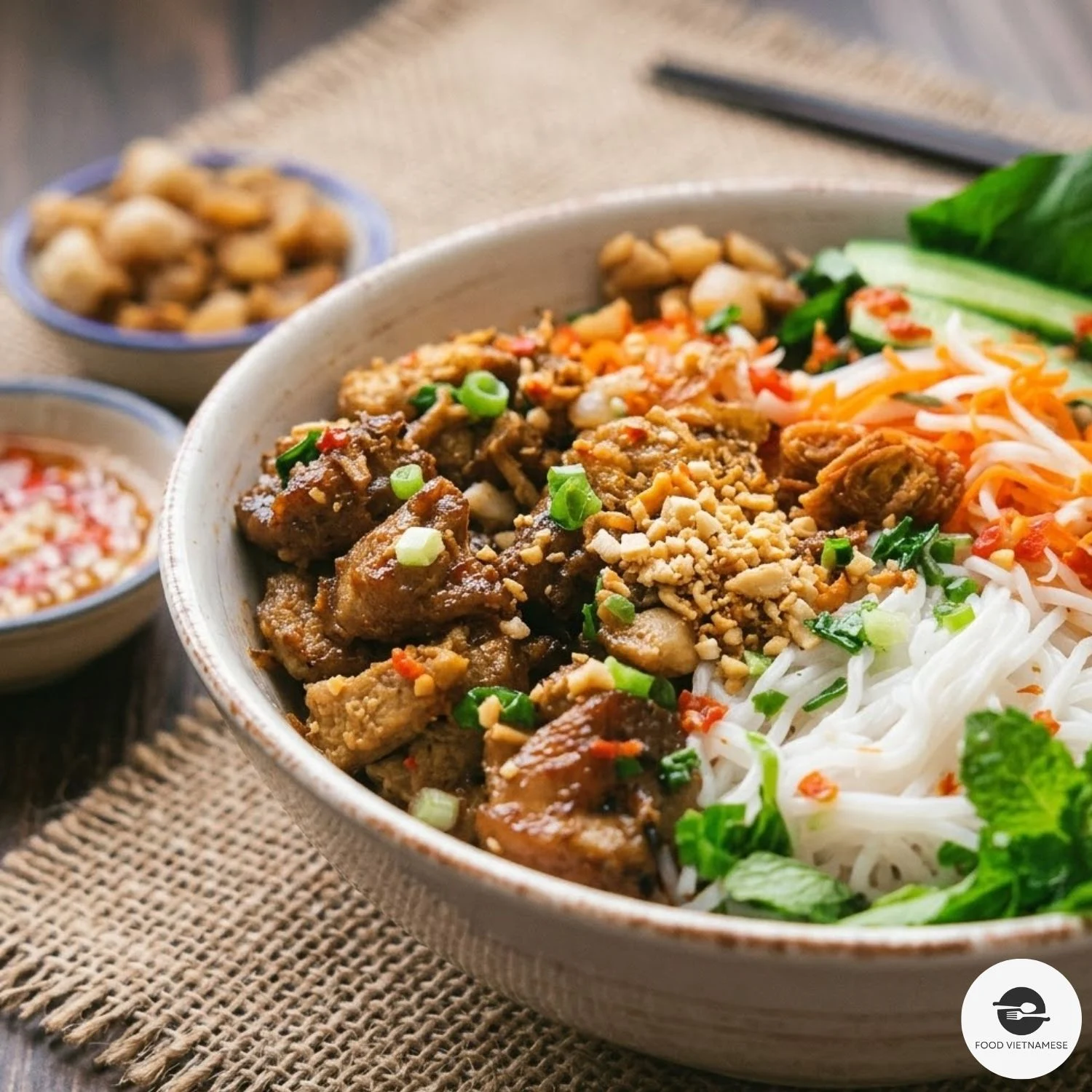
Bun Thit Nuong: Vietnam’s Grilled Pork Noodle Salad, Not a Soup
Bun Thit Nuong is a Vietnamese grilled pork noodle salad — cold rice vermicelli piled with lemongrass-marinated grilled…
Best Vietnam Food: 15 Must-Try Dishes
Best Vietnam food is defined by one core principle: maximum flavor from the freshest possible ingredients. Vietnamese cuisine balances…
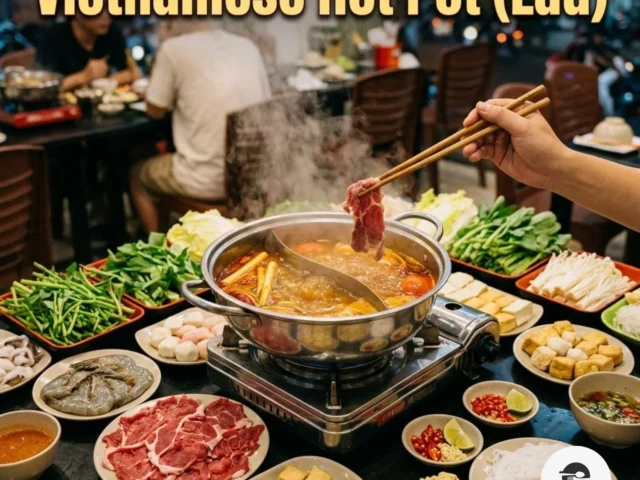
Vietnamese Hot Pot (Lẩu): Types, How to Eat, Dipping Sauces
Vietnamese hot pot (lẩu) is a pot of seasoned broth kept simmering at the table, where diners cook…