Table of contents
- A Chinese Name, Frequently Mistaken for a Khmer Dish
- Why Vietnamese Cooks Changed the Noodle
- What Goes Into a Bowl of Hu Tieu
- Hu Tieu Nam Vang vs. My Tho vs. Sa Dec
- Hu Tieu Kho vs. Hu Tieu Nuoc: Dry or Soup
- Hu Tieu vs. Pho: Not the Same Kind of Noodle Soup
- Hu Tieu Calories and Nutrition
- Following the Sound Down an Alley
- Where to Eat Hu Tieu
- Frequently Asked Questions
- Sources & References
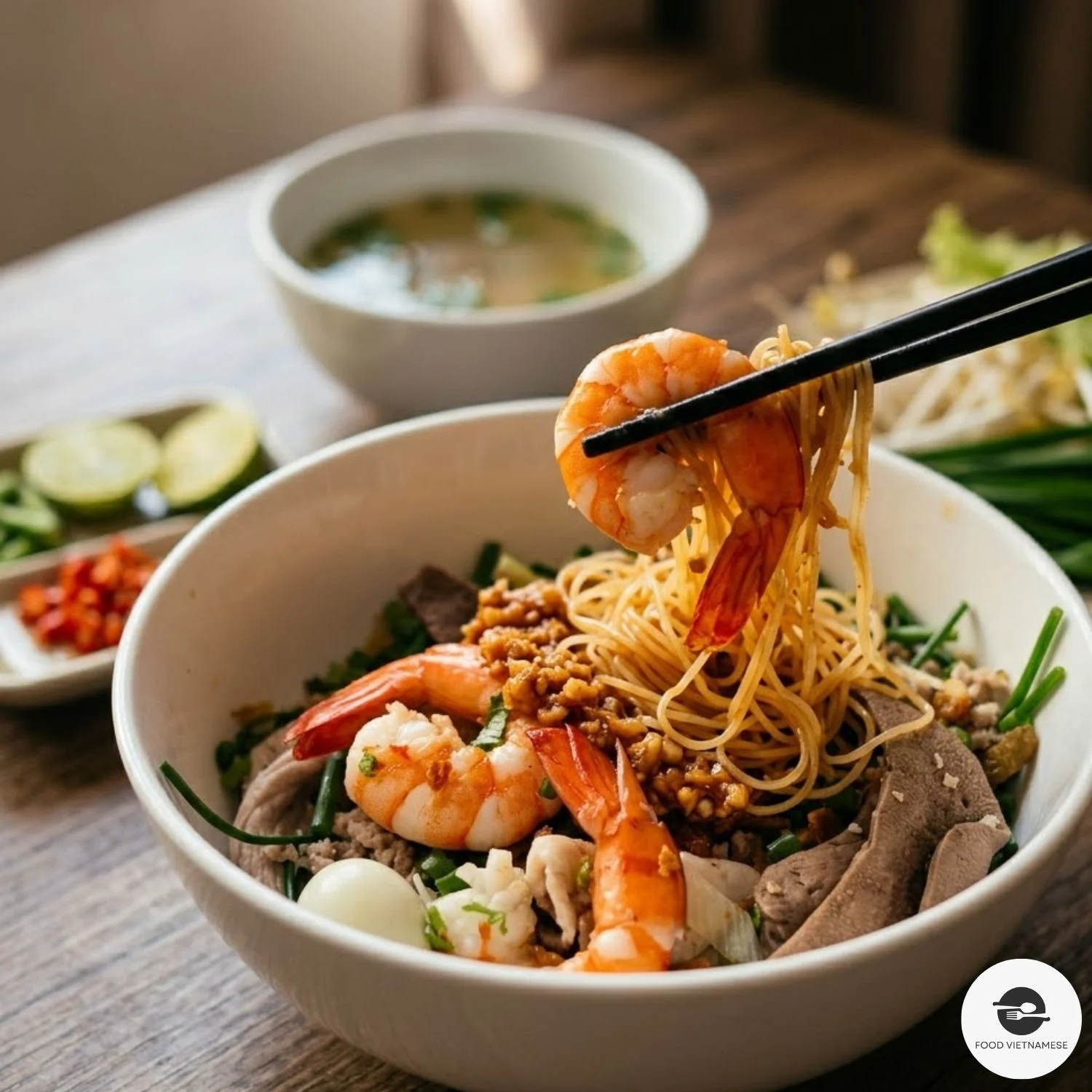
Hu Tieu is a Southern Vietnamese noodle soup built on a slow-cooked pork bone broth, chewy rice noodles, and a generous mix of toppings — pork, shrimp, quail eggs, liver, and fried garlic among the most common. Its lineage runs through three cultures before landing in the Mekong Delta: the name and original recipe come from Teochew Chinese immigrants, the dish took shape in Phnom Penh among the local Khmer population, and it was Vietnamese cooks in the south who reworked the noodles into the version served today. Unlike Pho, there’s no fish sauce in the broth — Hu Tieu leans on soy sauce, dried squid, and pork bones for its savory backbone, and it comes in enough regional variations that ordering “a bowl of hu tieu” in Saigon can mean at least three different dishes depending on which stall you walk into.
A Chinese Name, Frequently Mistaken for a Khmer Dish
The word “hu tieu” comes directly from Teochew (Chaozhou), a Chinese dialect spoken in eastern Guangdong province — some Vietnamese regional dialects still spell it “hu tiu,” closer to the original pronunciation. That linguistic root creates a common misunderstanding: because Hu Tieu is so closely tied to Phnom Penh in the popular imagination, many people assume Khmer cooks invented it. They didn’t. Teochew immigrants who settled in Phnom Penh in the 19th and early 20th centuries brought their noodle soup tradition with them, and it was there — blended with Khmer ingredients like lemongrass and fresh herbs — that the dish now known as Hu Tieu Nam Vang began to take its modern shape, alongside a closely related Khmer dish called kuyteav that still exists in Cambodia today.
Vietnamese traders and Chinese-Cambodian communities carried the dish across the border into southern Vietnam, particularly through Cholon (Ho Chi Minh City’s Chinese quarter) and the Mekong Delta trading town of My Tho. By the 1950s and 1960s it had become a fixture of Saigon street food, popular enough that entire regional sub-styles developed independently around the delta.
The sound of “hu tieu gõ”: For decades, mobile Hu Tieu vendors pushed carts painted in Chinese-style motifs through Saigon’s alleys, announcing themselves not by voice but by knocking two bamboo sticks together — a rhythmic tap-tap that gave rise to the nickname “hu tieu gõ,” or “knocking hu tieu.” Bamboo has mostly given way to metal bars today, but the practice survives in pockets of Ho Chi Minh City, one of the few street-food traditions in Vietnam that announces itself by sound rather than smell.
Why Vietnamese Cooks Changed the Noodle
The original Chinese-Cambodian version of Hu Tieu used soft, flat rice noodles — visually and texturally close to Pho noodles. When the dish reached southern Vietnam, that similarity became a problem rather than a feature: diners already had Pho, and a soft-noodle Hu Tieu risked reading as a redundant, lesser copy rather than its own dish. Cooks in the Mekong Delta, working with the region’s abundant rice supply, developed a different noodle entirely — thinner, more translucent, and distinctly chewy, known as hu tieu dai (“chewy hu tieu”). That texture is now considered the noodle’s defining trait, and it’s the detail most likely to surprise anyone expecting something closer to Pho.
What Goes Into a Bowl of Hu Tieu
| Component | Description | Role |
|---|---|---|
| Hu tieu noodles | Thin, chewy rice noodles, translucent when cooked | The base — regional versions vary noticeably in thickness and chew |
| Pork bone broth | Slow-simmered 7–8 hours, often with dried squid and dried shrimp added for sweetness and depth | Naturally sweet, clear, no fish sauce — the defining structural difference from Pho |
| Pork (sliced or minced) | Lean pork, sliced thin or minced and lightly seasoned | Standard across nearly every version |
| Shrimp | Fresh shrimp, peeled, sometimes supplemented with dried shrimp in the broth itself | Core topping in Nam Vang-style bowls specifically |
| Quail eggs | Boiled, halved or whole | A near-universal marker of the Nam Vang style |
| Pork liver and heart | Sliced thin, offered in most traditional versions | Adds mineral depth; some modern bowls omit this for broader appeal |
| Fried garlic | Garlic fried until golden and crisp | A defining seasoning specifically associated with the My Tho style |
| Bean sprouts, chives, herbs | Bean sprouts, garlic chives, celery, lettuce, cilantro depending on region | Added fresh at the table, along with lime and chili |
Hu Tieu Nam Vang vs. My Tho vs. Sa Dec
Ask three different vendors in Saigon what makes their Hu Tieu distinct, and each will point to the noodle first, the broth second. These three regional styles share a broad family resemblance but diverge in ways that are easy to taste and, with a bit of practice, easy to see.
| Feature | Hu Tieu Nam Vang | Hu Tieu My Tho | Hu Tieu Sa Dec |
|---|---|---|---|
| Noodle | Standard hu tieu dai, moderate thickness | Thin, small, notably chewy, made from Go Cat rice (Tien Giang) | Thick, milky-white, soft with a slight crispness, from Sa Dec’s rice-flour tradition |
| Broth character | Richer, slightly fattier, built with dried squid and dried shrimp | Clear, leaner, less fatty than Nam Vang | Clear, sweet, sometimes with a light brown tint |
| Signature seasoning | Soy sauce depth | Fried garlic | Fried shallots |
| Core toppings | Minced pork, shrimp, and quail egg — always all three | Shrimp, celery, chrysanthemum greens for color | Similar mix to Nam Vang; toppings alone don’t distinguish it |
| Usually served | As soup | Soup or dry | More often dry (hu tieu kho) than soup |
| Origin point | Named for Phnom Penh (Nam Vang) | Tien Giang province | Dong Thap province |
Sa Dec’s noodle in particular is easy to confuse with My Tho’s at a glance, but the two rarely get mixed up once tasted side by side — Sa Dec’s thicker, softer strand and slightly sweeter aftertaste stand apart from My Tho’s thinner, firmer bite.
Hu Tieu Kho vs. Hu Tieu Nuoc: Dry or Soup
Every regional style can be ordered two ways. Hu tieu nuoc is the soup version — broth ladled directly over the noodles and toppings. Hu tieu kho is dry: the noodles arrive tossed in a savory-sweet sauce with the toppings on top, and the broth is served separately in a small side bowl for sipping between bites rather than poured over the noodles. Sa Dec-style Hu Tieu leans toward the dry version more than the other regional styles; My Tho and Nam Vang appear comfortably in both formats depending on the stall.
Hu Tieu vs. Pho: Not the Same Kind of Noodle Soup
Both are Vietnamese noodle soups built on rice noodles and bone broth, and both get compared constantly by first-time visitors trying to keep the country’s noodle dishes straight. The resemblance stops at the surface.
| Feature | Hu Tieu | Pho |
|---|---|---|
| Region | Southern Vietnam, Mekong Delta | Northern Vietnam, Nam Dinh / Hanoi |
| Cultural roots | Teochew Chinese via Cambodia | Vietnamese, with French and Chinese culinary influence |
| Broth protein | Pork bones, dried squid, dried shrimp | Beef or chicken bones |
| Fish sauce | Not used in the broth | Used to season the broth |
| Spice profile | Soy sauce depth, mild sweetness | Star anise, cinnamon, charred ginger |
| Noodle | Thin, chewy rice noodles (hu tieu dai) | Flat, soft rice noodles |
| Format options | Soup or dry (kho) | Soup only |
For a full breakdown of Pho’s own regional differences and nutrition profile, see Pho Calories and Nutrition Facts.
Hu Tieu Calories and Nutrition
Calorie counts vary enormously depending on style and toppings — a plain bowl with minimal garnish sits at one end of the range, while a fully loaded Nam Vang bowl with pork, shrimp, squid, and quail egg sits at the other.
| Version | Calories | Notes |
|---|---|---|
| Light bowl, minimal toppings | ~250–290 kcal | Cross-referenced from MyNetDiary and independent food-blogger tracking |
| Standard bowl, moderate toppings | ~390–400 kcal | Fitia app data; consistent with Vinmec’s lower estimate for Nam Vang-style |
| Fully loaded Hu Tieu Nam Vang (pork, shrimp, squid, quail egg) | ~650–880 kcal | Vinmec and Nutribit both report figures in this range for a complete, topping-heavy bowl |
The spread is wide because Hu Tieu isn’t standardized — a “bowl” can mean a light breakfast portion or a dinner-sized serving loaded with every available topping. Sodium is generally high across all versions due to the pork bone and dried-seafood broth base. Sources: MyNetDiary, Fitia, Vinmec, Nutribit recipe and nutrition-tracking data.
Following the Sound Down an Alley
I heard the knocking before I saw the cart — two short taps, a pause, two more, somewhere behind a row of shuttered shopfronts in District 5. By the time I caught up, the vendor had already stopped and was ladling broth for someone who’d apparently heard the same signal from a balcony two floors up and come down in slippers. I asked how long he’d been doing the rounds with the sticks instead of a bell or a shout. “Bảng hiệu không cần, tiếng gõ là đủ,” he said — no sign needed, the knock is enough. He was right; nobody at that late hour was reading anything, but everyone within earshot knew exactly what the sound meant.
Where to Eat Hu Tieu
| Style | Where to Find It | Notes |
|---|---|---|
| Hu Tieu Nam Vang | Widely available across Ho Chi Minh City, especially in District 5 (Cholon) | Look for stalls advertising all three core toppings — minced pork, shrimp, quail egg — together |
| Hu Tieu My Tho | My Tho city, Tien Giang province; well-represented in Ho Chi Minh City too | Ask specifically for noodles made with Go Cat rice for the most traditional chew |
| Hu Tieu Sa Dec | Sa Dec town, Dong Thap province; select specialty stalls in Ho Chi Minh City | Order it dry (kho) for the style most associated with the town |
Frequently Asked Questions
What is Hu Tieu?
A Southern Vietnamese noodle soup with a pork bone broth, chewy rice noodles, and toppings like pork, shrimp, quail egg, and fried garlic. It traces to Teochew Chinese immigrants who brought the dish through Cambodia before Vietnamese cooks reworked it in the Mekong Delta.
Is Hu Tieu Khmer or Chinese in origin?
Chinese. Despite its strong association with Phnom Penh (Nam Vang), the dish was introduced by Teochew immigrants in Cambodia, blended with Khmer ingredients, then adapted further by Vietnamese cooks. It is commonly but incorrectly assumed to be a Khmer invention.
What is the difference between Hu Tieu Nam Vang, My Tho, and Sa Dec?
Nam Vang has a richer broth and always includes minced pork, shrimp, and quail egg. My Tho uses thin, chewy Go Cat rice noodles with a clearer broth and fried garlic. Sa Dec uses thicker, softer, milky-white noodles and is often served dry rather than in soup.
What is the difference between Hu Tieu and Pho?
Hu Tieu is Southern, uses a pork-bone broth without fish sauce, and comes in soup or dry formats. Pho is Northern, uses a beef or chicken broth seasoned with star anise and fish sauce, and is only served as soup. Different regions, different immigrant histories, different flavor profiles.
How many calories are in a bowl of Hu Tieu?
A light bowl runs roughly 250–400 kcal. A fully loaded Hu Tieu Nam Vang bowl with pork, shrimp, squid, and quail egg can reach 650–880 kcal, depending on portion size and topping choices.
Sources & References
- Wikipedia – Hủ tiếu. en.wikipedia.org/wiki/H%E1%BB%A7_ti%E1%BA%BFu
- Wikipedia – Kuyteav. en.wikipedia.org/wiki/Kuyteav
- Vietworld Kitchen (Andrea Nguyen) – Hu Tieu Nam Vang (Phnom Penh Noodle Soup). vietworldkitchen.com
- Vietnamnomad – Hu Tieu: A Guide to the Southern Vietnamese Noodle Soup. vietnamnomad.com
- Local Vietnam – Hu Tieu: Vietnam’s Most Underrated Noodle Soup Explained. localvietnam.com
- Vietrice Kitchen – Hu Tieu Nam Vang: A Southern Vietnamese Noodle Soup with Central Charm. vietricekitchen.com
- Vinmec – How Many Calories Are in a Bowl of Hu Tieu?. vinmec.com
- MyNetDiary, Fitia, Nutribit – nutrition data for Hu Tieu variants

Related articles
Bun Thit Nuong: Vietnam’s Grilled Pork Noodle Salad, Not a Soup
Bun Thit Nuong is a Vietnamese grilled pork noodle salad — cold rice vermicelli piled with lemongrass-marinated grilled…
Best Vietnam Food: 15 Must-Try Dishes
Best Vietnam food is defined by one core principle: maximum flavor from the freshest possible ingredients. Vietnamese cuisine balances…
Vietnamese Hot Pot (Lẩu): Types, How to Eat, Dipping Sauces
Vietnamese hot pot (lẩu) is a pot of seasoned broth kept simmering at the table, where diners cook…