Table of contents
- What Is Lap Xuong Hun Khoi?
- Origins and History
- The Defining Spice: Mac Khen
- Ingredients
- Traditional Production Process
- Flavour and Texture Profile
- Lap Xuong Hun Khoi vs Other Sausage Types: A Comparison
- How to Eat It
- Price Reference
- Where to Find Lap Xuong Hun Khoi
- Nutritional Value
- Storage Tips
- Frequently Asked Questions About Lap Xuong Hun Khoi
- Conclusion
When I encountered lap xuong hun khoi for the first time at a dawn market in Bac Kan, it was hanging in clusters of deep mahogany-brown links from a wooden peg at a Tay vendor’s stall. The smell arrived first: wood smoke, the distinctive tingle of mac khen, and something faintly sour underneath – the smell of a highland hearth. That combination is unmistakeable and unreproducible outside the region that created it.

What Is Lap Xuong Hun Khoi?
Lap xuong hun khoi is a wood-smoked fermented sausage made by the Tay, Thai and Nung people of northern Vietnam’s highland provinces. The production involves a dual preservation process: first sun-drying to concentrate and firm the meat, then wood-smoking to colour, flavour and activate natural lactic fermentation inside the casing. The result is a sausage with a multi-layered flavour profile entirely unlike either Southern Vietnamese lap xuong (sweet, sun-dried) or Chinese lap cheong (sweet, five-spice): here the defining notes are the tingling heat of mac khen, the warmth of ginger, a gentle natural sourness, and persistent wood smoke.
| Quick Facts | Details |
|---|---|
| Vietnamese name | Lạp sườn hun khói / Lạp xưởng hun khói |
| English names | Lap Xuong Hun Khoi · Vietnamese Highland Smoked Sausage · Northern Vietnam Wood-Smoked Sausage |
| Dish type | Smoked and fermented sausage – regional highland specialty |
| Ethnic origin | Tay, Thai and Nung people (and related highland ethnic groups) |
| Primary province | Bac Kan (also Cao Bang, Lao Cai, Ha Giang, Son La…) |
| Defining spice | Mac khen mountain pepper (Zanthoxylum spp.) |
| Production method | Sun-drying 2–4 days + wood-smoking over household hearth |
| Fermentation | Natural light lactic fermentation (no artificial preservatives) |
| Eaten with | Cham cheo dipping sauce or chili sauce; highland sticky rice or steamed rice |
Origins and History
Lap xuong hun khoi emerged from the same practical logic that produced trau gac bep (smoked buffalo) and other preserved-meat specialties of northern Vietnam’s highland communities: pigs were raised free-range and slaughtered only for festivals and ceremonies, producing more meat than a family could eat immediately, without refrigeration. Salting, sun-drying and wood-smoking were the available preservation tools.
What sets Bac Kan-style smoked sausage apart from other preserved sausages in the region – and the world – is the wild spice combination: mac khen mountain pepper, unavailable outside these highland forests, and local rice or corn wine, which triggers the distinctive natural fermentation. No two households make it identically: the lean-to-fat ratio, the amount of mac khen, the number of drying days and the duration of smoking are all household secrets passed down through generations.
Bac Kan became the most strongly associated province through its large Tay and Nung community with deep pig-rearing traditions, abundant wild mac khen in its mountain forests, and its position as a trading hub between Cao Bang, Lang Son and Thai Nguyen.

The Defining Spice: Mac Khen
Like trau gac bep and pa pinh top, lap xuong hun khoi is inseparable from mac khen – the wild mountain pepper that marks every highland specialty of northern Vietnam.
Mac khen (Zanthoxylum rhetsa or related Zanthoxylum species) grows wild in the highland forests of Northwest and Northeast Vietnam. When dry-toasted and roughly pounded, it releases an aroma combining black pepper, a faint star anise note, and a characteristic mild numbing tingle. In the smoked sausage, mac khen not only defines the flavour but also contributes natural antimicrobial compounds from its essential oils, supporting preservation during the drying and fermentation process.
Important distinction: Mac khen (Northeast and Northwest Vietnam, Zanthoxylum) is completely different from mac mat (Lang Son, Clausena indica – used in Lang Son’s grilled duck). Similar names, unrelated plants and aromas.

Ingredients
| Ingredient | Quantity (~1.2kg fresh pork) | Notes |
|---|---|---|
| Lean pork | ~800g / 1.75 lb | Free-range or woodland pig preferred – firmer, less watery than commercial pork; diced into 1–1.5cm cubes, never minced |
| Pork fat | ~200–300g | Diced to the same size as the lean pork; lean-to-fat ratio approximately 3:1 to 4:1 to taste |
| Mac khen peppercorns | ~1.5–2 tablespoons | Dry-toast until aromatic, cool, then pound coarsely in a stone mortar with salt – do not machine-grind (loses volatile oils) |
| Fresh ginger | ~2 small knobs | Finely chopped or pounded; adds warmth and contributes to preservation |
| Rice wine or corn liquor | ~2–3 tablespoons | Local highland liquor preferred; both de-odourises the meat and triggers natural lactic fermentation |
| Coarse salt | ~1.5 tablespoons | Season generously – salt is essential for both flavour and preservation |
| Pork small intestine casing | Sufficient to encase all the filling | Clean meticulously – knead with salt, rinse repeatedly; or use dried casing |
On Wood Type
As with trau gac bep, the wood matters. Bac Kan communities traditionally use dense hardwoods from mountain forests or sugarcane bagasse, both of which produce slow-burning, fragrant, clean smoke. Resinous softwoods or waste materials produce bitter, potentially harmful smoke and are avoided.
Traditional Production Process
Step 1 – Dice the pork correctly
Rinse pork and fat, pat completely dry. Cut into even 1–1.5cm cubes. Do not mince or grind. The cube size is a technical requirement: too small produces a dense, paste-like texture after curing; too large makes stuffing difficult and results in uneven curing. The visible cubes in the finished sausage are part of its identity.
Step 2 – Toast mac khen and marinate
Dry-toast mac khen peppercorns in a clean dry pan over low heat for 2–3 minutes until the aroma rises clearly. Cool completely, then pound coarsely in a stone mortar with the salt – coarsely pounded, not finely ground, so the broken halves retain their volatile oils longer in the marinade. Combine all ingredients and mix thoroughly by hand for 5–10 minutes until the spices coat every piece evenly. Marinate for at least 1–2 hours; overnight in a cool environment is ideal.
Step 3 – Stuff the casing and tie
Tie off one end of the cleaned casing securely. Pack the marinated pork in firmly with no air pockets – trapped air is the primary cause of spoilage during drying. Tie into links approximately 15–20cm long. Pierce a few small holes along each link with a skewer to allow fat and moisture to escape during drying and smoking.
Step 4 – Sun-dry for 2–4 days
Hang in a sunny, well-ventilated spot, protected from rain and night dew. Dry for 2–4 days depending on sun intensity – 2 days in strong summer sun, 3–4 days in cooler or overcast conditions. The casing should firm and contract; the colour lightens from pink toward pale brown. This step is essential before smoking: the surface must be dry enough to absorb smoke effectively.
Step 5 – Smoke over wood fire
Hang the links on a rack above – not directly over – a burning wood or bagasse fire, using the same indirect hearth-smoking technique as trau gac bep. Maintain continuous smoke. In traditional highland households, this happens naturally as the sausage hangs above the family hearth used for daily cooking, accumulating smoke gradually over days. The sausage is finished when the casing is uniformly deep brown, firm throughout, and a small piece cut from the end reveals the filling has developed a light natural sourness.
A Tay woman at Ba Be market didn’t have a recipe for me when I asked how she made lap xuong hun khoi. She just said: “Like my grandmother showed me.” The amount of mac khen, the drying days, the wood – all adjusted by feel, not measurement. That’s exactly why no two batches are identical, and why the version from the periodic market is always better than any packaged online version. The knowledge is in hands, not in grams.
— Kelly Thuy, field notes, Bac Kan

Flavour and Texture Profile
| Layer | Description | Source |
|---|---|---|
| Tingling spice heat | Not aggressive like chili – a slow, spreading tingle that lingers after swallowing | Mac khen peppercorns |
| Warm ginger note | Background warmth that stays present through the finish | Fresh ginger in the marinade |
| Light natural sourness | Very gentle, clean sourness – nothing like vinegar or lime; the lactic fermentation note | Natural lactic fermentation from rice wine and ambient microorganisms |
| Moderate salt | Well-balanced – present but not overwhelming | Coarse salt in the marinade |
| Wood smoke | Background smoke on the nose during eating; more pronounced when pan-fried or grilled | Hardwood or bagasse smoking |
| Rendered fat richness | The diced fat cubes melt during cooking, creating pockets of fragrant, juicy richness | Pork fat diced inside the casing |
| Texture | Casing: crispy and taut when pan-fried. Interior: firm, with clearly distinguishable pork cubes rather than a uniform paste | Dice technique + sun-drying + smoking |
Lap Xuong Hun Khoi vs Other Sausage Types: A Comparison
| Type | Primary spice | Method | Characteristic flavour | Region |
|---|---|---|---|---|
| Lap xuong hun khoi (Bac Kan) | Mac khen, ginger, rice wine | Sun-dry 2–4 days + wood-smoke | Tingly pepper + light sourness + wood smoke | North Vietnam highlands |
| Regular Vietnamese lap xuong (Southern) | Five-spice, sugar, Mai Que Lo wine | Sun-dry completely | Sweet, rich, aromatic | Southern Vietnam |
| Chinese lap cheong / lap chong | Five-spice, sugar, soy sauce, rice wine | Dry-cured / air-dried | Intensely sweet, deeply savoury | China, Hong Kong |
| Son La / Dien Bien smoked sausage | Mac khen (+ hat doi in some versions) | Sun-dry + wood-smoke | Similar; regional spice variations | Son La, Dien Bien |
How to Eat It
Lap xuong hun khoi must be cooked before eating – it is a fermented and cured product, not ready-to-eat raw.
Pan-frying (most common)
Place the links in a dry pan over medium heat – no added oil needed, the fat inside renders out. Fry until the casing is crispy and taut, the surface is lightly caramelised, and you can hear a consistent sizzle. Slice diagonally before serving. At this point the mac khen, smoke and light sourness all come forward simultaneously.
Charcoal grilling
Grill directly over medium charcoal, turning regularly until all sides are evenly cooked. Grilling deepens the smoke character compared to pan-frying.
Accompaniments
- Cham cheo – the traditional Thai ethnic dipping sauce made from roasted chili, mac khen, roasted tomato and fresh herbs pounded together. Balances the salt, adds complementary spice and freshness.
- Chili sauce – a simpler alternative for those unfamiliar with cham cheo.
- Highland sticky rice (xôi nếp nương) – the most traditional pairing; fragrant, slightly chewy, the ideal contrast to the intensely flavoured sausage.
- Steamed white rice – for everyday serving.
- Fresh or blanched vegetables – cooling and refreshing; cuts the richness.
As a cooking ingredient
Sliced lap xuong hun khoi is also excellent stir-fried with greens, added to fried rice, or simmered in vegetable soups. The mac khen and smoke aromas transfer into the surrounding ingredients, elevating the overall dish.
Price Reference
| Purchase context | Approximate price (VND) | Notes |
|---|---|---|
| Periodic markets in Bac Kan | ~350,000–550,000 VND/kg | Home-produced by local Tay and Nung vendors; best quality; price varies by season |
| Specialty shops, Bac Kan town | ~450,000–650,000 VND/kg | Vacuum-packed; convenient for gifting |
| Specialty stores, Hanoi | ~500,000–800,000 VND/kg | Transport cost adds up; verify provenance |
| Online (Shopee, Lazada, Tiki) | ~400,000–750,000 VND/kg | Highly variable quality; choose sellers with verified reviews, real product photos and explicit smoking process description |
⚠️ Many products sold online as “lap xuong hun khoi” are simply regular dried sausage with no genuine wood-smoking. Authentic smoked sausage: non-uniform deep brown colour (not glossy-even like industrial sausage), visible smoke aroma when packaging is opened, light sourness when tasted.
Where to Find Lap Xuong Hun Khoi
In Bac Kan
- Bac Kan town central market – specialty food section; Tay and Nung vendors bring products from surrounding districts.
- Ba Be district periodic markets – near the famous Ba Be National Park lake; Tay vendors sell home-made smoked sausage alongside other forest specialties.
- Ngan Son, Na Ri, Cho Don district periodic markets – weekly or monthly market days in the highland districts; best source for genuine home-produced product.
Beyond Bac Kan
- Cao Bang, Lao Cai, Ha Giang – neighbouring highland provinces with their own smoked sausage traditions using the same technique.
- Hanoi – some Northwest and Northeast Vietnamese specialty food shops in the Old Quarter and Cau Giay district carry it.
- Online – available but quality varies considerably; select carefully.
Nutritional Value
The figures below are estimates based on the main ingredients (lean pork and pork fat, cured and smoked). The lean-to-fat ratio significantly affects fat content and calorie count. No independently verified laboratory nutritional analysis of lap xuong hun khoi has been published.
| Nutrient | Estimated value / serving (~80–100g smoked sausage) |
|---|---|
| Energy | ~300–380 kcal (range reflects lean-to-fat ratio variability) |
| Protein | ~18–24g |
| Total fat | ~20–30g (pork fat is the primary fat source) |
| Carbohydrates | ~1–3g (from spices only) |
| Sodium | High – salted for preservation; those on sodium-restricted diets should eat in moderation |
Lap xuong hun khoi is protein-rich but also high in fat and sodium. It functions best as an accompaniment or flavouring ingredient rather than a daily main protein source. People managing cardiovascular health or sodium intake should consume in moderation.
Storage Tips
- Whole uncut links: hang in a cool, dry, ventilated place away from direct sunlight – 2–4 weeks at ambient temperature.
- Refrigerator (airtight container or vacuum-packed): 1–2 months.
- Freezer: 3–6 months. Thaw overnight in the refrigerator before use.
- Signs of spoilage: unusually sharp sourness (beyond the characteristic mild lactic note), sticky or slimy surface, green or white patches. Authentic lap xuong hun khoi has a uniformly dry, deep brown casing and a distinctive smoke-and-mac-khen aroma.
Frequently Asked Questions About Lap Xuong Hun Khoi
What is lap xuong hun khoi?
Lap xuong hun khoi (lạp sườn hun khói) is a traditional wood-smoked sausage from northern Vietnam’s highland provinces – primarily Bac Kan – made by Tay, Thai and Nung communities. Diced pork is marinated with mac khen mountain pepper, ginger and rice wine, stuffed into casing, sun-dried for 2–4 days, then wood-smoked until deep brown and lightly naturally fermented.
How is it different from regular lap xuong or lap cheong?
Regular lap xuong and Chinese lap cheong are sweet, sun-dried only, no wood smoke, no fermented sourness. Lap xuong hun khoi is additionally wood-smoked (deep brown colour, smoke aroma), develops natural lactic sourness during production, and is spiced primarily with mac khen rather than five-spice and sugar. Completely different flavour profile.
What is mac khen?
Mac khen (Zanthoxylum spp.) is wild mountain pepper native to Vietnam’s highland forests. Aroma: black pepper + light star anise + mild numbing tingle. Dry-toast and pound coarsely before use. The defining spice of this sausage – not substitutable with regular black pepper alone.
Why is it slightly sour?
The mild sourness is intentional – it comes from natural lactic fermentation triggered by the rice wine, salt and ambient microorganisms during sun-drying and smoking. Same principle as nem chua (Vietnamese sour pork rolls). Light and clean, not sharp.
How long does it keep?
2–4 weeks at cool ambient temperature; 1–2 months refrigerated; 3–6 months frozen.
How do I cook it?
Pan-fry in a dry pan (no oil needed) over medium heat until the casing is crispy and taut, then slice diagonally. Or grill over charcoal. Eat with cham cheo dipping sauce and highland sticky rice, or use sliced as a cooking ingredient in stir-fries and fried rice.
Conclusion
Lap xuong hun khoi is what happens when preservation necessity meets a landscape full of wild spices and the accumulated knowledge of generations. The Tay and Nung communities of Bac Kan didn’t set out to create a specialty – they solved the problem of preserving pork without refrigeration, using what the forest around them provided. Mac khen, wood smoke, rice wine, time. The solution turned out to be remarkable.
If you are in Bac Kan – or at any highland periodic market in northern Vietnam – look for the clusters of dark, uneven-coloured sausage hanging from wooden pegs at a Tay or Nung vendor’s stall. Buy a link, ask them to pan-fry it on the spot, eat it with sticky rice while it is still hot. That is the most direct way to understand what makes this product worth the journey.
Read more on FoodVietnamese:
- Trau gac bep – Smoked buffalo of Meo Vac, Ha Giang (same mac khen spice, same wood-smoke hearth technique)
- Pa Pinh Top – Mac khen grilled fish of Dien Bien (mac khen in a grilled fish preparation)
- Thit chua – Fermented pork of Phu Tho (another natural lactic fermentation specialty of northern Vietnam)
- Mac khen – The wild mountain pepper of northern Vietnam

Related articles
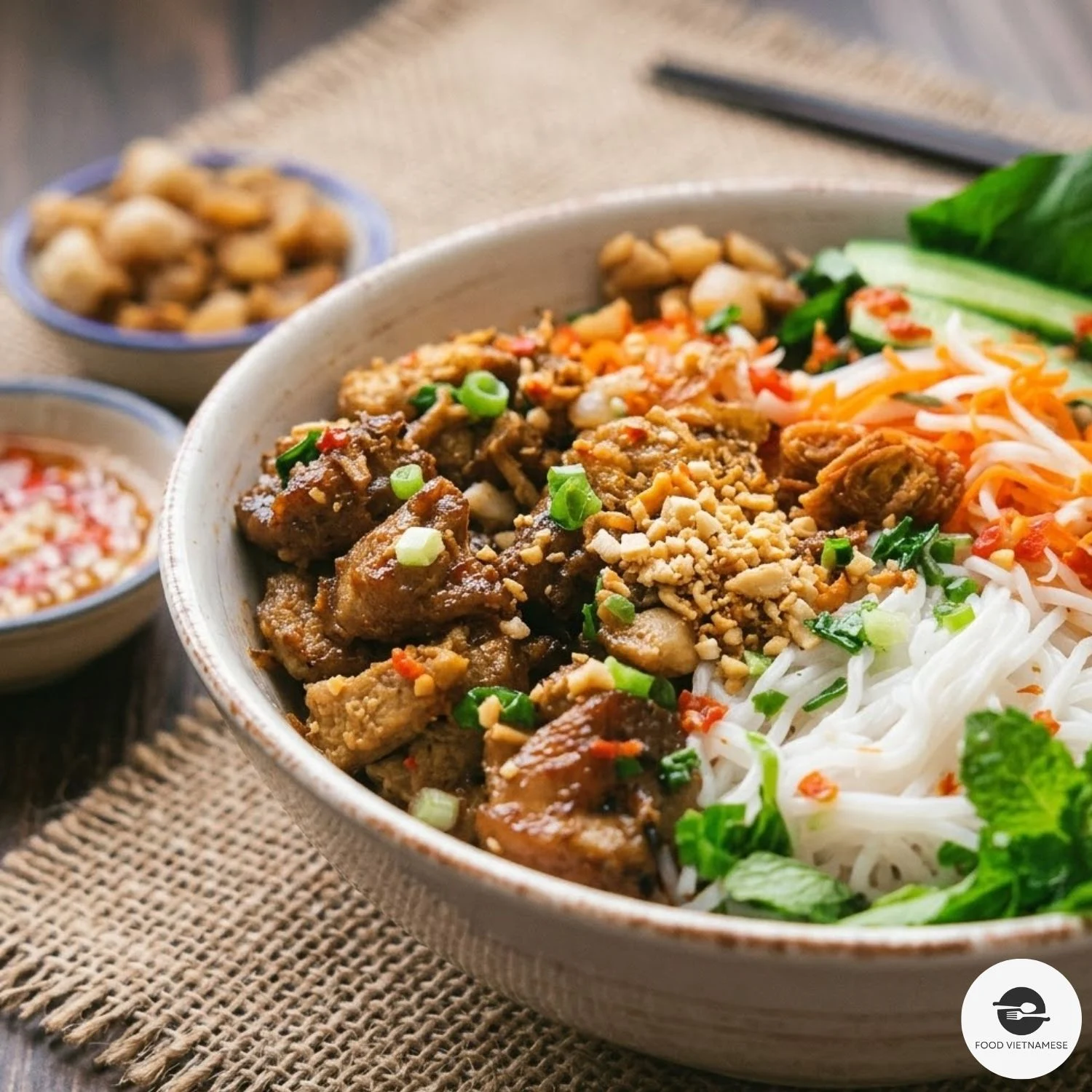
Bun Thit Nuong: Vietnam’s Grilled Pork Noodle Salad, Not a Soup
Bun Thit Nuong is a Vietnamese grilled pork noodle salad — cold rice vermicelli piled with lemongrass-marinated grilled…
Best Vietnam Food: 15 Must-Try Dishes
Best Vietnam food is defined by one core principle: maximum flavor from the freshest possible ingredients. Vietnamese cuisine balances…
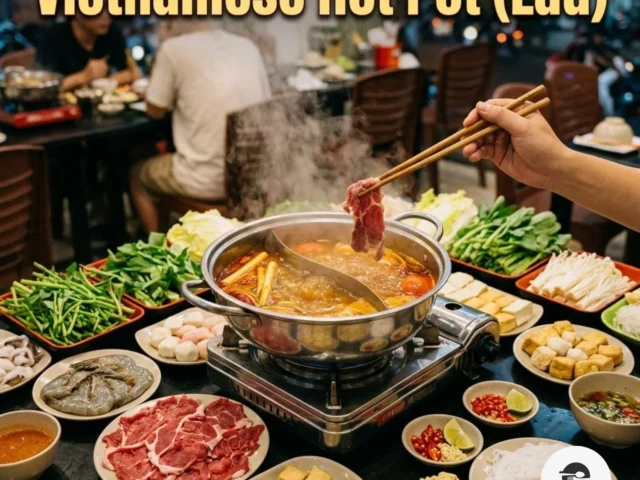
Vietnamese Hot Pot (Lẩu): Types, How to Eat, Dipping Sauces
Vietnamese hot pot (lẩu) is a pot of seasoned broth kept simmering at the table, where diners cook…