Table of contents
- Mi Quang at a Glance
- What Is Mi Quang?
- Why “Mì” When the Noodles Are Made From Rice?
- What Goes Into a Bowl of Mi Quang
- Mi Quang Variations by Protein
- How to Eat Mi Quang
- Mi Quang vs. Pho vs. Cao Lau: What Sets Each Apart
- Mi Quang Calories and Nutrition
- The History Behind the Dish
- Where to Eat Mi Quang in Da Nang and Hoi An
- Frequently Asked Questions
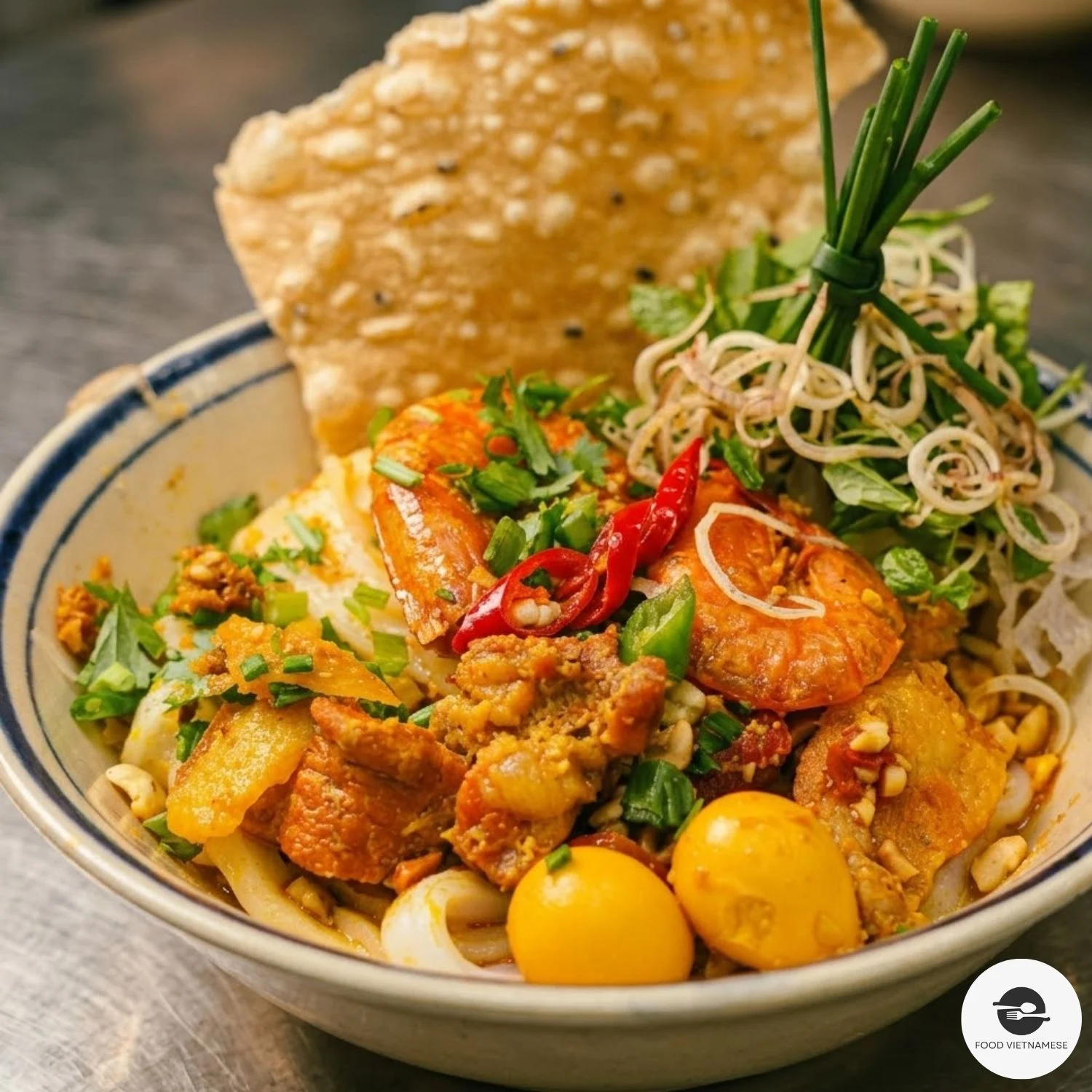
Mi Quang (Mì Quảng) is a turmeric-yellow rice noodle dish from Quang Nam Province in Central Vietnam, defined by a small amount of intensely flavored broth — just enough to coat the noodles, never enough to submerge them. A bowl combines wide rice noodles, a protein of choice (pork, shrimp, chicken, or fish), halved quail eggs, roasted peanuts, fresh herbs, and a broken piece of crispy rice cracker. It is not a soup in the way Pho or Bun Bo Hue are soups — food writers more accurately describe it as a noodle salad with broth folded through rather than poured over. The name itself is a small historical puzzle: “mì” means wheat noodles, yet Mi Quang has used rice flour for generations.
Mi Quang at a Glance
| Vietnamese name | Mì Quảng |
| Region | Quang Nam Province and Da Nang, Central Vietnam |
| Noodle type | Flat, wide rice noodles, colored yellow with turmeric |
| Broth style | Minimal — coats rather than submerges the noodles |
| Common proteins | Pork, shrimp, chicken, fish, eel, or frog |
| Calories per bowl | ~450–650 kcal, varies by recipe and portion |
| Typical price in Vietnam | 20,000–40,000 VND (~$1–2 USD) |
| When it’s eaten | Any meal — breakfast, lunch, or dinner; also served at family gatherings, death anniversaries, and Tet |
| Naming origin | “Mì” (wheat noodle) + “Quảng” (Quang Nam Province) |
What Is Mi Quang?
Ask a Da Nang local to describe Mi Quang in one sentence and most will say the same thing: it’s not a soup. That single distinction does more to explain the dish than any list of ingredients. Vietnamese noodle culture is dominated by broth-forward dishes — Pho, Bun Bo Hue, Hu Tieu — where the liquid is the point. Mi Quang inverts that logic. The broth exists to season, not to fill the bowl.
A cook ladles just enough broth to reach roughly a third of the way up the noodles. What results is closer to a dressed noodle salad than a soup: wide, flat rice noodles tinted gold from turmeric, tangled with shredded lettuce, banana blossom, and bean sprouts, topped with a chosen protein, halved quail eggs, and crushed roasted peanuts, then finished with a shard of grilled rice cracker for crunch. The broth that does make it into the bowl is concentrated — built from pork or chicken bones, deepened with annatto oil and turmeric, and meant to be tasted in every bite rather than sipped on its own.
Why “Mì” When the Noodles Are Made From Rice?
The name carries a small contradiction that most first-time visitors never notice. In Vietnamese, mì conventionally refers to noodles made from wheat flour — the word used for instant noodles, egg noodles, and Chinese-style wheat noodles. Mi Quang’s noodles, however, have been made from rice flour for as long as anyone can document. The “Quảng” half is straightforward: it refers to Quang Nam Province, the noodle’s home region.
Food historians trace the naming mismatch to Hoi An’s history as a 16th-century trading port. Chinese merchants who settled there brought wheat-noodle dishes with them. Local cooks in Quang Nam adapted the concept but substituted rice flour — the ingredient they actually had — while the borrowed name “mì” remained attached to the dish. By the time rice flour had fully replaced wheat in the recipe, the name was already too embedded in local vocabulary to change. It has stayed “Mì Quảng” ever since, a linguistic fossil of the dish’s Chinese-influenced origin.
Da Nang or Quang Nam? Both cities claim Mi Quang, and both are technically correct. Da Nang was administratively part of Quang Nam Province until 1997, when it split off to become its own independent municipality. Mi Quang predates that split by centuries, so the dish belongs to the shared cultural territory of both places rather than to one city specifically.
What Goes Into a Bowl of Mi Quang
| Component | Description | Role in the Dish |
|---|---|---|
| Noodles (mì Quảng) | Wide, flat rice noodles, colored yellow with turmeric powder mixed into the batter before steaming | The base. Similar cut to pho noodles but wider and chewier, with a distinct golden hue |
| Broth | Concentrated stock from pork or chicken bones, seasoned with turmeric, annatto oil (dầu điều), and fish sauce | Used sparingly — enough to season the noodles, never enough to make the dish soupy |
| Protein | Pork belly and shrimp is the classic combination; chicken, fish, eel, or frog are common regional variants | Simmered or braised separately, then added on top of the assembled bowl |
| Quail eggs (trứng cút) | Hard-boiled, halved, placed on top | A near-universal garnish across all Mi Quang variants |
| Rice cracker (bánh tráng nướng) | Thin grilled sesame rice cracker, broken into large shards | Diners crumble it into the bowl at the table for texture contrast — a defining ritual of eating Mi Quang |
| Roasted peanuts | Crushed, sprinkled on top | Adds crunch and nutty depth against the turmeric broth |
| Herbs and vegetables | Shredded banana blossom, bean sprouts, Vietnamese coriander (rau răm), lettuce | Folded through the noodles for freshness and bulk — a defining textural layer |
| Lime and chili | Served on the side | Added at the diner’s discretion to brighten and add heat |
Mi Quang Variations by Protein
The noodles, broth style, and garnishes stay constant. What changes bowl to bowl — and shop to shop — is the protein, which reflects what was locally available and affordable at any given time in Quang Nam’s history.
| Variation | Vietnamese Name | Notes |
|---|---|---|
| Pork and shrimp | Mì Quảng tôm thịt | The most common version, widely considered the standard |
| Chicken | Mì Quảng gà | Shredded or braised chicken thigh; popular for its lighter broth |
| Fish (typically snakehead) | Mì Quảng cá lóc | Common in inland and rural Quang Nam areas near rivers |
| Eel | Mì Quảng lươn | A specialty variant, less commonly found outside Central Vietnam |
| Frog | Mì Quảng ếch | A rural variation, associated with countryside cooking traditions |
| Vegetarian | Mì Quảng chay | Tofu and mushroom in place of meat, seasoned broth kept turmeric-forward |
Michelin Guide’s coverage of the dish notes that Mi Quang is eaten at any hour in Da Nang — breakfast, lunch, or dinner — and holds a place at family gatherings, death anniversaries, and Tet celebrations, according to Da Nang-born cookbook author Helen Le. That everyday-to-ceremonial range is unusual among Vietnamese regional noodle dishes, most of which are associated with a single mealtime.
How to Eat Mi Quang
The rice cracker is not a side dish — it is meant to be broken directly into the bowl. Most diners crush a piece with their hands and scatter it over the noodles just before eating, letting it soften slightly at the edges while staying crisp in the center. Squeeze lime over the top, add chili to taste, then mix everything — noodles, broth, protein, herbs, cracker — together with chopsticks before the first bite. Because the broth is minimal, thorough mixing matters more here than in soupier noodle dishes; an unmixed bowl of Mi Quang tastes uneven, with some noodles under-seasoned and others over-salted from pooled broth.
Some shops serve a small side dish of fish sauce with garlic and chili for diners who want extra seasoning beyond what the broth provides.
Mi Quang vs. Pho vs. Cao Lau: What Sets Each Apart
All three are iconic Vietnamese noodle dishes built on rice noodles, and all three get confused with each other by first-time visitors. The differences are structural, not just regional.
| Feature | Mi Quang | Pho | Cao Lau |
|---|---|---|---|
| Noodle shape | Wide, flat, turmeric-yellow | Thin, flat, white | Thick, round, pale yellow |
| Broth volume | Minimal — coats, doesn’t submerge | Generous — a true soup | Almost none — essentially dry |
| Broth flavor base | Turmeric, annatto oil, pork/chicken bones | Star anise, cinnamon, charred ginger, beef/chicken bones | Minimal seasoning liquid from pork |
| Typical protein | Pork, shrimp, chicken, fish, frog, eel — highly variable | Beef or chicken | Char siu pork almost exclusively |
| Region | Quang Nam / Da Nang | Nam Dinh / Hanoi (North) | Hoi An specifically |
| Signature crunch element | Grilled rice cracker, crumbled in | None | Pork cracklings (tóp mỡ) |
| Eating format | Mixed together before eating | Eaten as-is, garnishes added to taste | Mixed, similar to Mi Quang |
For a full breakdown of Pho’s regional variations and nutrition, see Pho Calories and Nutrition Facts. Cao Lau — Hoi An’s noodle specialty made with water from a specific ancient well — is a separate dish from the same corner of Vietnam, worth understanding precisely because it’s so often lumped together with Mi Quang despite almost no broth in common between them.
Mi Quang Calories and Nutrition
Because Mi Quang varies so much by protein and portion, published calorie counts for the dish range widely — from around 400 kcal for a lighter, smaller bowl to over 700 kcal for a home-cooked version loaded with chicken, shrimp, and a generous broth pour. A realistic estimate for a standard street-food bowl in Vietnam sits in the middle of that range.
| Source / Version | Calories | Protein | Fat | Carbs |
|---|---|---|---|---|
| Street-food bowl (estimated, smaller portion) | ~450–500 kcal | ~15–20g | ~10–15g | ~65–75g |
| Home recipe, chicken (Cooking Therapy) | 642 kcal | 12g | 25g | 90g |
| Home recipe, mixed protein (Delightful Plate) | 754 kcal | 38g | 43g | 50g |
| Home recipe, chicken + shrimp (DelishGlobe) | 692 kcal | 41g | 42g | 40g |
Values vary significantly by recipe, protein choice, and portion size. Home recipes tend to use more generous protein and broth than a typical Vietnamese street-food serving. Sources: Cooking Therapy, Delightful Plate, DelishGlobe recipe nutrition data; street-food estimate derived from ingredient-level comparison with similar Vietnamese noodle dishes.
The dish’s protein content is notably higher than broth-heavy noodle soups of similar calorie count, largely due to the combination of meat or seafood with quail eggs and peanuts — three separate protein sources in one bowl.
The History Behind the Dish
Hoi An’s role as a 16th-century international trading port shaped much of Quang Nam’s food culture, and Mi Quang is one of its clearest results. Chinese merchants who settled near the port during that period brought wheat-noodle cooking traditions with them; Japanese traders passing through the same port left their own culinary fingerprints on nearby Cao Lau. Local cooks absorbed these external techniques and adapted them using regional ingredients — rice instead of wheat, turmeric grown locally for color, and whatever protein a household or region had access to.
That adaptability is arguably why Mi Quang has so many regional sub-variants today — chicken inland, fish near the rivers, frog in rural areas — while dishes like Cao Lau, tied to one specific well in one specific town, remained narrower in scope. Mi Quang scaled with local resources; Cao Lau stayed anchored to Hoi An’s particular water and wood-ash chemistry.
“The first time I watched someone break a rice cracker into their bowl at a stall on Hai Phong Street in Da Nang, I assumed it was optional — a garnish you could skip. The woman running the stall corrected me almost instantly: ‘Không bẻ bánh tráng thì ăn mì Quảng làm gì’ — ‘if you don’t break in the cracker, why even eat Mi Quang.’ She wasn’t being dramatic. Without that crunch running through every bite, the dish loses half its identity.”
— Kelly Thuy, FoodVietnamese.com
Where to Eat Mi Quang in Da Nang and Hoi An
| Restaurant | Location | Known For |
|---|---|---|
| Mì Quảng 1A | 1A Hai Phong Street, Hai Chau District, Da Nang | Featured in the Michelin Guide’s Bib Gourmand coverage. Serves pork-and-shrimp or chicken versions, with or without hard-boiled egg. Known for a well-balanced turmeric broth. |
| Mì Quảng Bà Mua | Da Nang (multiple locations) | Long-running local favorite, popular with residents rather than tourists |
| Local stalls in Hoi An Ancient Town | Central market area, Hoi An | Smaller, family-run stalls serving traditional recipes alongside Cao Lau vendors |
Frequently Asked Questions
What is Mi Quang?
Mi Quang is a turmeric-colored rice noodle dish from Quang Nam Province, Central Vietnam, served with minimal broth — just enough to coat the noodles. It includes a protein (pork, shrimp, chicken, or fish), quail eggs, peanuts, herbs, and a crumbled rice cracker. It functions more like a dressed noodle salad than a soup.
Why is it called Mi Quang if the noodles are made from rice, not wheat?
“Mì” traditionally means wheat noodles in Vietnamese. Mi Quang’s noodles are rice-based, but the name reflects the dish’s origin — Chinese wheat-noodle traditions introduced through 16th-century Hoi An trade, later adapted with rice flour by Quang Nam locals. The name stuck even after the ingredient changed.
Is Mi Quang from Da Nang or Quang Nam?
Both. Da Nang was part of Quang Nam Province until administratively splitting off in 1997. Mi Quang predates that split, so both cities legitimately claim it as a local specialty.
How many calories are in Mi Quang?
Approximately 450–650 kcal per bowl, depending on protein and portion. Street-food servings tend toward the lower end (400–500 kcal); home recipes with generous chicken, shrimp, or pork often reach 640–750 kcal.
What is the difference between Mi Quang, Pho, and Cao Lau?
Pho is a true soup with generous clear broth and thin white noodles. Mi Quang uses wide turmeric-yellow noodles with minimal broth — not a soup. Cao Lau, from Hoi An specifically, has thick noodles and almost no broth at all, topped with char siu pork. All three are regionally and structurally distinct despite all being Vietnamese rice-noodle dishes.

Related articles
Bun Thit Nuong: Vietnam’s Grilled Pork Noodle Salad, Not a Soup
Bun Thit Nuong is a Vietnamese grilled pork noodle salad — cold rice vermicelli piled with lemongrass-marinated grilled…
Best Vietnam Food: 15 Must-Try Dishes
Best Vietnam food is defined by one core principle: maximum flavor from the freshest possible ingredients. Vietnamese cuisine balances…
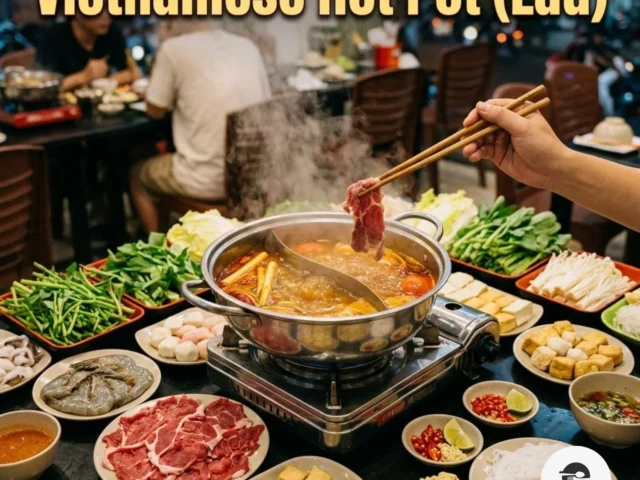
Vietnamese Hot Pot (Lẩu): Types, How to Eat, Dipping Sauces
Vietnamese hot pot (lẩu) is a pot of seasoned broth kept simmering at the table, where diners cook…