
Table of contents
- Quick Comparison
- Mueller 7-Inch Meat Cleaver — Best Budget
- Utopia Kitchen Meat Cleaver 7″ — Best for Bone-In Cuts
- TUO Vegetable Cleaver Knife 7″ — Best Overall
- PAUDIN Nakiri Knife 7″ — Most Popular
- SYOKAMI Cleaver Chef Knife with Herb Stripper — Best Extra Feature
- imarku Cleaver Knife 7″ — Best for Heavy Prep
- HOSHANHO Cleaver Knife 7″ — Best Curved “Rocking” Blade
- WÜSTHOF 7″ Chinese Chef’s Knife — Best Lightweight Premium
- KYOKU Shogun Series Vegetable Cleaver — Best With Sheath & Case
- Dalstrong Shogun Series Elite 7″ — Best Splurge / Gift
- What Actually Matters When You’re Choosing a Cleaver
- Frequently Asked Questions
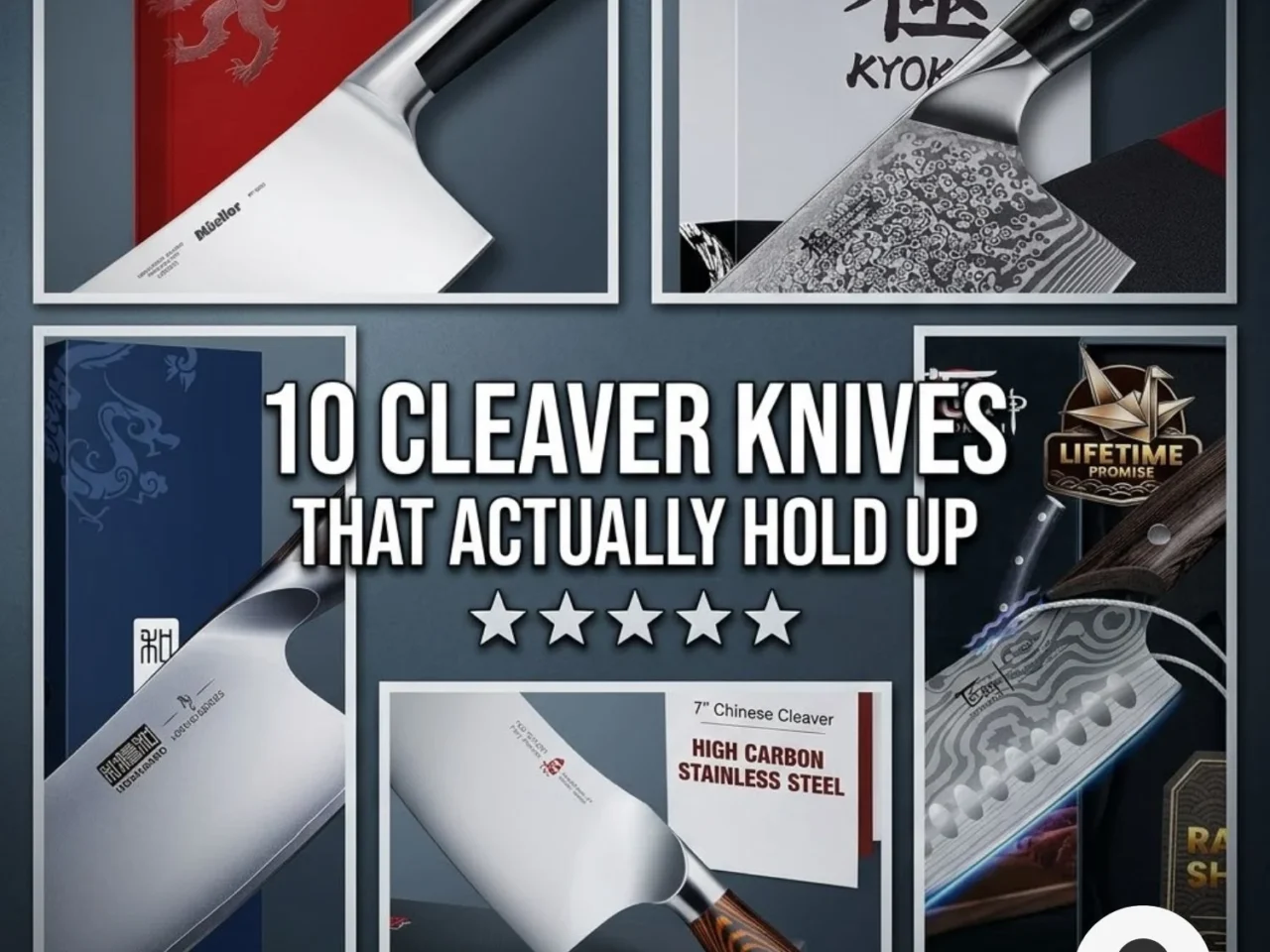
If you’ve only ever cooked with a Western chef’s knife, a Chinese-style cleaver looks like overkill — a slab of steel built for a butcher shop, not a home kitchen. In practice, the wide, flat blade is one of the most useful shapes you can own. The heel handles heavy chopping, the middle does the everyday slicing and dicing, and the flat side scoops garlic, ginger, or diced onion straight off the cutting board into the pan — a motion that’s second nature in Vietnamese and Chinese kitchens and genuinely saves time once you get used to it.
We looked at ten 7-inch cleavers currently sold on Amazon, spanning $19.99 to $149, reading through the actual “About this item” specs and hundreds of verified owner reviews for each one — not just the marketing copy — to see which ones hold up to daily chopping, mincing, and the occasional joint of chicken. One candidate that looked strong on paper (a ZWILLING Twin Signature cleaver) turned out to carry Amazon’s “Frequently Returned Item” flag, so we left it out. Here’s what actually held up, from cheapest to most expensive.
This post contains affiliate links. If you buy through one, foodvietnamese.com earns a small commission at no extra cost to you.
Quick Comparison
| Cleaver | Best For | Blade Material | Key Feature | Price |
|---|---|---|---|---|
| Mueller 7-Inch Meat Cleaver | Best Budget | German stainless steel | Full-tang stainless handle, dishwasher safe; one owner chopped 30lbs of beef ribs with it | $19.99 |
| Utopia Kitchen Meat Cleaver | Best for Bone-In Cuts | Stainless steel | Heaviest blade of the ten — splits chicken joints cleanly | $23.09 |
| TUO Vegetable Cleaver | Best Overall | German stainless (X50CrMoV15) | Balance point sits right at the pinch grip; owners report 5+ years of daily use with no issues | $31.75 |
| PAUDIN Nakiri Knife | Most Popular | 5Cr15MoV stainless | 1,000+ bought in the past month; wide, flat-topped nakiri profile | $32.99 |
| SYOKAMI Cleaver with Herb Stripper | Best Extra Feature | German high-carbon steel | Built-in 3-hole herb stripper for kale, basil, thyme | $32.99 |
| imarku Cleaver Knife | Best for Heavy Prep | Japanese high-carbon stainless | 2.4mm blade thickness, hand-sharpened 15° edge | $45.99 |
| HOSHANHO Cleaver Knife | Best Curved “Rocking” Blade | Japanese 10Cr15CoMoV stainless | 58+2 HRC, gently curved edge for a rocking cutting motion | $89.99 |
| WÜSTHOF Chinese Chef’s Knife | Best Lightweight Premium | German high-carbon stainless | 4.8-star rating from 65 owners; noticeably thinner than a true meat cleaver | $105.00 |
| KYOKU Shogun Series Damascus | Best With Sheath & Case | VG10 Damascus (58-60 HRC) | Comes with a fitted sheath and storage case included | $109.99 |
| Dalstrong Shogun Series Elite | Best Splurge / Gift | AUS-10V Damascus (66 layers) | 62+ HRC steel core, mirror-polished edge, gift box included | $149.00 |
Mueller 7-Inch Meat Cleaver — Best Budget
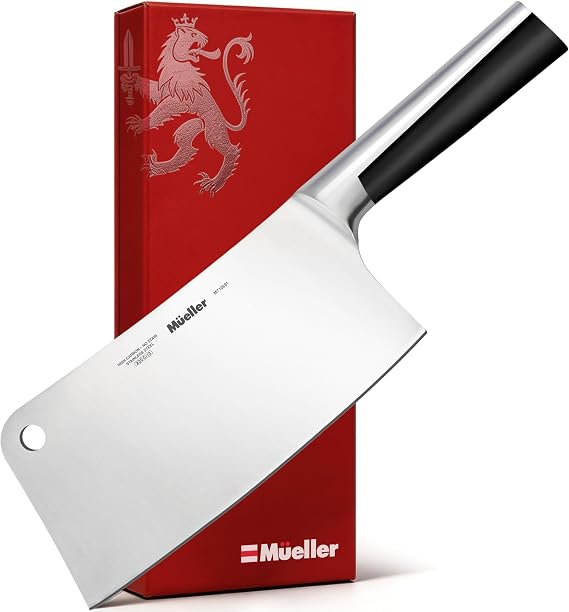
At $19.99, this is the cheapest cleaver on the list and also one of the best-reviewed, with 2,791 ratings at 4.7 stars and over 1,000 bought in the past month. It’s forged from German high-carbon stainless steel, hand-sharpened to an 18-degree double-bevel edge, with a full-tang seamless stainless steel handle rather than wood — which means no oiling or swelling to worry about, and it’s dishwasher safe (though hand-washing is recommended to protect the edge longer). Amazon’s review summary for this listing specifically highlights one owner who chopped through 30 pounds of raw beef ribs with it, and several others mention 6+ months of near-daily use without needing to resharpen.
Worth knowing: this cleaver is listed with a curved blade edge, which gives it a rocking motion more like a Western chef’s knife than a traditional flat-bottomed Chinese cleaver — some cooks prefer that, others don’t. And despite the marketing calling it a “heavy-duty bone chopper,” at least one detailed reviewer pushed back hard on that claim, writing plainly that it’s “not for bones, use a bone saw” and that it excels instead at boneless meat and vegetables. Take the bone-chopping claims with a grain of salt and treat this as an excellent all-purpose prep knife.
Check Price on Amazon →Utopia Kitchen Meat Cleaver 7″ — Best for Bone-In Cuts

At $23.09 this is the second-cheapest cleaver here, and it’s also the one with the most reviews by a wide margin — 7,639 ratings at 4.6 stars, with over 1,000 bought in the past month. It’s a full-tang stainless steel blade with a molded ABS/steel handle, and it’s noticeably heavier than most of the others, which is exactly what you want if you’re breaking down a whole chicken or splitting crab. One owner who bought it in 2019 said it had butchered “hundreds of chickens” over six years with zero chips and only occasional touch-up sharpening. Another described it as “heavy enough to easily split chicken wings at the joint” — a task the lighter, thinner-bladed options on this list simply aren’t built for.
Reviewers are consistent that this knife arrives sharp but is not dishwasher safe — several mention hand-washing and drying it immediately to avoid rust, since the handle is ABS rather than a sealed wood composite. It’s also worth noting: this is a genuinely heavy, genuinely sharp tool. More than one review recommends keeping your free hand well clear of the board when chopping with real force, which is just good practice with any cleaver but especially this one.
Check Price on Amazon →TUO Vegetable Cleaver Knife 7″ — Best Overall

TUO’s Fiery Phoenix cleaver is forged from German high-carbon stainless steel (DIN X50CrMoV15) at HRC56±2, hand-sharpened to 18 degrees per side, with a full-tang pakkawood handle. It’s the #1 top-rated cleaver in Amazon’s search results for this category, and the review history backs that up — one of the most detailed reviews on the listing is from an owner who’s used it almost daily since 2017 and, as of an update 18 months later, said the edge was still holding after regular honing. Another longtime owner, a former professional cook who owns Shun and Messermeister knives, called the fit and finish “impeccable” and said the balance point lands right at the pinch grip, which is unusual for a cleaver-shaped blade and makes it easier to control for fine work like slicing herbs.
The catch: Amazon’s own review summary for this listing flags durability as “mixed” — most owners report the blade holding its edge for years, but a handful mention the handle breaking on first use, which points to occasional quality-control misses rather than a design flaw. It’s built as a vegetable cleaver first; if you regularly break down bone-in chicken, pair it with the Utopia above rather than asking this one to do both jobs.
Check Price on Amazon →PAUDIN Nakiri Knife 7″ — Most Popular

PAUDIN’s listing is the single best-selling cleaver-style knife in this search — over 1,000 bought in the past month, 4,873 ratings, and an Amazon’s Choice badge. It’s a nakiri-profile blade (flat-topped rather than curved like a traditional Chinese cleaver), made from 5Cr15MoV stainless steel with a wave-pattern finish. Owners consistently praise how it handles dense vegetables: one review describes slicing a whole butternut squash top-to-bottom in one pass, something the reviewer’s much more expensive chef’s knife couldn’t manage as cleanly, and several others mention tomatoes and pineapple sliced with minimal pressure.
One thing worth knowing before you buy: PAUDIN’s own product listing states the wave pattern is decorative, “not real Damascus,” so don’t expect the layered look to mean forged Damascus steel underneath — it’s a lower-cost steel dressed up to look like one. A one-star reviewer made the same point more bluntly, calling it “laser patterns not the metal.” For the price, most buyers still consider it a good value pick — just don’t pay a Damascus premium expecting Damascus performance.
Check Price on Amazon →SYOKAMI Cleaver Chef Knife with Herb Stripper — Best Extra Feature

At $32.99, the SYOKAMI is priced right alongside the PAUDIN, but it earns its spot on this list with a genuinely useful extra: a 3-hole herb stripper built into the spine of the blade, designed to pull the leaves off kale, basil, thyme, and rosemary stems in one motion instead of picking them off by hand. It’s a full-tang German steel blade at 56+ HRC with a wenge wood handle that’s textured with a gear-tooth grip pattern specifically so it stays secure when your hands are wet or oily — a detail multiple reviewers called out as genuinely working as advertised. At 4.8 stars across 734 ratings, it’s one of the highest-rated cleavers in this entire roundup.
Like the PAUDIN, the Damascus-style pattern here is decorative rather than true forged Damascus steel, which one reviewer noted directly. And one detailed review is worth flagging: the reviewer tested it on raw chicken with skin and found it struggled to cut clean slits compared to a dedicated butcher knife, concluding it’s better suited to vegetables and herbs than serious meat prep. A separate reviewer also mentioned their unit arrived duller than expected and needed a $10 professional sharpening before it performed well. For light, varied kitchen work — especially if you cook with a lot of fresh herbs — it’s a strong, slightly different pick from the rest of this list.
Check Price on Amazon →imarku Cleaver Knife 7″ — Best for Heavy Prep

imarku’s cleaver sits in the middle of the lineup at $45.99, with a thicker 2.4mm blade forged from Japanese high-carbon stainless steel at 57+1 HRC and hand-sharpened to a 15-degree edge. Amazon’s AI-generated review summary for this listing specifically calls out that it “slices through both raw and cooked steak” and handles bone better than most cleavers in this price range — one reviewer confirmed it cuts through chicken bones cleanly, though they noted it doesn’t get through thicker pork bones without more effort. The FSC-certified pakkawood handle is designed to work equally well for right- and left-handed cooks, which several reviewers called out specifically.
The same review summary flags blade durability as mixed: most owners report the edge holding up well with regular use, but a few mention the blade breaking after about a month of use, which suggests some inconsistency in the batch rather than a universal issue. If you want a cleaver that can occasionally handle a chicken bone without buying a dedicated bone cleaver, this is one of the most capable on the list — just don’t lean on it for anything heavier.
Check Price on Amazon →HOSHANHO Cleaver Knife 7″ — Best Curved “Rocking” Blade

At $89.99, HOSHANHO’s cleaver is forged from Japanese 10Cr15CoMoV stainless steel at 58+2 HRC, with a 2.3mm blade and a pakkawood handle. One of the most detailed reviews on the listing — from a buyer who specifically tested it against Japanese high-carbon steel expectations — called the fit, finish, and out-of-box sharpness better than the price suggests, and said the edge was still holding weeks into regular use without needing a touch-up. Several reviewers specifically like the slightly curved edge for a rocking cutting motion when mincing herbs or garlic, which feels closer to a Western chef’s knife technique than the flat-bottomed chop of a traditional cleaver.
That curved edge is also a matter of preference, not universal praise: one reviewer who owns a straight-edge Chinese cleaver for comparison said they actually prefer the straight profile and found this one “more of a rocking knife than a chopping knife.” And Amazon’s review summary flags a genuine durability concern — some customers report the blade chipping after first use, which didn’t show up as a pattern in the majority of reviews but is worth knowing about before you buy. Like the other Japanese high-carbon options here, it’s hand-wash only.
Check Price on Amazon →WÜSTHOF 7″ Chinese Chef’s Knife — Best Lightweight Premium

WÜSTHOF has been making knives in Solingen, Germany for over 200 years, and this is the smallest-batch, highest-rated cleaver on this entire list — 4.8 stars across 65 ratings with zero 1- or 2-star reviews at the time of writing. It’s German high-carbon stainless steel with a POM synthetic handle and comes backed by WÜSTHOF’s limited lifetime warranty. What stands out most in the reviews is how different it feels from a true meat cleaver: multiple owners specifically mention it’s thin, light, and precise rather than thick and heavy, which makes it easier to use for everyday slicing and scooping chopped vegetables off the board, a technique one reviewer said replaced their French chef’s knife entirely.
WÜSTHOF’s own product description is refreshingly direct about a limitation that other brands gloss over: “The Chinese chef’s knife is shaped like a cleaver but is not suitable for cutting through bones.” That’s a straightforward admission worth taking at face value — this is a slicing and chopping tool for vegetables, herbs, and boneless meat, not a bone cleaver. One reviewer also noted it feels “not as balanced or sturdy” as WÜSTHOF’s larger Classic-line knives, though they kept it anyway for the size. At $105, you’re paying for the brand’s consistency and finish more than raw capability.
Check Price on Amazon →KYOKU Shogun Series Vegetable Cleaver — Best With Sheath & Case

At $109.99, KYOKU’s cleaver is built around a VG10 Japanese Damascus steel core at HRC 58-60, cryogenically treated, with a triple-riveted G10 handle. Unlike most of the others on this list, it ships with both a protective sheath and a storage case included, which is a genuine convenience if you don’t keep a knife block. One long-time owner who directly compared it to a similarly-priced Dalstrong said the KYOKU arrived slightly sharper out of the box and that its Damascus pattern looked more authentic than the competing brand’s — high praise from someone who owns both. Reviewers also like it for slicing larger fruit like mango and melon, where its long, straight edge and weight do the work with minimal sawing.
The edge geometry here is thin and delicate by design, and more than one reviewer confirms that means it’s not built for chopping through bone or hard squash — one owner said they resharpened it to an even finer angle and it “cuts like a dream,” but explicitly avoids using it on anything harder than root vegetables. Another reviewer who owns genuine hand-forged Damascus steel wasn’t fully convinced this pattern is true folded Damascus rather than a well-done etched finish, and a separate review mentioned their unit broke after about two months of regular use. It’s a beautiful, capable slicing cleaver — just don’t buy it expecting bone-chopping toughness.
Check Price on Amazon →Dalstrong Shogun Series Elite 7″ — Best Splurge / Gift

At $149, the Dalstrong is the most expensive cleaver on this list and it’s not trying to be a daily workhorse — it’s a gift-box knife with real performance behind the presentation. The core is AUS-10V Japanese super steel at 62+ Rockwell hardness, wrapped in 66 layers of Damascus-pattern steel, with a hand-polished, mirror-finished 8–12 degree edge and a triple-riveted G10 handle. It comes with a fitted sheath and a branded gift box. Reviewers consistently mention it arrives razor-sharp with no chips, and one long-time Dalstrong owner said it’s become the knife they reach for most often in their kitchen despite owning several pricier Dalstrong sets.
Two things to know before buying: this is explicitly a “medium-duty” cleaver, best suited to boneless meat, fish, vegetables, and fruit — one detailed review specifically warns not to hack through chicken bones with it and to use Dalstrong’s dedicated German-steel bone cleaver for that instead, since the hardened edge can chip on impact with bone. And like most high-carbon Japanese steel, it’s hand-wash only; more than one reviewer stresses never putting it in the dishwasher, since the detergent will dull and eventually damage the edge over time.
Check Price on Amazon →What Actually Matters When You’re Choosing a Cleaver
Blade material and hardness. Most cleavers in this price range use either German stainless steel (softer, around HRC56, easier to sharpen at home, more forgiving of hard use) or Japanese high-carbon stainless (harder, up to HRC62+, holds an edge longer but chips more easily on bone and needs more careful sharpening). If you cook mostly vegetables and boneless meat, the harder Japanese steel is worth it. If you’re regularly breaking down bone-in chicken or fish, the softer, tougher steel — or a purpose-built bone cleaver like the Utopia or Mueller — will hold up better.
Straight edge vs. curved edge. A traditional Chinese cleaver has a nearly flat bottom edge, meant to be lifted and brought straight down in a chopping motion. Several cleavers in this roundup (Mueller, HOSHANHO) instead use a slightly curved edge that rocks like a Western chef’s knife — great if that’s the technique you already know, less traditional if you specifically want the flat-chop motion. Neither is wrong; it’s about which cutting motion feels natural to you.
Weight and balance. A lighter cleaver like the TUO or WÜSTHOF is easier to control for mincing garlic or slicing herbs. A heavier one like the Utopia does the work for you when you’re chopping through joints — you let gravity and the blade’s mass do the cutting instead of muscling through with force. Neither is “better”; it depends on what’s on your cutting board most days.
Is it actually rated for bone? This is the detail most buyers miss, and it shows up repeatedly in the reviews above: a knife labeled “meat cleaver” isn’t automatically built to chop through bone. WÜSTHOF says so directly in its own product description, and reviewers flag the same limitation on the imarku, Dalstrong, KYOKU, and HOSHANHO. If bone-in chicken, fish heads, or crab are a regular part of your cooking, the Utopia’s weight and softer steel — or the Mueller’s German steel, despite one reviewer’s pushback — are the safer choices, not the premium options.
Handle and maintenance. Pakkawood handles (TUO, PAUDIN, imarku, HOSHANHO) feel warmer and more traditional but should still be hand-washed to avoid the wood composite swelling over time. Wenge wood (SYOKAMI) behaves similarly. Stainless steel (Mueller) and polymer/G10 handles (Dalstrong, KYOKU, WÜSTHOF) are more water-resistant in theory, but the harder steels paired with them almost always call for hand-washing anyway to protect the edge — check the specific product’s care instructions rather than assuming.
Frequently Asked Questions
What’s the difference between a cleaver and a regular chef’s knife?
A Chinese-style cleaver has a wider, flatter, more rectangular blade than a Western chef’s knife. The extra width and flat spine let you use the whole blade to scoop chopped food off the board, and the weight distribution makes rocking through piles of vegetables or mincing garlic faster once you’re used to the shape. A chef’s knife is more maneuverable for fine, precise cuts like filleting or trimming.
Can a 7-inch cleaver cut through bone?
Some can, but not all, and it depends entirely on the steel and edge thickness. Heavier, softer-steel cleavers like the Utopia Kitchen model are built for it and reviewers confirm they split chicken joints cleanly. Thinner, harder Japanese steel cleavers like the Dalstrong, KYOKU, or WÜSTHOF are explicitly not designed for it — WÜSTHOF says so directly in its own listing — and the harder edge can chip on impact with bone, even when the knife is marketed or shaped like a “meat cleaver.”
Is a “Damascus pattern” cleaver actually made of Damascus steel?
Not always. Several listings in this roundup, including the PAUDIN and SYOKAMI, explicitly state their wave or layered pattern is decorative rather than genuine forged Damascus steel — a lower-cost steel finished to look like one. Even on cleavers marketed as true Damascus, like the KYOKU, at least one reviewer who owns hand-forged Damascus knives said they weren’t fully convinced it was the real, folded construction. If the authenticity of the Damascus pattern matters to you, look for the steel core spec (like VG10 or AUS-10V) called out separately from the pattern, and treat the pattern itself as cosmetic unless the listing is specific about a folded, multi-layer construction.
Are these cleavers dishwasher safe?
Mostly no. Based on the manufacturer instructions and owner reviews across all ten products here, hand-washing and immediate drying is recommended for nearly every one of them. The Mueller is the one exception that’s explicitly labeled dishwasher safe, though even its own listing recommends hand-washing for longer edge retention. Dishwasher detergent is both abrasive and corrosive, and it will dull the edge and can damage pakkawood, wenge, or composite handles over repeated washes.
Do I need to sharpen a new cleaver before using it?
No — nearly every cleaver in this roundup ships sharp out of the box, according to owner reviews (one reported exception among the ten arrived duller than expected and needed a professional sharpening). What varies is how long that factory edge lasts with regular use. Softer German steel (TUO, Mueller, Utopia) typically needs more frequent honing but is easier to resharpen at home; harder Japanese and Damascus-clad steel (imarku, HOSHANHO, KYOKU, Dalstrong) holds its edge longer between sharpenings but is less forgiving if you get the angle wrong.
Should I get a curved or straight-edge cleaver?
It comes down to the cutting motion you’re used to. A straight, flat-bottomed edge — like the WÜSTHOF or KYOKU here — is built for the traditional cleaver motion: lift and chop straight down, using the full width of the blade. A curved edge — like the Mueller or HOSHANHO — lets you rock the blade back and forth the way you would with a Western chef’s knife, which feels more familiar if that’s how you already cut. Neither is more “authentic” or better; try both motions with whatever knife you currently own and see which one your hand already prefers.
None of these ten cleavers are a bad choice — they’re simply built for slightly different kitchens and budgets. If you want one knife that does almost everything well without spending much, start with the Mueller or the TUO. If bone-in cuts are a regular part of your cooking, the Utopia’s extra weight will save you from buying a second knife later. If you cook with a lot of fresh herbs, the SYOKAMI’s built-in stripper is a genuinely useful extra most cleavers don’t offer. And if you’re shopping for someone who already has the basics covered and wants something that feels as good as it cuts, the Dalstrong or KYOKU are the ones that get unwrapped and actually used.

Related articles
I Tested 10 End Grain Cutting Boards — Here’s What Held Up
My chef’s knives are the one kitchen expense I don’t skimp on, which is exactly why the cutting…
Best Rice Cookers for Jasmine and Sticky Rice, Based on Reviews
Rice cookers get marketed like they’re all the same machine in a different shell. They’re not — not…