
Table of contents
- Quick Comparison
- Cosori 10-Cup, 18-in-1 — Best Overall
- BLACK+DECKER RC506 — Best Budget
- Aroma ARC-914SBD — Best Value for Families
- Toshiba Small (3-Cup) — Best for 1-3 People
- CUCKOO CR-0375FW — Most Consistent Texture
- Toshiba TRCS01 (6-Cup) — Best for Families and Cháo
- What Actually Matters When You’re Choosing
- Questions Worth Answering Before You Buy
Rice cookers get marketed like they’re all the same machine in a different shell. They’re not — not if you’re cooking jasmine rice most nights and occasionally switching over to sticky rice for xôi, or trying to get a pot of cháo going without babysitting the stove. For this guide I went through the actual owner reviews for each of these six cookers — not just the “About this item” bullet points, which all promise fluffy, even rice — because what a cooker is like after six months of real use tells you a lot more than a spec sheet does.
The two things that actually separate a good rice cooker from a mediocre one for Vietnamese cooking are how it handles different rice textures — jasmine, sticky, sometimes brown rice for a change — and whether the keep-warm setting dries the rice out after a couple of hours or actually holds it. Fuzzy logic cookers adjust cook time and temperature based on what’s in the pot, which matters more than most of the extra buttons printed on the box.
Quick note: some of the links below are Amazon affiliate links, so foodvietnamese.com earns a small commission if you buy through them — it doesn’t change what you pay.
Quick Comparison
| Rice Cooker | Best For | Capacity | Key Feature | Price |
|---|---|---|---|---|
| Cosori 10-Cup, 18-in-1 | Best overall | 10 cups uncooked / 20 cooked | Fuzzy logic, ceramic pot, 18 functions | $89.99 |
| BLACK+DECKER RC506 | Best budget | 3 cups uncooked / 6 cooked | Simple one-touch, steaming basket included | ~$20–27 |
| Aroma ARC-914SBD | Best value for families | 4 cups uncooked / 8 cooked | Cool-touch stainless exterior | $36.99 |
| Toshiba Small (3-Cup) | Best for 1-3 people | 3 cups uncooked | Compact, 8 functions incl. cake & eggs | $80.49 |
| CUCKOO CR-0375FW | Most consistent texture | 3 cups uncooked / 6 cooked | Micom fuzzy logic, auto-clean | $93.49 |
| Toshiba TRCS01 (6-Cup) | Best for families & cháo | 6 cups uncooked | Fuzzy logic, dedicated porridge setting | $109.95 |
Cosori 10-Cup, 18-in-1 — Best Overall

This is the one owners compare to rice cookers three times its price. One reviewer who’d used it for months put it side by side with her old $300 Zojirushi and said the fuzzy logic sensor is forgiving enough that you just have to get close on the water-to-rice ratio — it compensates for the rest. Another switched to it specifically because her previous cooker’s Teflon coating had started flaking into the rice; the Cosori’s ceramic-coated pot was the whole reason she bought it, and after regular use she reports no sign of wear. The 24-hour keep-warm doesn’t dry out or scorch the bottom layer the way her old cooker did, and at 10 cups uncooked (up to 20 cooked), one owner cooks a full week’s rice for a family of four in a single batch.
The trade-offs are real ones pulled straight from owners, not hypotheticals: there’s no on/off switch, so you turn it off by unplugging it, which catches some people off guard. It also takes noticeably longer than the stovetop — one long-time user keeps a Cuckoo pressure cooker around specifically for nights she’s short on time, since that one finishes rice in 14 minutes versus the Cosori’s more patient cycle. And it’s the largest footprint on this list; one owner in a smaller kitchen mentioned it fits on top of her air fryer for storage between uses.
BLACK+DECKER RC506 — Best Budget

One owner replaced a Black+Decker steamer from the 1990s that had lasted 30 years, and picked this one specifically because it was about $100 cheaper than tracking down another vintage unit — that’s the kind of loyalty this line has built. Another uses it several times a week for brown rice and quinoa and says it’s faster than the stovetop without needing to be watched. For anyone cooking plain jasmine rice most nights without wanting a menu of settings to sort through, the simplicity here isn’t really a downside.
The complaints that come up repeatedly: the water-measurement lines are pressed into the side of the bowl in a color that’s hard to read unless the light hits it right, and rice left on “keep warm” for more than about an hour starts to harden where it touches the pot walls. One owner reported the non-stick coating chipped after a year of regular use, and the included steaming basket is tight for anything bulkier than a couple of dumplings — pork buns barely fit. At this price, most owners seem to consider those trade-offs acceptable.
Aroma ARC-914SBD — Best Value for Families

This is the cheapest cooker on the list by a wide margin, and it’s also the one with by far the most ratings behind it — over 65,000. One reviewer who’d only ever cooked rice on the stovetop with a steamer switched over and tested it on both basmati and sticky rice, reporting it turned out “perfectly, like in restaurants,” with the keep-warm holding it afterward. The cool-touch stainless exterior is the real reason to pick this over a cheaper plastic-bodied cooker — the housing doesn’t get hot, which matters if kids are around it.
It skips fuzzy logic, so results depend more on your own rinsing and water ratio than on the machine compensating for you — and the water-fill lines draw the same complaint here as on the BLACK+DECKER, hard to read without good light. One long-term owner downgraded her review after continued use: brown rice came out stuck and hard, worse than the discontinued Sunbeam steamer she’d replaced it with, and the nonstick coating had started chipping after a year of regular use. For white and jasmine rice, though, the reviews stay consistently positive.
Toshiba Small (3-Cup) — Best for 1-3 People
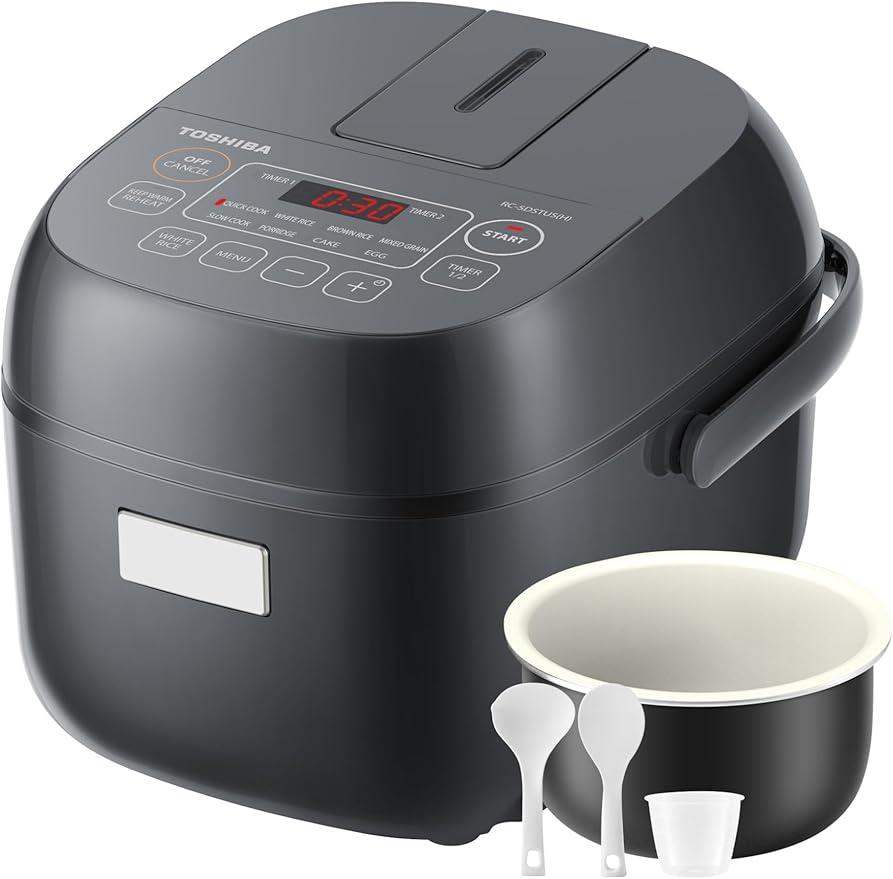
One owner ran an actual side-by-side test against a Zojirushi Neuro Fuzzy — same rice, same water ratio, both started at once — and reported the Toshiba came out only slightly softer and stickier than the $240 Zojirushi, with a noticeably heavier, higher-quality non-stick liner. It also has settings the Zojirushi doesn’t: cake, hard-boiled eggs, and slow cook, alongside the usual white rice, brown rice, and porridge modes. Another owner accidentally left hers running on white rice for over 10 hours and came back to rice that was still fluffy and warm, not burnt or dried out.
Cooking takes around 50 minutes, longer than some expect from a “small” cooker, and at roughly $80 this isn’t actually the budget pick its size suggests — it’s priced closer to the 6-cup Toshiba than to the BLACK+DECKER. For one to three people who want genuine fuzzy-logic cooking in a compact footprint, owners consistently rate it above cookers twice its size.
CUCKOO CR-0375FW — Most Consistent Texture

Cuckoo’s Micom sensors read moisture rather than running on a fixed timer, and it shows in how owners describe the rice: perfectly cooked jasmine and basmati, a keep-warm setting that doesn’t burn the bottom layer, and — notably — no boil-over even when the rice hasn’t been rinsed first, which several other cookers on this list can’t claim.
The complaint that comes up again and again is the lid: it’s spring-loaded and pops open fast enough that more than one owner reported denting a cabinet above it. A family of four also found the 6-cup cooked capacity overkill for their typical two cups of rice — this particular size is really built for a bigger household. And there’s a warning worth taking seriously: owners stress that you need to let the inner parts fully dry out after every use, since trapped condensation can lead to mold if the cooker sits closed between uses.
Toshiba TRCS01 (6-Cup) — Best for Families and Cháo

Owners who’d been cooking their weekly rice batch in an Instant Pot switched to this specifically because they no longer had to be precise about water levels or babysit the process — one described filling the pot to the line “by sight alone” and getting perfectly cooked rice every time, no monitoring required. The seven cooking functions include a dedicated porridge setting, useful for cháo without standing over the stove, and the keep-warm holds rice for up to 15 hours without drying it out.
The steam tray is plastic rather than stainless steel, which one reviewer specifically wished were upgraded, and the power cord plug sits on the right side of the unit, which can be awkward depending on where your outlet is. It’s also messier than a dedicated rice cooker should be if you try cooking something starchy like pasta in it — that tends to boil up into the steam vent. For actual rice and porridge, though, it’s the one families keep reaching for.
What Actually Matters When You’re Choosing
Fuzzy logic versus a basic on/off switch is the biggest fork in the road. A basic switch works fine if you’re cooking the same type of rice the same way most of the time — plenty of long-term BLACK+DECKER and Aroma owners cook that way weekly without complaint. Fuzzy logic earns its price difference once you’re switching between jasmine, brown, and sticky rice regularly, or once you want the machine to compensate for a water ratio you didn’t measure exactly.
Inner pot material is worth checking too. Several owners who moved to ceramic-coated pots did it specifically because an older Teflon-coated cooker had started flaking into their food after a couple of years — not a universal problem, but common enough across these reviews to be worth a look before you buy, especially if you’re cooking daily.
On capacity: 1 cup of uncooked rice roughly covers two people’s worth once cooked, so a 3-cup cooker suits one or two people with maybe a small portion left over, while a family of four or five is more realistic with a 6- to 10-cup machine — though as more than one owner found out, “overkill” is a real risk on the bigger end if your household doesn’t actually eat that much rice.
If cháo or xôi show up in your kitchen regularly, a dedicated porridge setting or a steaming basket rated for sticky rice is worth checking for specifically — most machines can technically produce both, but a cooker built for it does noticeably better than one improvising.
Questions Worth Answering Before You Buy
Do you need a Japanese or Korean brand specifically for Vietnamese rice?
No. Brand origin doesn’t determine how well a cooker handles jasmine or sticky rice — fuzzy logic sensing and a dedicated porridge or multigrain setting matter more than where the company is based.
Can you cook xôi (sticky rice) in a regular rice cooker?
Most can, if you steam it in a basket rather than run it through the direct-cook cycle, since sticky rice generally needs less direct water contact than jasmine rice does. A couple of the machines above have a setting built specifically for it.
What does fuzzy logic actually change about the rice?
It adjusts cook time and temperature in response to sensors reading the rice and water in the pot, rather than running a fixed timer regardless of what’s inside. Owners who’ve compared fuzzy logic cookers to basic ones consistently describe it as more forgiving of an imprecise water ratio, with less scorching on the bottom layer.
How much capacity does a typical household actually need?
As a rough rule, 1 cup of uncooked rice makes about 2 cups cooked, or roughly two servings. A household of four eating rice most nights is usually better served by a 6-cup or larger uncooked capacity than by the smallest model on the shelf — though it’s worth sizing down rather than up if you don’t actually go through that much rice, since more than one owner above ended up with a cooker larger than they needed.
None of these six is the “right” rice cooker in the abstract — it depends on whether you’re cooking for one person or refilling bowls for a family, and whether cháo or xôi are regular enough in your kitchen to justify paying for a dedicated setting. The Cosori earns its price if you want one machine that does most of it and don’t mind unplugging it to turn it off. The BLACK+DECKER and the Aroma earn theirs by not pretending to be more than a rice cooker. And if there’s one pattern across every review on this list, good and bad, it’s that the actual complaints — not just the star rating — tell you more about a $27 cooker or a $110 one than any spec sheet does.

Related articles
I Tested 10 End Grain Cutting Boards — Here’s What Held Up
My chef’s knives are the one kitchen expense I don’t skimp on, which is exactly why the cutting…

10 Cleaver Knives That Actually Hold Up to Daily Chopping
If you’ve only ever cooked with a Western chef’s knife, a Chinese-style cleaver looks like overkill — a…