Table of contents
- Bun Cha at a Glance
- What Is Bun Cha?
- The Two Pork Components: Chả Viên and Chả Miếng
- Ingredients for Classic Hanoi Bun Cha
- How to Eat Bun Cha: The Right Way
- Bun Cha vs. Bun Thit Nuong: North vs. South
- The Marinade and the Broth: Where the Flavor Lives
- Why Charcoal Grilling Is Non-Negotiable
- The Obama–Bourdain Dinner: What Actually Happened
- Where Bun Cha Comes From
- Where to Eat Bun Cha in Hanoi
- Bun Cha Calories and Nutrition
- Frequently Asked Questions
- Sources & References
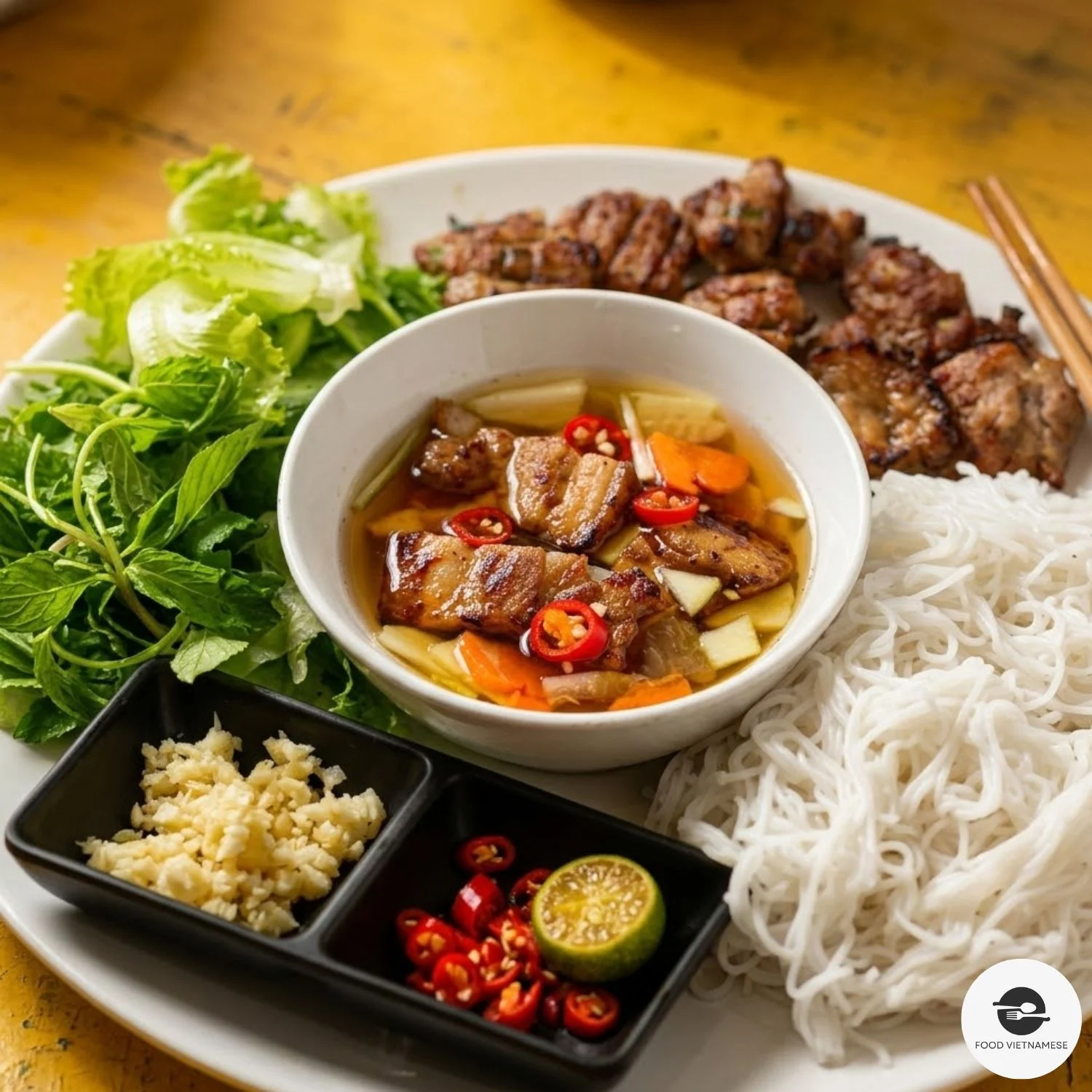
Bun Cha (Bún Chả) is a northern Vietnamese dish of charcoal-grilled pork served in a warm, lightly sweet-sour fish sauce broth, with white rice vermicelli and fresh herbs on the side. It has two pork components: chả viên (grilled minced pork patties) and chả miếng (grilled sliced pork belly) — both marinated and grilled over glowing charcoal until caramelized at the edges. The pork sits submerged in the broth; diners dip noodles and herbs in to eat. Bun Cha is considered one of Hanoi’s defining dishes, and became internationally known when U.S. President Barack Obama ate it with Anthony Bourdain on CNN’s Parts Unknown in 2016 — for a total bill of six dollars.
Bun Cha at a Glance
| Vietnamese name | Bún Chả |
| Region | Hanoi, Northern Vietnam |
| Meal type | Traditionally lunch only (10am–2pm); tourist restaurants now serve dinner |
| Key components | Chả viên (pork patties), chả miếng (grilled pork belly), rice vermicelli (bún), dipping broth (nước chấm), fresh herbs |
| Defining cooking method | Charcoal grilling (than hoa) — the smoke is inseparable from the dish’s identity |
| Calories (restaurant serving) | ~380–480 kcal per serving |
| Price in Hanoi | 40,000–80,000 VND (~2–3 USD) at street stalls |
| Famous moment | Obama–Bourdain dinner at Bún Chả Hương Liên, May 2016; total bill $6 |
| First documented mention | 1959, by Vietnamese food writer Vũ Bằng |
What Is Bun Cha?
The name is straightforward: bún means rice vermicelli, and chả refers to the grilled pork — specifically to both types of pork that define the dish. What makes Bun Cha distinct from every other Vietnamese noodle dish is the serving structure: the noodles never touch the broth until the moment of eating. The broth bowl arrives first, warm, with pork already swimming in it. The noodle plate comes on the side. You dip.
This deconstructed format is deliberate. The broth slowly absorbs the smoky, fatty juices from the grilled pork as it sits, deepening in flavor throughout the meal. A spoonful taken at the start tastes different from one taken twenty minutes later — the pork has been giving itself to the broth the entire time.
Vietnamese food writer Vũ Bằng described Hanoi in 1959 as a city “transfixed by bún chả.” The description still holds. Charcoal smoke from bun cha grills drifts through Hanoi’s streets every midday, and the sound of pork sizzling over coals is as much a part of the city’s sensory identity as the sound of motorbike engines.
The Two Pork Components: Chả Viên and Chả Miếng
Every bowl of Bun Cha contains both. They are not interchangeable — each plays a different role.
| Component | Vietnamese | What It Is | Key Characteristic |
|---|---|---|---|
| Pork patties | Chả viên | Ground pork belly formed into flat, round patties about 4–5cm in diameter | Juicy interior from pork belly fat; caramelized, slightly charred exterior from charcoal. The fat-to-lean ratio of pork belly is non-negotiable — lean pork shoulder produces dry, flavorless patties. |
| Grilled pork belly slices | Chả miếng | Pork belly sliced thin (~4mm), marinated, grilled until edges char and fat renders | Textural contrast to the patties — more chew, visible fat layers, stronger caramel char. The rendered fat dissolves into the dipping broth over time. |
Why pork belly specifically? According to Pham Thu Hoai, owner of Bun Cha Ta (Michelin Bib Gourmand, 2024): “The minced pork must come from pork belly to ensure the right balance of lean meat and fat for a juicy texture.” Pork shoulder or lean mince produces patties that dry out over the grill and lack the fat content to season the dipping broth. This is the most common mistake in home recipes that substitute leaner cuts.
Ingredients for Classic Hanoi Bun Cha
| Component | Ingredient | Amount (4 servings) | Notes |
|---|---|---|---|
| Pork marinade | Pork belly (minced, for patties) | 300g | Mince by hand or pulse in food processor — not too fine; some texture is desirable |
| Pork belly (sliced, for chả miếng) | 300g | Slice 3–4mm thick; score fat cap lightly so it doesn’t curl on the grill | |
| Fish sauce (nước mắm) | 3 tbsp | The primary savory backbone of the marinade | |
| Sugar | 2 tbsp | Promotes caramelization on the grill; essential for the char | |
| Shallots, minced | 2 medium | Adds sweetness and aromatics; avoid using onion | |
| Garlic, minced + black pepper | 3 cloves + ½ tsp | Classic Hanoi marinade keeps it simple — no lemongrass, no five-spice | |
| Dipping broth | Fish sauce | 3 tbsp | Use a good-quality fish sauce; the broth’s flavor is transparent, so quality shows |
| White vinegar or rice vinegar | 2 tbsp | Adds the tartness characteristic of Hanoi-style bun cha (not lime juice, which is more southern) | |
| Sugar | 2 tbsp | Hanoi bun cha broth leans slightly sweet — noticeably more so than southern nuoc cham | |
| Warm water | 250ml | Serves as the broth base | |
| Pickled carrot and papaya (đồ chua) | To taste | Thinly julienned, marinated in vinegar and sugar. Papaya is traditional; carrot alone is acceptable. These float in the broth with the pork. | |
| Noodles | Rice vermicelli (bún) | 400g fresh or 200g dry | Thin round rice vermicelli. Served at room temperature or slightly warm — never hot. |
| Garlic, chili (for broth) | 2 cloves, 1–2 chilies | Thinly sliced and added to individual broth bowls, not cooked into the broth | |
| Herb plate | Perilla (tía tô), lettuce, Thai basil, fish mint (diếp cá), cilantro, bean sprouts | Large mixed plate per serving | Fish mint (diếp cá) is Hanoi’s signature herb for bun cha — it has a distinctive fish-like herbal flavor. Rarely found outside Vietnam; substitute with extra perilla. |
How to Eat Bun Cha: The Right Way
First-time visitors to Hanoi frequently make the same mistake: they pour the broth over the noodles and eat it like soup. Bun Cha is not soup. The noodle plate and the broth bowl are separate instruments that work together only at the moment of each bite.
The correct method: pick up a bundle of vermicelli with chopsticks, add a leaf of perilla or lettuce and a piece of grilled pork from the broth bowl, then dip everything into the warm broth and eat in one motion. Some Hanoians drop a small amount of noodles directly into the broth bowl for a few seconds, then lift them back out. The broth is meant to coat and season, not to submerge.
| Step | Action | Notes |
|---|---|---|
| 1 | Add sliced garlic and chili to your broth bowl | This is customizable — Hanoians typically add both; adjust heat to preference |
| 2 | Pick up a small bundle of vermicelli (about 2 tbsp worth) | Don’t take too much at once — smaller bundles coat evenly with broth |
| 3 | Add a leaf of perilla, lettuce, or other herb | Herbs are not garnish — they are a structural component of each bite |
| 4 | Dip the bundle into the broth bowl | Hold for 2–3 seconds; the broth should cling to the noodles |
| 5 | Eat noodles, pork, and herbs together in one bite | The ratio of noodle to herb to pork changes the flavor profile significantly — experiment |
| 6 | Order nem (fried spring rolls) on the side | The classic Hanoi pairing. Hanoians dip nem rán into the same broth bowl as the pork. |
Bun Cha vs. Bun Thit Nuong: North vs. South
Both dishes involve grilled pork and rice vermicelli. Both are served with herbs and dipping sauce. They are not the same dish, and Vietnamese people from each region feel strongly about which is better. The differences go deeper than geography.
| Feature | Bún Chả (Hanoi / North) | Bún Thịt Nướng (Saigon / South) |
|---|---|---|
| Serving structure | Deconstructed: pork in broth, noodles separate. Diners dip. | Assembled: single bowl, pork slices on top of noodles, sauce drizzled over |
| Pork type | Minced pork belly patties + sliced pork belly | Thinly sliced pork shoulder, marinated in lemongrass |
| Marinade | Fish sauce, sugar, shallot, garlic, black pepper — no lemongrass | Fish sauce, sugar, lemongrass, garlic — the lemongrass is defining |
| Dipping liquid | A warm, light broth (not thick sauce) — slightly sweet, slightly sour from vinegar. The pork fat enriches it over time. | Nuoc Cham — cold, thinner, more acidic from lime juice |
| Pickled vegetables | Green papaya and carrot julienne, submerged in broth | Daikon and carrot julienne, served as side |
| Charcoal grilling | Essential and non-negotiable for authentic Bun Cha | Charcoal preferred but less central to the dish’s identity |
| Herbs | Perilla (tía tô), fish mint (diếp cá), lettuce, cilantro | Lettuce, bean sprouts, cucumber, shredded carrot |
| Fried spring roll pairing | Standard — nem rán dipped in the same broth bowl | Chả giò often added but not traditional pairing |
| Meal timing | Traditionally lunch only | Lunch or dinner |
For a full guide to Vietnamese fresh and fried rolls — including how they differ from Bun Cha’s nem rán pairing — see Spring Roll vs. Egg Roll. For the gỏi cuốn (fresh roll) version that sometimes appears alongside bun cha in southern-style adaptations, see the guide to Vietnamese Fresh Spring Rolls.
The Marinade and the Broth: Where the Flavor Lives
The pork marinade
Authentic Hanoi-style marinade is restrained by design. Fish sauce, sugar, shallots, garlic, black pepper. No lemongrass, no five-spice, no honey in the traditional version. The simplicity is intentional — the marinade’s job is to season and promote caramelization on the grill, not to compete with the smoke. Sugar is the crucial ingredient: without it, the pork browns but doesn’t develop the caramelized, slightly sticky exterior that defines good chả. Marinate for a minimum of 2 hours; overnight produces noticeably juicier patties.
The dipping broth (nước chấm bún chả)
This is what separates Bun Cha from every other Vietnamese noodle dish. The broth is not nuoc cham. It is a diluted, slightly warm mixture of fish sauce, water, vinegar (not lime), and sugar — sweeter and less acidic than southern-style nuoc cham, and served warm rather than cold. Sliced garlic and chili are added at the table individually. Pickled papaya and carrot float in the broth alongside the pork. The fat that renders off the grilled pork belly as it sits in the broth gradually enriches the liquid — a broth eaten at the end of the meal tastes fundamentally different from one that’s just been poured.
| Feature | Bun Cha Broth (Hanoi) | Standard Nuoc Cham (nationwide) |
|---|---|---|
| Acid source | White vinegar or rice vinegar | Lime juice |
| Sweetness level | Notably sweet (higher sugar ratio) | Less sweet, more tangy |
| Temperature | Warm — heated briefly before serving | Room temperature or cold |
| Contents | Pork, pickled papaya/carrot submerged in broth | Sauce only, served on side |
| Garlic/chili | Added raw by the diner at table | Sometimes blended in during preparation |
| Over time | Gets richer as pork fat dissolves into it | Remains stable |
Why Charcoal Grilling Is Non-Negotiable
Bun Cha cooked on an electric grill or in a pan tastes like grilled pork with noodles. Bun Cha cooked over charcoal tastes like Bun Cha. The difference is the smoke — it penetrates the meat during grilling, and then continues to flavor the dipping broth as the pork sits in it. Food writer Graham Holliday, writing for Roads & Kingdoms, described the experience: the broth bowl arrives with “charred, minced-pork patties and crispy cuts of pork belly submerged in fish sauce… dusted with black pepper” — the char is a component, not a byproduct.
Traditional Hanoi bun cha vendors grill over than hoa (charcoal briquettes made from agricultural waste), which burns consistently and produces a specific aromatic smoke. The smell of bun cha grills at midday is one of Hanoi’s most identifiable street-food signals. For home cooking without a charcoal grill, a cast-iron grill pan at very high heat gets closer to the result than any electric appliance — but no indoor method fully replicates the charcoal smoke.
The Obama–Bourdain Dinner: What Actually Happened
In May 2016, during President Obama’s official state visit to Vietnam, Anthony Bourdain arranged a dinner at Bún Chả Hương Liên — a modest, family-run restaurant at 24 Le Van Huu Street in Hanoi’s Hai Ba Trung district, up a narrow staircase to a crowded second floor. The two men sat on low plastic stools, shared Hanoi beer, and ate bun cha with nem rán. The conversation covered diplomatic outreach, Cuba, Iran, and sneaking out for food. The meal cost $6 total. Bourdain paid.
The photo taken by crew member Helen Cho showed Obama hunched over a bowl, chopsticks in hand, at what looked like a completely normal Hanoi lunch spot — because it was. The image spread globally within hours. Bourdain later wrote that strangers in Hanoi recognized him the next day by his tattoos: “Mr. Bún Chả!”
The dinner aired as the season 8 premiere of Parts Unknown on CNN. Bún Chả Hương Liên subsequently had the table, stools, dishes, and beer bottles encased in glass on the second floor — preserved for visitors who now come specifically for the experience. The restaurant now goes by “Bún Chả Obama” informally, though its official name remains unchanged.
What they actually ate: Bún chả (grilled pork + vermicelli + herbs + broth), nem rán (fried spring rolls), and bottles of Hanoi Beer. The full bill, including beer, was $6. Anthony Bourdain noted that the Secret Service had been briefed to expect “a working-class, family-run joint” — they had initially requested a more controllable venue like a hotel banquet room.
Where Bun Cha Comes From
The exact origins of Bun Cha are not documented with precision, but food historians trace it to late 19th or early 20th century Hanoi, likely associated with the charcoal grill culture that developed in the city’s street food ecosystem. The Michelin Guide notes that “French colonial influences introduced techniques such as pâté-making and charcuterie, refining the minced pork patties and perfecting the balance of flavours in the dipping sauce.”
The first written documentation is Vietnamese food writer Vũ Bằng’s 1959 description of Hanoi as a city “transfixed by bún chả.” By that time the dish was already well-established as a midday staple. Traditional vendors sold it from portable charcoal stoves carried by shoulder pole — setting up on street corners at around 10am, grilling until the pork sold out, usually by 1pm.
Bun Cha remained largely a Hanoi secret for decades. Unlike Pho or Banh Mi, it didn’t travel well with the diaspora — it’s too dependent on fresh charcoal grilling and the specific broth-with-pork format to translate easily to packaged or takeaway form. The Obama dinner changed that.
Where to Eat Bun Cha in Hanoi
| Restaurant | Address | Known For |
|---|---|---|
| Bún Chả Hương Liên (“Bún Chả Obama”) | 24 Lê Văn Hưu, Hai Bà Trưng | The Obama–Bourdain restaurant. Preserved table on 2nd floor. Busy and tourist-heavy; food is consistent and good — the fame didn’t hurt quality. |
| Bún Chả Ta (Nguyễn Hữu Huân) | 21 Nguyễn Hữu Huân, Hoàn Kiếm | Michelin Bib Gourmand 2024. Over 30 years in business. Classic Hanoi-style bun cha: tender smoky pork, well-seasoned patties, balanced sweet-sour broth. More locals than tourists. |
| Bún Chả Đắc Kim | 1 Hàng Mành, Hoàn Kiếm | Family-run since 1965. Known for stronger, more savory flavors. One of Hanoi’s longest-running bun cha institutions. |
| Bún Chả Bà Đắc | 67 Trần Hưng Đạo | Old-school street stall format, open from 10am until sold out (usually by 1pm). Minimal décor, maximum smoke. |
Timing matters: Go at lunch. Traditional Bun Cha is a midday dish — stalls typically open around 10am and sell out by 1–2pm. The grilled pork is freshest in the first hour of service. Arriving after 1pm at traditional venues often means settling for what’s left at the bottom of the grill, and the broth may be more diluted. Tourist-oriented restaurants serve through dinner but the charcoal-to-pan ratio tends to shift by evening.
Bun Cha Calories and Nutrition
Bun Cha offers a reasonable macronutrient profile for a full meal — substantial protein from the pork, carbohydrates from the rice vermicelli, and moderate fat. The main nutritional concern is sodium from the fish sauce broth.
| Component | Serving | Calories | Protein | Fat | Carbs |
|---|---|---|---|---|---|
| Grilled pork (both types, ~120g) | ~120g | ~280–320 kcal | ~18–22g | ~18–24g | ~5g |
| Rice vermicelli (~150g cooked) | ~150g | ~110–130 kcal | ~2g | ~0g | ~25–28g |
| Dipping broth with pickled veg | ~100ml | ~30–40 kcal | ~1g | ~0g | ~8g |
| Fresh herbs (herb plate) | ~30g | ~5–10 kcal | ~0.5g | ~0g | ~1g |
| Full serving total | ~350–400g | ~380–480 kcal | ~25–30g | ~18–24g | ~40–50g |
Values are estimates based on a standard restaurant serving. Sodium content is significant (~800–1,200mg from fish sauce broth). Sources: Calorique (385 kcal/350g), NutriScan (420 kcal/restaurant serving), cross-referenced against individual ingredient data from USDA FoodData Central.
Nem rán (fried spring rolls), if ordered as the traditional side, add approximately 100–150 kcal per 2 rolls. Using nuoc cham dipping strategy — not drinking the broth, using it only for dipping — reduces sodium intake meaningfully.
Frequently Asked Questions
What is Bun Cha?
Bun Cha (Bún Chả) is a Hanoi dish of charcoal-grilled pork — both patties (chả viên) and sliced pork belly (chả miếng) — served in a warm, lightly sweet-sour fish sauce broth, with rice vermicelli and fresh herbs on the side. Diners dip noodles into the broth to eat, not pour broth over noodles. It is considered one of Hanoi’s defining dishes.
What is the difference between Bun Cha and Bun Thit Nuong?
Bun Cha is northern (Hanoi): deconstructed, pork submerged in warm broth, noodles separate, dipping format. Marinade has no lemongrass. Bun Thit Nuong is southern (Saigon): assembled in one bowl, lemongrass-marinated pork on top of noodles, sauce drizzled over. Two distinct regional dishes that happen to share their core ingredients.
Why is Bun Cha called the Obama dish?
In May 2016, President Obama and Anthony Bourdain ate Bun Cha at Bún Chả Hương Liên in Hanoi, filmed for CNN’s Parts Unknown. Total bill: $6. The image of Obama on a plastic stool eating noodles went globally viral. The restaurant now preserves the table under glass and is informally known as “Bún Chả Obama.”
How many calories are in Bun Cha?
A standard restaurant serving (~350g) contains approximately 380–480 kcal, with 25–30g protein, 40–50g carbohydrates, and 18–24g fat. Sodium is high (~800–1,200mg from fish sauce broth). Nem rán (fried spring rolls), if ordered as side, add ~100–150 kcal per 2 rolls.
Is Bun Cha only served at lunch?
Traditionally yes — most Hanoi stalls serve from ~10am until sold out, usually by 1–2pm. The charcoal grilling is done in the morning. Tourist restaurants now serve dinner too, but the freshest charcoal-grilled pork is at traditional stalls before noon.
What is the correct way to eat Bun Cha?
Pick up a small bundle of vermicelli, add herbs (perilla, lettuce), and dip everything into the warm broth bowl with chopsticks. Eat noodles, pork, and herbs together in one bite. Do not pour the broth over the noodles. The broth is for dipping, not souping.
Sources & References
- Wikipedia – Bun cha. en.wikipedia.org/wiki/Bun_cha
- Michelin Guide Vietnam – What Is Bun Cha, Hanoi’s Grilled Pork and Noodle Dish? (March 2025). guide.michelin.com
- Vũ Bằng – Miếng Ngon Hà Nội (1959). First written documentation of Bun Cha in Vietnamese literature.
- CNN Parts Unknown – Season 8, Episode 1: Hanoi, Vietnam (2016). Obama–Bourdain dinner at Bún Chả Hương Liên.
- Roads & Kingdoms – A Ballistic Bowl of Bun Cha by Graham Holliday; Mr. Bún Chả: A Q&A with Anthony Bourdain. explorepartsunknown.com
- Calorique – Bun Cha: 385 calories per 350g serving. caloriqueapp.com
- NutriScan – Bun Cha Nutrition: 420 calories, 25g protein. nutriscan.app

Related articles
Vietnamese Hot Pot (Lẩu): Types, How to Eat, Dipping Sauces
Vietnamese hot pot (lẩu) is a pot of seasoned broth kept simmering at the table, where diners cook…
Bun Thit Nuong: Vietnam’s Grilled Pork Noodle Salad, Not a Soup
Bun Thit Nuong is a Vietnamese grilled pork noodle salad — cold rice vermicelli piled with lemongrass-marinated grilled…
Is Vietnamese Food Spicy? Only If You Ask It to Be
Is Vietnamese food spicy? Not by default — most of the country’s best-known dishes, from phở to bánh…