Table of contents
- What Is Bun Dau Mam Tom?
- What Mam Tom Actually Is — And Why It Smells the Way It Does
- What Goes On the Platter
- How to Make the Mam Tom Dipping Sauce
- How to Eat Bun Dau Mam Tom
- Bun Dau Mam Tom vs. Bun Cha: Two Hanoi Dipping Dishes
- A Dish Born From Having Little
- First Bite, Second Thoughts
- The Autumn Version: Chả Cốm
- Bun Dau Mam Tom Calories and Nutrition
- Where to Eat Bun Dau Mam Tom in Hanoi
- Tips for Trying Mam Tom for the First Time
- Frequently Asked Questions
- Sources & References
Bun Dau Mam Tom is a Hanoi platter dish of cold rice vermicelli (bún), deep-fried tofu (đậu), and fermented shrimp paste (mắm tôm) — the dipping sauce that gives the dish both its name and its reputation. Most platters also include boiled pork belly, pork offal such as blood sausage, and fried spring rolls, all wrapped in fresh herbs and dipped piece by piece into the sauce. No English name has ever stuck for this dish; food writers routinely admit that “Vietnamese vermicelli with shrimp paste” is the closest available description, and none of them consider it adequate. The dish divides opinion instantly on smell alone — and just as instantly builds a following among people who get past it.
What Is Bun Dau Mam Tom?
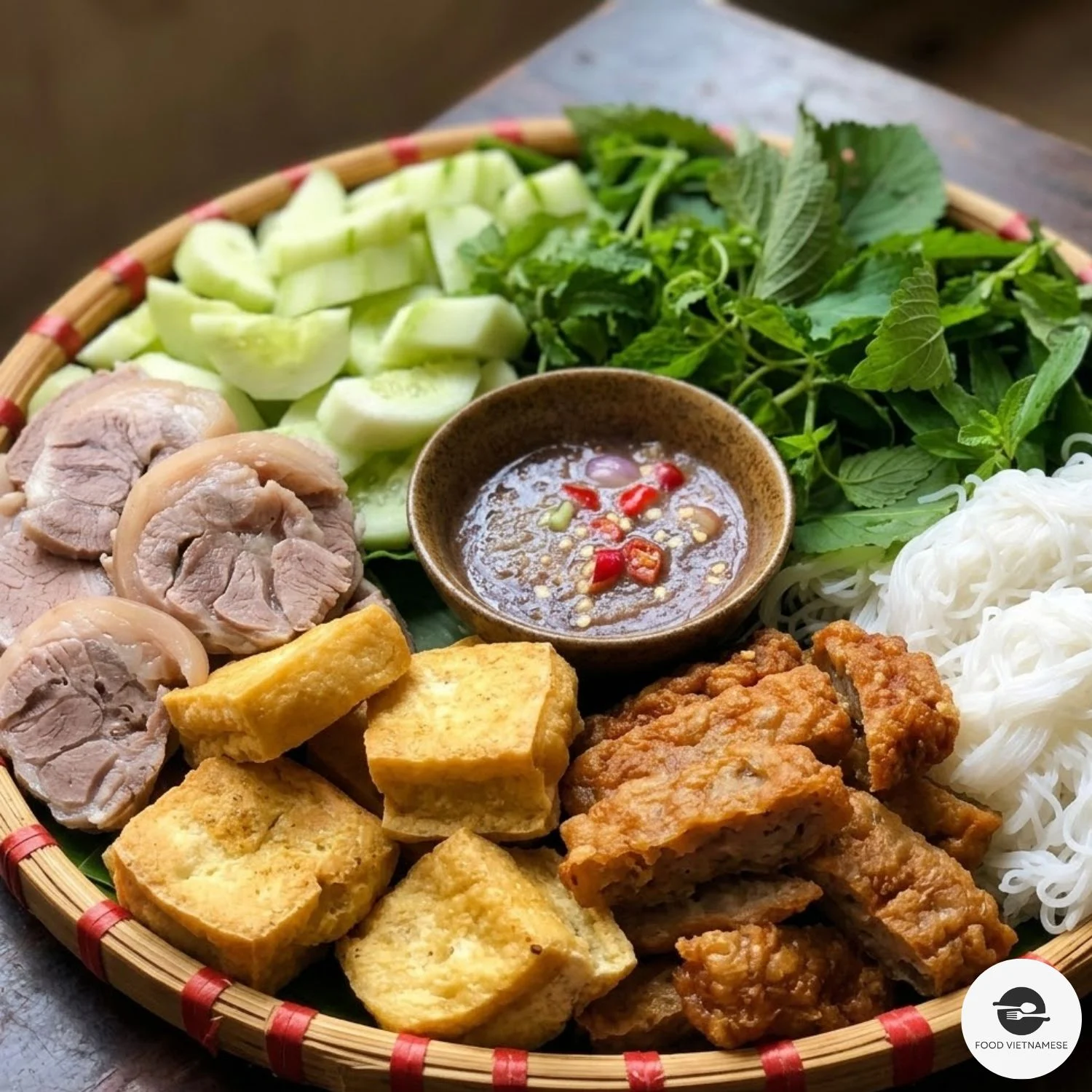
The name is a straight inventory of ingredients: bún is rice vermicelli, đậu is tofu, mắm tôm is fermented shrimp paste. Nothing in the name hints at flavor or technique — which is fitting, since the dish itself is really an assembly rather than a cooked composition. Everything arrives on a single platter, often lined with banana leaf: chilled noodles cut into bite-sized blocks, cubes of tofu fried until the outside crackles and the inside stays custard-soft, slices of boiled pork belly, and a small bowl of thick, purple-grey shrimp paste sitting at the center like the whole plate’s gravitational core.
Nothing about the eating format is subtle. Diners pick up noodles, tofu, or meat with chopsticks, wrap them in perilla or mint, and dip everything directly into the mam tom before eating. The sauce is meant to coat, not season lightly — a proper bite carries a real hit of fermented shrimp flavor, cut by the acidity of lime or kumquat mixed into the paste beforehand.
What Mam Tom Actually Is — And Why It Smells the Way It Does
Mam tom is made from moi, a tiny shrimp species common along northern Vietnam’s coast, mixed with sea salt at roughly a 4:1 ratio and packed into clay or glass jars to ferment. Over several weeks to several months, naturally occurring bacteria break the shrimp proteins down into free amino acids — the same category of compound responsible for umami flavor in aged cheese, soy sauce, and fish sauce. That breakdown is also what produces the paste’s characteristic smell: a mix of ammonia-like sharpness and deep marine funk that first-time diners tend to find genuinely alarming before tasting anything.
The color deepens to a purple-grey as fermentation progresses, and longer fermentation generally means a more intense, complex flavor. Vietnam’s most highly regarded mam tom is traditionally produced in Thanh Hoa and Nghe An provinces, where a combination of local shrimp stock and salt is credited with a notably cleaner finish than mass-produced versions.
Is it the same as shrimp paste used elsewhere in Southeast Asia? Not exactly. Vietnamese mam tom is wetter and more liquid than the dense, brick-like shrimp paste (belacan, kapi, bagoong) common in Malaysian, Thai, or Filipino cooking, and it’s eaten as a dipping condiment rather than cooked into dishes as a background seasoning. This is why mam tom sold in Western grocery stores under a generic “shrimp paste” label is often the wrong product — buying a jar specifically labeled mắm tôm matters if the goal is an authentic result.
What Goes On the Platter
| Component | Description | Role |
|---|---|---|
| Bún (rice vermicelli) | Thin rice noodles, boiled, rinsed, and pressed into bite-sized blocks (bún lá) | The neutral carbohydrate base — designed to carry the sauce, not compete with it |
| Đậu (fried tofu) | Fresh tofu, cubed and deep-fried until the exterior is crisp and golden while the interior stays soft | The dish’s namesake protein; texture contrast is the whole point |
| Mắm tôm (fermented shrimp paste) | Whisked with sugar, lime or kumquat juice, chili, and a splash of hot oil until foamy | The defining sauce — every other component exists to be dipped in this |
| Boiled pork belly | Simmered until tender, sliced thin | The most common protein add-on across nearly every version of the dish |
| Dồi (blood sausage) & other pork offal | Pork intestine, sometimes stuffed and grilled; blood sausage sliced into rounds | Common at traditional stalls; adds richness and organ-meat depth |
| Nem rán (fried spring rolls) | Crispy fried rolls, added at most modern restaurants as an extra | A textural addition that rounds out the platter — see our full spring roll vs. egg roll guide for how nem rán compares to other Vietnamese rolls |
| Chả cốm (seasonal green rice cake) | Pork mixed with young green sticky rice (cốm), pan-fried until golden | A genuinely seasonal addition, at its best from September to November when fresh cốm is in season; frozen versions exist year-round but lack the same fragrance |
| Fresh herbs & cucumber | Perilla, mint, Thai basil, sliced cucumber | Wrapped around each dipped bite to cut the richness and funk |
How to Make the Mam Tom Dipping Sauce
Combine 2 tablespoons fermented shrimp paste, 2 tablespoons sugar, 2 tablespoons lime juice (or the juice of 1–2 kumquats), and sliced chili to taste. Whisk vigorously — this step matters more than it sounds. Proper whisking incorporates air and emulsifies the mixture into a pale, foamy consistency that tames the raw paste’s sharpest edges. Finish with a tablespoon of hot oil poured in while still whisking, which rounds out the flavor and adds sheen. The result should taste salty, sweet, and sharply citrus-forward all at once, with the fermented funk present but no longer overwhelming.
How to Eat Bun Dau Mam Tom
There’s no fixed sequence, which is part of the dish’s appeal — it’s closer to a shared, grazing meal than a plated course. Pick up a piece of tofu or a slice of pork with chopsticks, wrap it in a perilla or mint leaf, dip it into the mam tom, and eat it in one bite. Alternate between components rather than finishing one before starting the next; the point is variety within each bite, not sequence. A cold beer is the standard accompaniment at most Hanoi bún đậu stalls, and a full sitting typically runs 30 to 60 minutes of slow eating and conversation rather than a quick meal.
Bun Dau Mam Tom vs. Bun Cha: Two Hanoi Dipping Dishes
Both dishes share a structural idea — a centerpiece protein dipped into a defining sauce, eaten with rice noodles and herbs — but the sauces could not be more different, and that difference defines the entire eating experience.
| Feature | Bun Dau Mam Tom | Bun Cha |
|---|---|---|
| Defining sauce | Fermented shrimp paste (mắm tôm) — pungent, funky, divisive | Warm sweet-sour fish sauce broth — mild, approachable |
| Centerpiece protein | Fried tofu + boiled pork belly (plus offal, often) | Charcoal-grilled pork patties and sliced pork belly |
| Temperature | Cold platter throughout | Warm broth with hot grilled pork |
| Cooking technique | Frying and boiling — no open flame | Charcoal grilling is essential to the dish’s identity |
| Meal timing | Any meal — breakfast, lunch, or dinner | Traditionally lunch only |
| First-timer difficulty | High — the smell alone stops many visitors before they taste it | Low — broadly approachable flavor profile |
For the full breakdown of Bun Cha’s charcoal-grilling technique, dipping broth, and the Obama-Bourdain story that made it internationally famous, see Bun Cha: Hanoi’s Charcoal-Grilled Pork Noodle Dish.
A Dish Born From Having Little
Bun Dau Mam Tom’s exact origin isn’t documented with precision — even Hanoi locals describe it more as inherited knowledge than recorded history. The dish is widely associated with Vietnam’s Bao Cấp era, the post-war subsidy period when food was scarce and rationed. Tofu, noodles, and shrimp paste were all cheap, shelf-stable, or easy to produce at home, which made the combination practical rather than aspirational. One recurring anecdote credits a countryside Hanoi woman with assembling the dish from household leftovers to feed her family — an origin story that, whether or not it’s literally accurate in its specifics, captures the dish’s real character: resourceful, unpretentious, built from what was on hand.
That humble background is part of why the dish still feels different from Vietnam’s more polished culinary exports. It never aimed to impress outsiders. It was never selling anything. It’s lunch.
First Bite, Second Thoughts
The first time I sat down to a full platter, the smell reached the table before the food did — a woman two seats over caught my hesitation and just said, “cứ ăn đi, quen là nghiện” — eat it, once you’re used to it you’ll be hooked. I dipped a piece of tofu, wrapped it in perilla the way she showed me, and the first thing I noticed wasn’t the funk at all — it was how much the lime and sugar had already tamed it into something closer to a savory vinaigrette than raw fermented shrimp. The smell and the taste turned out to be two almost unrelated experiences. She was right about the second part too; I ordered a second platter before finishing the first beer.
The Autumn Version: Chả Cốm
Between September and November, Hanoi’s bún đậu stalls add a genuinely seasonal item to the platter: chả cốm, a pork patty mixed with fresh young green sticky rice (cốm) and pan-fried until the outside crisps while the inside stays soft and fragrant with rice. This isn’t a marketing gimmick — cốm has a narrow harvest window, and the difference between fresh and frozen versions is noticeable to anyone who’s tried both. Outside those months, some stalls still offer chả cốm made from frozen cốm; it’s a reasonable stand-in but doesn’t carry the same aroma. Visitors timing a Hanoi trip for autumn have a genuine reason to seek this version out specifically.
Bun Dau Mam Tom Calories and Nutrition
Calorie counts vary enormously depending on how much fried tofu, pork, and seasonal chả cốm end up on the platter — this is one of the widest ranges among common Vietnamese dishes.
| Version | Calories | Protein | Fat | Carbs |
|---|---|---|---|---|
| Home-style, modest serving (Teresa’s Recipes) | 320 kcal | 15g | 12g | 41g |
| Full restaurant platter, with chả cốm and extra tofu | 600–900 kcal | — | — | — |
Values vary significantly with platter size and components ordered. Fried tofu and pork account for most of the fat and calorie load; mam tom itself contributes minimal calories but notable sodium (roughly 800mg per serving in home-recipe estimates). The dish is naturally gluten-free; those with shellfish or soy allergies should note that mam tom (shellfish) and tofu (soy) are both central, non-optional components.
Where to Eat Bun Dau Mam Tom in Hanoi
| Location | Notes |
|---|---|
| Ngõ 31 Hàng Khay (alley 31, off Hang Khay Street, opposite Hoan Kiem Lake) | Two long-running stalls in the same small alley, both well-regarded locally; a common first stop for visitors |
| Bún Đậu Homemade | Corner of Nguyen Van Trang and Le Lai streets; a cleaner, more tourist-comfortable setup while keeping traditional flavor |
| Street vendors with shoulder-pole baskets | Mobile vendors carrying tofu, mam tom, and a portable stove on a bamboo pole remain the most traditional format, especially around Hanoi’s Old Quarter |
Typical prices as of 2026 run 50,000–100,000 VND for a standard platter, with larger sharing platters at 150,000–250,000 VND — inexpensive by any standard, and one of the reasons the dish remains an everyday lunch choice rather than an occasion meal.
Tips for Trying Mam Tom for the First Time
- Don’t smell the paste directly before dipping. Mixed with lime, sugar, and chili, the sauce tastes far milder than the raw paste smells on its own — smelling it in isolation sets an unfair first impression.
- Start with tofu, not offal. Fried tofu’s neutral flavor is the gentlest entry point; save pork intestine or blood sausage for a second visit once the shrimp paste itself feels familiar.
- Use the herbs generously. Perilla and mint aren’t optional garnish here — they meaningfully cut the richness and funk of each bite.
- Order from a busy stall. High turnover means fresher tofu and fresher mam tom preparation; a quiet, empty bún đậu shop at lunchtime is often a sign to look elsewhere.
Frequently Asked Questions
What is Bun Dau Mam Tom?
A Hanoi platter dish of cold rice vermicelli, fried tofu, and fermented shrimp paste dipping sauce, usually served with boiled pork, pork offal, and fried spring rolls. No standard English name exists for it.
What exactly is mam tom made of?
Tiny shrimp (moi) mixed with sea salt at roughly 4:1, fermented in jars for weeks to months. Bacterial breakdown produces the paste’s umami depth, thick texture, and purple-grey color. Thanh Hoa and Nghe An provinces produce the most highly regarded versions.
Why does mam tom smell so strong, and is it safe to eat?
The smell comes from natural fermentation — the same process behind fish sauce, just more concentrated. Properly made and stored mam tom from a reputable producer is safe and is an everyday condiment in northern Vietnam. Buy from an established brand for the safest experience.
How many calories are in Bun Dau Mam Tom?
A modest home-style serving is around 320 kcal. A full restaurant platter with fried tofu, pork, and chả cốm commonly reaches 600–900 kcal, with fried components driving most of the fat and calorie content.
What is the difference between Bun Dau Mam Tom and Bun Cha?
Both are Hanoi dipping dishes, but Bun Cha centers on charcoal-grilled pork in a mild sweet-sour fish sauce broth, while Bun Dau Mam Tom centers on fried tofu and boiled pork dipped in pungent fermented shrimp paste — a much stronger, more polarizing flavor. Bun Cha is traditionally lunch-only; Bun Dau Mam Tom is eaten any time.
Sources & References
- Jungle Boss Tours – Bun Dau Mam Tom: Vietnamese Noodles & Shrimp Paste 2026. junglebosstours.com
- Savour the Pho – Bún Đậu Mắm Tôm: The Hanoi Dish Worth The Funk. savourthepho.com
- VinWonders – Shrimp Paste (Mắm Tôm): A Popular Fermented Condiment in Vietnamese Cuisine. vinwonders.com
- Vietnamnomad – Bun Dau Mam Tom: A Uniquely Delightful Vietnamese Food. vietnamnomad.com
- NGON Vietnam – Bún Đậu Mắm Tôm Recipe, chả cốm preparation reference. ngon-vietnam.com
- Revitrip – Bun Dau Mam Tom in Hanoi, seasonal chả cốm note. revitrip.com
- Joy Journeys – Vietnamese Bun Noodles: Culinary Magic in a Bowl, nutrition data. joyjourneys.com.vn
- Teresa’s Recipes – Bun Dau Mam Tom, home-recipe nutrition data. teresasrecipes.com
- FoodMap – What is Bun Dau Mam Tom?, allergen information. foodmap.in

Related articles
Vietnamese Hot Pot (Lẩu): Types, How to Eat, Dipping Sauces
Vietnamese hot pot (lẩu) is a pot of seasoned broth kept simmering at the table, where diners cook…
Bun Thit Nuong: Vietnam’s Grilled Pork Noodle Salad, Not a Soup
Bun Thit Nuong is a Vietnamese grilled pork noodle salad — cold rice vermicelli piled with lemongrass-marinated grilled…
Is Vietnamese Food Spicy? Only If You Ask It to Be
Is Vietnamese food spicy? Not by default — most of the country’s best-known dishes, from phở to bánh…