Table of contents
- Why This Counts as a Salad, Not a Soup
- The Marinade That Defines the Flavor
- What Goes Into a Bowl of Bun Thit Nuong
- Bun Thit Nuong vs. Bun Cha: Two Grilled Pork Dishes, Two Different Formats
- Common Additions and Variations
- Bun Thit Nuong Calories and Nutrition
- Watching the Char Happen
- Frequently Asked Questions
- Sources & References
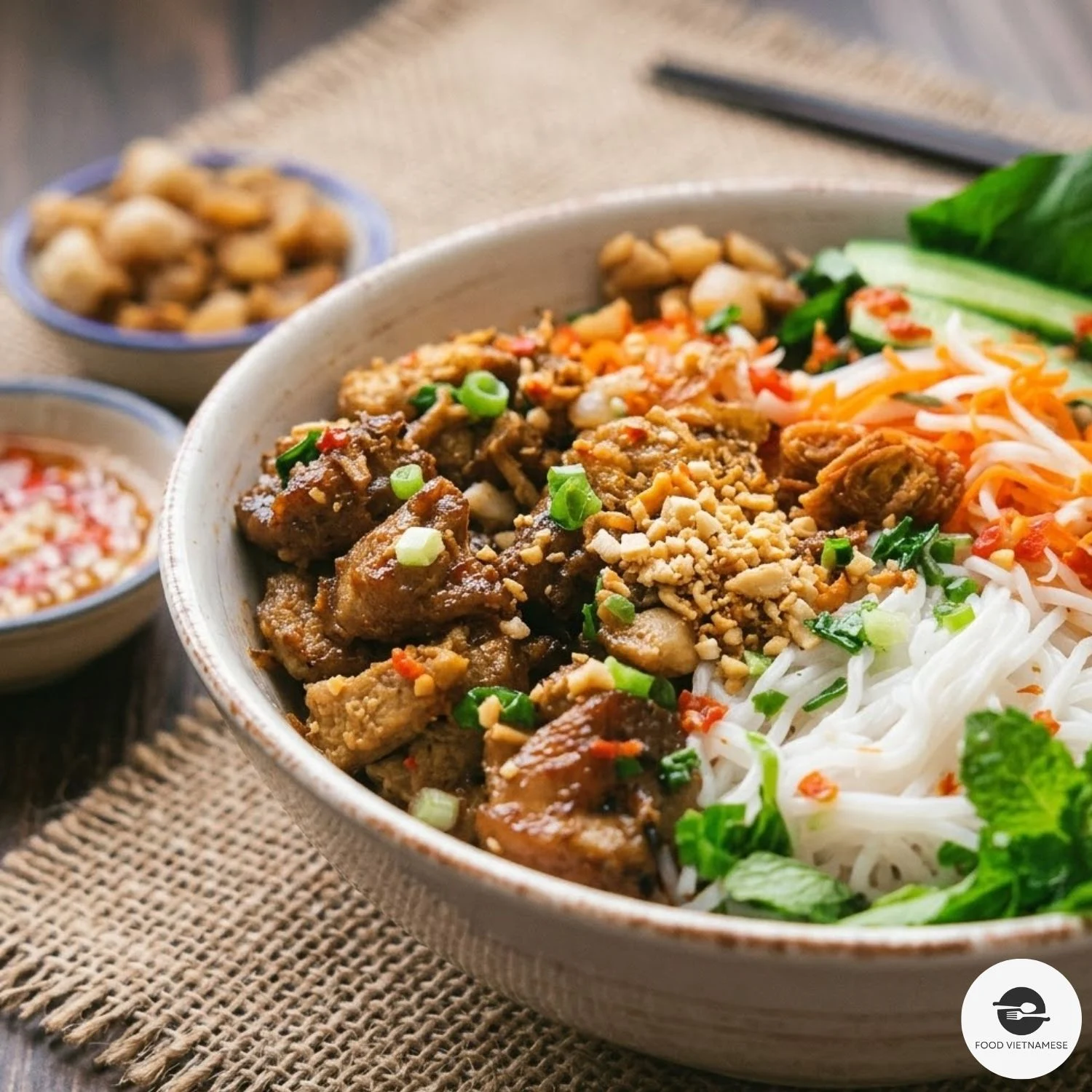
Bun Thit Nuong is a Vietnamese grilled pork noodle salad — cold rice vermicelli piled with lemongrass-marinated grilled pork, fresh herbs, lettuce, bean sprouts, pickled carrot and daikon, crushed peanuts, and a generous pour of nuoc cham. The first thing to understand about it is what it isn’t: despite the word “bún” putting it in the same family as Pho or Bun Bo Hue in a visitor’s mind, there’s no broth here at all. It’s served cold or at room temperature, placing it in a distinct category Vietnamese cooks call bún trộn — tossed or mixed noodle dishes — as opposed to the soup-based bún nước most people picture when they hear “bún.” It originated in Southern Vietnam and remains one of the most commonly ordered bún dishes there.
Why This Counts as a Salad, Not a Soup
The distinction matters more than it might seem. Vietnam’s noodle dishes split broadly into two families: bún nước, built around a simmered broth, and bún trộn, built around a dressing poured over cold or room-temperature components. Bun Thit Nuong sits firmly in the second category — every element goes into the bowl already prepared and cooled, then gets tossed together at the table with nuoc cham rather than submerged in hot liquid. That structure is why English-language sources consistently land on “noodle salad” as the most accurate translation rather than “noodle soup,” even though the Vietnamese name gives no direct hint of the distinction on its own.
The Marinade That Defines the Flavor
Lemongrass is the ingredient that separates Bun Thit Nuong’s pork from nearly every other grilled pork preparation in Vietnamese cuisine. Thin pork slices marinate in a mixture built on fish sauce, sugar, minced lemongrass, garlic, shallots, and black pepper — with honey or brown sugar frequently added specifically to help the pork caramelize and char at the edges once it hits the grill. That caramelization is not incidental; the slightly blackened, sticky edges on well-made thit nuong are part of what diners are looking for, and a marinade without any sugar component tends to produce paler, less complex-tasting pork.
The choice of cut matters as much as the marinade. Pork shoulder (sometimes called pork butt) or pork belly are the standard picks, sliced thin against the grain. Lean cuts like tenderloin are generally avoided in traditional recipes — without enough fat marbling, the meat dries out and toughens under the high, direct heat that gives grilled pork its char.
What Goes Into a Bowl of Bun Thit Nuong
| Component | Description | Role |
|---|---|---|
| Grilled pork (thịt nướng) | Thin-sliced pork shoulder or belly, marinated in lemongrass, fish sauce, sugar, garlic, and black pepper, grilled — traditionally over charcoal | The centerpiece; smoky char and caramelized edges are the flavor signature of the dish |
| Rice vermicelli (bún) | Thin rice noodles, boiled and served cold or at room temperature | The base layer — chosen thin so it absorbs the nuoc cham without becoming heavy |
| Fresh herbs and lettuce | Shredded lettuce, mint, Thai basil, perilla (tía tô), sometimes fish mint or Vietnamese balm | Layered generously — this is what earns the dish its “salad” description as much as anything else in the bowl |
| Bean sprouts and cucumber | Raw, added fresh | Adds crunch and moisture against the richer grilled pork |
| Pickled carrot and daikon (đồ chua) | Julienned, quick-pickled in vinegar and sugar | Cuts through the richness of the pork and peanuts with acidity |
| Crushed roasted peanuts | Sprinkled on top | Textural contrast — one of the few crunchy, dry elements in an otherwise wet dish |
| Scallion oil (mỡ hành) | Scallions cooked briefly in hot oil | Drizzled over the top for aroma and a glossy finish, common in fuller versions |
| Nuoc cham | Fish sauce, sugar, water, lime juice, garlic, chili | Poured generously over the entire bowl just before eating — the element that actually “dresses” the salad |
Bun Thit Nuong vs. Bun Cha: Two Grilled Pork Dishes, Two Different Formats
Visitors who’ve tried both often assume they’re variations of the same idea — grilled pork, rice vermicelli, herbs — and structurally that’s not wrong. But the two dishes come from different regions and are built around entirely different eating mechanics.
| Feature | Bun Thit Nuong (South) | Bun Cha (Hanoi / North) |
|---|---|---|
| Format | Assembled bowl — everything combined, nuoc cham poured over | Deconstructed — warm dipping broth with pork submerged, noodles on a separate plate |
| Marinade | Lemongrass-forward: fish sauce, sugar, lemongrass, garlic, pepper | Fish sauce, sugar, shallot, garlic, pepper — no lemongrass |
| Pork cut | Thin-sliced shoulder or belly | Minced pork patties (chả viên) plus sliced pork belly (chả miếng) |
| Sauce temperature | Room temperature nuoc cham | Warm dipping broth |
| Eating method | Toss and eat directly from the bowl | Dip noodles and herbs into the broth bowl bite by bite |
For the full breakdown of Bun Cha’s charcoal-grilling technique, its distinct dipping broth, and the Obama-Bourdain story that made it internationally famous, see Bun Cha: Hanoi’s Charcoal-Grilled Pork Noodle Dish.
Common Additions and Variations
The most frequent add-on by far is chả giò — crispy fried spring rolls, dropped whole or sliced into the bowl alongside the grilled pork. The combination appears so often on menus that it has its own name, Bun Thit Nuong Cha Gio, and many Vietnamese diners order it as the default rather than the exception. A chicken version, Bun Ga Nuong, follows the same construction with grilled lemongrass chicken in place of pork, and a vegetarian version substitutes grilled tofu or mushrooms for the meat while keeping the rest of the bowl intact.
For readers curious about how chả giò itself is made and how it compares to Vietnam’s fresh (unfried) spring rolls, see Spring Roll vs. Egg Roll.
Bun Thit Nuong Calories and Nutrition
| Nutrient | Per Bowl |
|---|---|
| Calories | 451 kcal |
| Protein | 14.7g |
Because the dish skips fried batter and heavy broth in favor of grilled meat and a large volume of raw vegetables, it tends to sit in a moderate calorie range compared to Vietnam’s richer noodle soups. The biggest variables are how much nuoc cham gets poured on (sugar and sodium both scale with quantity), whether chả giò is added, and how generously peanuts and scallion oil are used. Ordering the sauce on the side is the simplest way to control both sugar and sodium intake without changing anything else about the bowl.
Watching the Char Happen
A vendor near a market in District 10 let me stand close enough to the grill to feel the heat while she worked through a tray of marinated pork slices, flipping each piece exactly once, timing it by sound rather than a clock — she said the sizzle changes pitch right before it’s ready to turn. The edges she pulled off were nearly black in spots, sticky from the sugar in the marinade, and she waved off my instinct to call that burnt. “Cháy vậy mới ngon,” she said — that’s the char that makes it good. She was right; the blackened bits turned out to be the best part of the bowl, not a flaw in it.
Frequently Asked Questions
What is Bun Thit Nuong?
A Vietnamese grilled pork noodle salad — cold rice vermicelli topped with lemongrass-marinated grilled pork, fresh herbs, pickled vegetables, peanuts, and nuoc cham. Served cold or room temperature, not as a soup. Originated in Southern Vietnam.
What cut of pork is used for Bun Thit Nuong?
Pork shoulder or pork belly, sliced thin. Lean cuts like tenderloin are avoided because they dry out and toughen on the grill without enough fat to stay juicy.
What is the difference between Bun Thit Nuong and Bun Cha?
Bun Thit Nuong is an assembled cold bowl from Southern Vietnam with lemongrass-marinated sliced pork and nuoc cham poured over. Bun Cha is a Hanoi dish served deconstructed, with warm broth for dipping and no lemongrass in the marinade.
How many calories are in Bun Thit Nuong?
Approximately 451 kcal with 14.7g protein per bowl. Adding chả giò (fried spring rolls) increases both calories and fat.
Is Bun Thit Nuong a healthy option?
Relatively, yes — grilled protein, no fried batter, and a large proportion of raw vegetables and herbs. Around 451 kcal per bowl is moderate; requesting nuoc cham on the side helps control sugar and sodium.
Sources & References
- Wikipedia – Bún thịt nướng. en.wikipedia.org/wiki/B%C3%BAn_th%E1%BB%8Bt_n%C6%B0%E1%BB%9Bng
- What to Cook Today – Bun Thit Nuong (Vietnamese Grilled Pork Rice Vermicelli Noodles). whattocooktoday.com
- Cooking Therapy – Authentic Bun Thit Nuong (Vietnamese Grilled Pork Vermicelli Bowls). cooking-therapy.com
- RecipeTin Eats – Vietnamese Lemongrass Pork Noodle Bowls (Bun Thit Nuong). recipetineats.com
- Wok and Kin – Bún Thịt Nướng (Grilled Pork Noodle Salad). wokandkin.com
- Grooviet – Bun Thit Nuong: The Essential Guide to Vietnam’s Ultimate Noodle Salad. grooviet.com

Related articles
Vietnamese Hot Pot (Lẩu): Types, How to Eat, Dipping Sauces
Vietnamese hot pot (lẩu) is a pot of seasoned broth kept simmering at the table, where diners cook…
Is Vietnamese Food Spicy? Only If You Ask It to Be
Is Vietnamese food spicy? Not by default — most of the country’s best-known dishes, from phở to bánh…
Is Vietnamese Food Halal? What the Cham Community Knows
Is Vietnamese food halal? Not by default — pork shows up across the cuisine, from bánh mì pate…