Table of contents
- What Is Cao Lau?
- The Ba Le Well Legend — And What’s Actually True
- Where the Name “Cao Lau” Comes From
- How Cao Lau Noodles Are Actually Made
- What Goes Into a Bowl of Cao Lau
- Cao Lau vs. Mi Quang vs. Pho: Three Distinct Bowls
- A Trading Port’s Fingerprint on a Bowl of Noodles
- A Morning at the Noodle Workshop
- Anthony Bourdain’s Bowl of Cao Lau
- Cao Lau Calories and Nutrition
- Where to Eat Cao Lau in Hoi An
- Frequently Asked Questions
- Sources & References
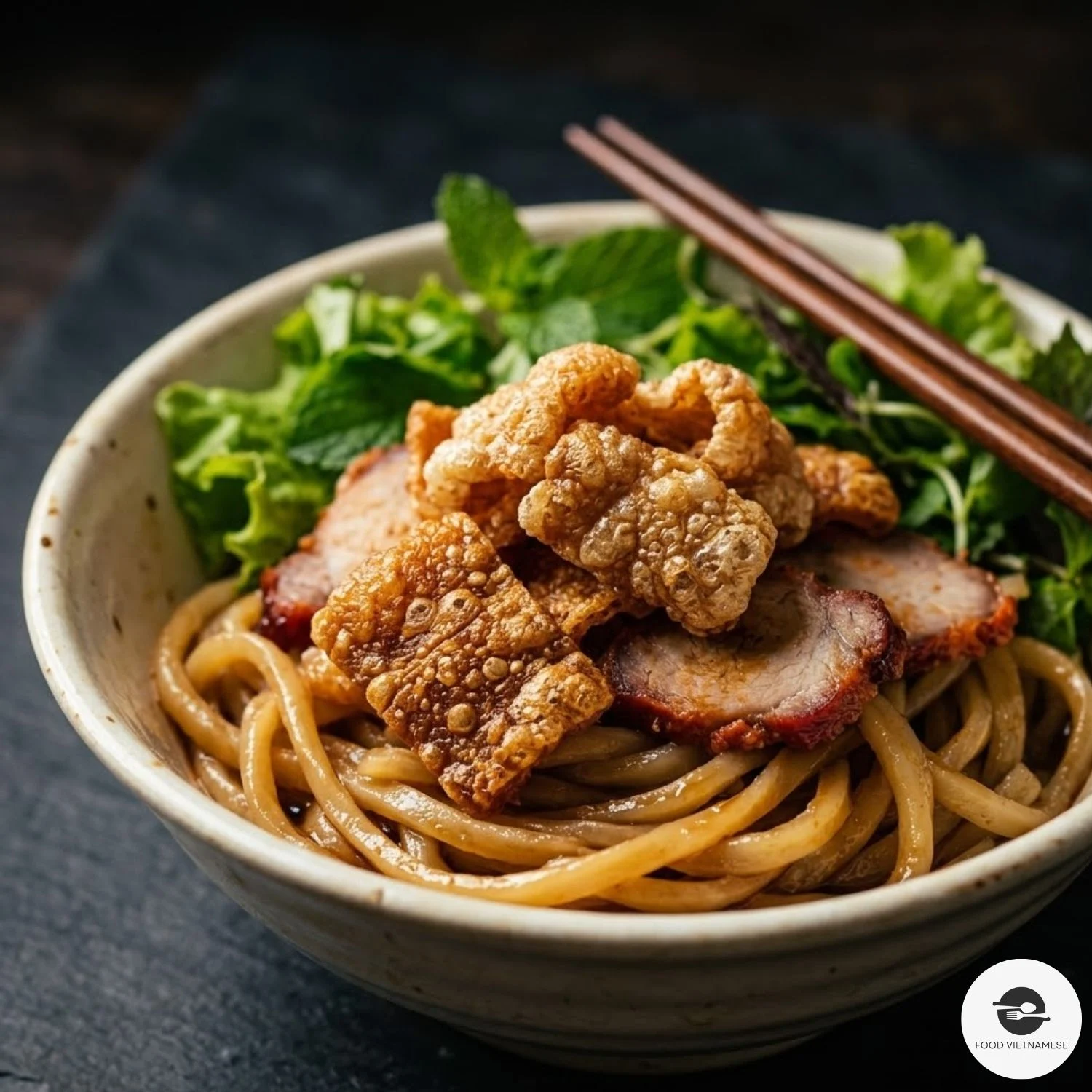
Cao Lau is a noodle dish found exclusively in Hoi An, Central Vietnam — thick, chewy rice noodles with a faint smoky flavor and pale golden-brown color, topped with sliced char siu-style pork, crispy pork crackling, bean sprouts, local herbs, and crunchy fried noodle croutons, finished with just a spoonful of concentrated pork broth rather than a full soup. What makes Cao Lau genuinely unusual among Vietnamese noodle dishes is a widely repeated claim that it can only be made using water from one specific well in Hoi An’s old quarter, combined with ash from a tree grown on an offshore island. Part of that claim holds up to scrutiny; part of it is town folklore that has outgrown the facts. Either way, the dish that results is, as The Guardian once put it, “the history of the city in a bowl.”
What Is Cao Lau?
Set a bowl of Cao Lau next to Pho or Bun Bo Hue and the first thing you’ll notice is what’s missing: broth. Where most Vietnamese noodle dishes are built around a generous, simmered liquid, Cao Lau gets only a spoonful — just enough pork stock to moisten the noodles and round out the flavor, never enough to make it a soup. Bean sprouts sit at the bottom of the bowl, blanched but still faintly crisp. The noodles go on top: thick, chewy, faintly smoky, somewhere in texture between Japanese udon and Chinese alkaline noodles, though made entirely from rice. Sliced char siu pork, crispy pork crackling, torn herbs from the nearby Tra Que vegetable village, and crumbled fried rice-dough croutons finish the bowl. A wedge of lime and Hoi An’s own fiery chili jam go in at the table, and everything is mixed by hand before the first bite.
The Ba Le Well Legend — And What’s Actually True
Every guidebook entry on Cao Lau repeats some version of the same story: the noodles can only be made with water from the Ba Le well, a centuries-old well tucked into an alley in Hoi An’s old quarter, combined with lye ash from a tree that grows only on Cu Lao Cham, an island roughly 13 miles offshore. The recipe, the story goes, is a closely guarded secret known to only one family.
Some of that is accurate. Ba Le well water does have a documented mild alkalinity, and noodle makers in Hoi An have relied on it for generations, believing it essential to the noodles’ chewy texture and golden hue. The ash — a genuine source of lye, chemically similar to the alkaline solutions used in Chinese wheat noodles and Japanese ramen — really is sourced from wood grown on Cu Lao Cham, now a UNESCO-designated biosphere reserve since 2009.
But the “one secret family” part of the story doesn’t hold up as cleanly. Atlas Obscura’s reporting on the dish found that at least one long-running noodle-making family in Hoi An stopped drawing water from Ba Le well years ago — they now use their own well, which they say produces water with comparable mineral properties, and no longer source ash specifically from Cu Lao Cham, using the same tree species grown elsewhere instead. Travel writer Lara Dunston, who spent months living in Hoi An interviewing noodle producers directly for Grantourismo, went further, describing the “secretive single family” framing common in guidebooks as embellished well past the facts — she found multiple family-run noodle workshops operating in plain sight, willing to explain their process to anyone who asked.
What this means in practice: The dish’s dependence on hyper-local water and ash is real and well-documented — that part of Cao Lau’s mystique isn’t exaggerated. What’s overstated is the idea of a single, secretive source. Several Hoi An families produce Cao Lau noodles using closely related methods and comparably mineral-rich local water, which is precisely why the dish still cannot be authentically replicated outside the town, even if no single well holds an absolute monopoly on it.
Where the Name “Cao Lau” Comes From
The most commonly cited explanation ties the name to Hoi An’s old architecture. In the town’s trading heyday, noodle shops and eateries were often built along the river on stilts or elevated foundations, with the dining area on an upper floor above street or water level. Diners would climb a set of stairs to eat while watching boats pass beneath them. “Cao lầu” translates roughly to “high floor” or “tall building,” and over time the elevated dining rooms became so associated with the noodle dish served in them that the name transferred to the food itself.
A second, less common theory connects the name to an aspect of the noodle-making process itself, though this explanation is less consistently documented across sources than the “high floor” story.
How Cao Lau Noodles Are Actually Made
The technical process explains why the dish resists replication even when the well-and-ash story gets simplified into folklore. Local rice — never old or stale grain — is soaked in water treated with wood ash, a solution known in Vietnamese as nước tro, or lye water. This is the same category of alkaline treatment used to make Chinese wheat noodles chewy and yellow-tinted, and it’s chemically related to the kansui used in Japanese ramen. The difference is that Cao Lau applies this technique to rice rather than wheat — an adaptation unique to Hoi An.
The soaked rice is ground into flour, kneaded into a dense dough, rolled into thin sheets, and steamed. Once cooked, the sheets are cut into individual noodle strands. The alkaline treatment is what gives the finished noodles their pale golden-brown color, their firm chew, and a faint smoky note that plain rice noodles never develop. Traditional producers in Hoi An still make the noodles almost entirely by hand, often working through the night to have fresh noodles ready for the morning market.
What Goes Into a Bowl of Cao Lau
| Component | Description | Role in the Dish |
|---|---|---|
| Cao Lau noodles | Thick, round, chewy rice noodles, pale golden-brown, made with lye-treated local rice and well water | The defining element — cannot be substituted with any other noodle type without losing the dish’s identity |
| Char siu-style pork (xá xíu) | Pork loin or belly, marinated and roasted with a five-spice profile, sliced thin | The primary protein, adding sweetness and char to balance the noodles’ smoky note |
| Pork crackling (tóp mỡ) | Fried pork skin, crisp and golden | Adds textural contrast and richness |
| Fried noodle croutons | Small squares of the same noodle dough, deep-fried until crisp | A unique textural signature — no other Vietnamese noodle dish tops itself with fried pieces of its own noodles |
| Bean sprouts | Lightly blanched, kept crisp | Placed at the bottom of the bowl, beneath the noodles |
| Fresh herbs | Mint, Vietnamese coriander (rau răm), fish mint, sourced largely from the nearby Tra Que herb village | Provides the dish’s brightness against the rich pork and smoky noodles |
| Concentrated pork broth | A small amount, ladled over just before serving | Moistens the noodles and unifies the flavors — never enough to make the dish soupy |
| Lime and chili jam | Served on the side | Added and mixed in by the diner; Hoi An’s chili jam is notably fiery compared to standard Vietnamese chili sauce |
Cao Lau vs. Mi Quang vs. Pho: Three Distinct Bowls
All three are considered essential Vietnamese noodle dishes, and Cao Lau in particular is routinely confused with Mi Quang by visitors passing through the same Quang Nam and Da Nang region. The two share a home territory but almost nothing else.
| Feature | Cao Lau | Mi Quang | Pho |
|---|---|---|---|
| Noodle shape | Thick, round, chewy | Wide, flat, turmeric-yellow | Thin, flat, white |
| Noodle base | Rice, treated with lye ash water | Rice, colored with turmeric | Rice, untreated |
| Broth | A spoonful — almost dry | Small amount, coats the noodles | Generous — a true soup |
| Typical protein | Char siu pork, almost exclusively | Pork, shrimp, chicken, fish, frog — highly variable | Beef or chicken |
| Signature crunch | Fried noodle-dough croutons | Grilled rice cracker, crumbled in | None |
| Geographic availability | Hoi An only | Quang Nam / Da Nang region-wide | Nationwide, originating Nam Dinh / Hanoi |
For a full breakdown of Mi Quang’s ingredients, regional variations, and the reason behind its own name puzzle, see Mi Quang: The Noodle Dish Named After Wheat That’s Made From Rice.
A Trading Port’s Fingerprint on a Bowl of Noodles
Cao Lau’s layered identity traces directly back to Hoi An’s role as one of Southeast Asia’s busiest international trading ports from the 15th through the 19th centuries. Chinese and Japanese merchants settled in the town in large numbers, many marrying into local families to solidify trading relationships, and both communities left identifiable marks on Hoi An’s food. The dish’s thick, chewy noodle texture invites comparison to Japanese udon; the char siu pork preparation and the lye-treatment technique both point toward Chinese culinary influence. Vietnamnomad and other sources trace the dish’s likely emergence to the 17th century, during the height of this cross-cultural exchange, though the noodle-making technique as currently practiced likely solidified later, with some sources tracing specific family noodle-making lineages back to the late 19th century.
Hoi An’s Ancient Town — canals, Chinese shophouses, French colonial facades, and the covered Japanese Bridge among them — was inscribed as a UNESCO World Heritage Site in 1999, formal recognition of exactly the kind of layered trading history that produced dishes like Cao Lau in the first place.
A Morning at the Noodle Workshop
I got to watch a batch of Cao Lau noodles being made at around five in the morning, in a narrow kitchen behind a house not far from the old market. The woman kneading the dough had flour dust up to her elbows and didn’t look up when I walked in — her husband, tending the fire under a huge steamer, was the one who explained what was happening. The room smelled like burnt wood before it smelled like food, and the noodle sheets came off the steamer in long, slightly translucent layers that got cut into strips right there on the table. I asked whether the water really came from a specific well. He shrugged and said their family used their own well now, had for years, and the taste hadn’t changed that anyone could tell. It wasn’t the answer the guidebooks promise, but it matched what I’d heard from two other noodle makers earlier that week — the story is more flexible than the legend lets on, and the flavor is what actually stayed consistent.
Anthony Bourdain’s Bowl of Cao Lau
In 2009, during the filming of No Reservations Season 5, Anthony Bourdain sat down at a stall called Hai Chien Cao Lau inside Hoi An’s central market — vendor stall E034, still open today — and ate Cao Lau for breakfast with his travel companion Philippe Lajaunie. He followed it immediately with a Banh Mi from Banh Mi Phuong, later remarking that the combined meal was “a reasonably sized, fully satisfying breakfast” and adding, dryly, that under ordinary circumstances it would have been more than enough. The episode remains one of the most-cited pieces of English-language media coverage of the dish, and the stall he visited is still a regular stop on Hoi An food tours nearly two decades later.
Cao Lau Calories and Nutrition
Published calorie counts for Cao Lau vary widely depending on the amount of pork, crackling, and frying oil used — a pattern consistent with most Vietnamese noodle dishes that lack a single standardized recipe.
| Source / Version | Calories | Protein | Fat | Carbs |
|---|---|---|---|---|
| Street-food bowl (estimated, standard portion) | ~350–550 kcal | ~15–20g | ~12–18g | ~45–55g |
| Home recipe, lighter version (Mate Food Recipes) | 350 kcal | — | — | — |
| Home recipe, generous pork and crackling (DelishGlobe) | 843 kcal | 18g | 70g | 37g |
Values vary significantly by recipe and portion. Home recipes that include substantial pork crackling and frying oil skew considerably higher than a typical Hoi An street-food serving. Sources: SnapCalorie, Mate Food Recipes, DelishGlobe recipe nutrition data.
Where to Eat Cao Lau in Hoi An
| Location | Address / Area | Known For |
|---|---|---|
| Hai Chien Cao Lau | Stall E034, Hoi An Central Market | Where Anthony Bourdain ate Cao Lau on camera in 2009; still operating in the same market stall |
| Ty Cao Lau | Laneway stall off Phan Chu Trinh Street, opens 4:30pm daily | Run by Mr. Ty for over 20 years, specializing exclusively in Cao Lau; noted for richly flavored pork slices |
| Hai Restaurant | 6A Truong Minh Luong, off Phan Boi Chau Street | Family-home eatery open 11am until the noodles sell out; thinner, succulent pork slices |
| Ms. Ly Cafe | 22 Nguyen Hue Street | Air-conditioned sit-down option, family-run, serves refined versions of several Hoi An classics |
Hoi An’s other essential noodle specialty, Mi Quang, is available at shops throughout the same old town district — see where to eat Mi Quang for a comparable list. Visitors pairing Cao Lau with Hoi An’s famous baguette can also check Banh Mi calories and nutrition before ordering both in one sitting, as Bourdain did.
Frequently Asked Questions
What is Cao Lau?
Cao Lau is a noodle dish unique to Hoi An, made from thick, chewy rice noodles with a faint smoky flavor, topped with char siu pork, pork crackling, herbs, and fried noodle croutons, finished with just a spoonful of concentrated broth rather than a full soup.
Is it true Cao Lau can only be made with water from one well in Hoi An?
Partly. Ba Le well water has genuinely been used for generations and is believed to affect the noodles’ texture, but reporting from noodle-making families shows at least one long-running producer now uses their own well with comparable mineral properties. The “single secretive well and family” framing is more folklore than fact, though the dish’s dependence on hyper-local water and ash remains real.
What is the difference between Cao Lau and Mi Quang?
Cao Lau uses thick, round, chewy noodles found only in Hoi An, with almost no broth and char siu pork. Mi Quang uses wide, flat, turmeric-yellow noodles found throughout Quang Nam and Da Nang, with a small amount of broth and variable protein choices. They come from overlapping regions but are structurally distinct dishes.
How many calories are in Cao Lau?
A standard street-food bowl contains approximately 350–550 calories. Home recipes with generous pork crackling and frying oil can range up to 750–850 calories, depending on portion and preparation.
Did Anthony Bourdain eat Cao Lau?
Yes — in 2009, during No Reservations Season 5, Bourdain ate Cao Lau at Hai Chien Cao Lau, a stall inside Hoi An’s central market, followed by a Banh Mi from Banh Mi Phuong. The stall is still open today.
Sources & References
- Atlas Obscura / Gastro Obscura – Cao Lầu: Local Well Water Is the Secret to Hội An’s Signature Noodles. atlasobscura.com
- Grantourismo Travels – Cao Lau, the Legendary Noodles of Hoi An in Central Vietnam, Lara Dunston. grantourismotravels.com
- Vietnamnomad – Cao Lau: A Guide to the Unique Dish of Hoi An’s Heritage. vietnamnomad.com
- Nghe Prana Hoi An Riverside Hotel – The Story of Cao Lầu — Why It Only Works in Hội An. nghevilla.com
- VnExpress International – How to Make Hoi An Thick Noodles Cao Lau, citing The Guardian’s description of the dish. e.vnexpress.net
- UNESCO World Heritage Centre – Hoi An Ancient Town, inscription 1999 (ref. C 948)
- UNESCO Man and the Biosphere Programme – Cu Lao Cham – Hoi An Biosphere Reserve, designated 2009
- Eat Like Bourdain – Anthony Bourdain in Hội An: 3 Spots Where Tony Ate. eatlikebourdain.com
- Continents & Condiments – Anthony Bourdain Vietnam: The Restaurants on No Reservations. continentscondiments.com
- SnapCalorie, Mate Food Recipes, DelishGlobe – nutrition data for Cao Lau recipes

Related articles
Bun Thit Nuong: Vietnam’s Grilled Pork Noodle Salad, Not a Soup
Bun Thit Nuong is a Vietnamese grilled pork noodle salad — cold rice vermicelli piled with lemongrass-marinated grilled…
Best Vietnam Food: 15 Must-Try Dishes
Best Vietnam food is defined by one core principle: maximum flavor from the freshest possible ingredients. Vietnamese cuisine balances…
Vietnamese Hot Pot (Lẩu): Types, How to Eat, Dipping Sauces
Vietnamese hot pot (lẩu) is a pot of seasoned broth kept simmering at the table, where diners cook…