Table of contents
- What Is Sup Luon Nghe An?
- The CNN Story Behind Sup Luon
- Field Eel and Hanh Tam – The Two Ingredients That Define the Region
- The Bamboo-Splint Technique – A Detail Few Outsiders Notice
- Full Ingredient List
- How It’s Made
- Flavour and Texture Profile
- Comparing Nghe An’s Three Eel Specialties
- How to Eat It
- Where to Eat Sup Luon
- Price Reference
- Nutritional Value
- Frequently Asked Questions
- Conclusion
I – Kelly Thuy – arrived in Vinh City on a chilly morning, steam still rising off the pots of eel soup lining Tran Hung Dao Street. The shop owner had been selling there for more than forty years, hands moving fast, separating eel meat with a thinly whittled bamboo strip instead of a knife. I asked why not just use a knife, faster surely. She answered simply: “Metal makes the eel fishier. Bamboo doesn’t.” My first spoonful confirmed it — the warmth of turmeric meeting the sharp, distinctive fragrance of hanh tam, a mild heat building slowly. I understood immediately why a CNN film crew chose this exact city to shoot their breakfast segment.
— Kelly Thuy
What Is Sup Luon Nghe An?
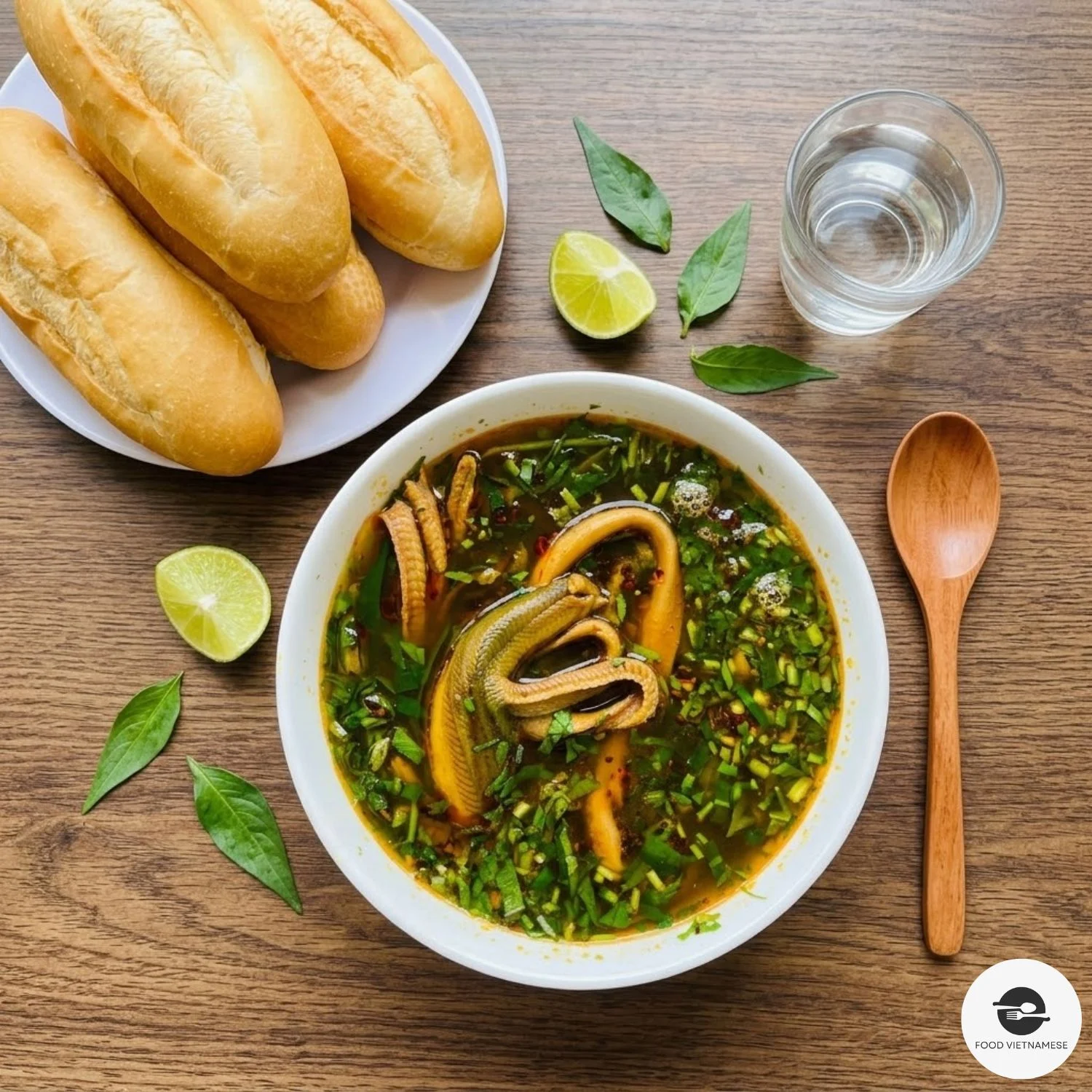
Sup luon is woven into daily life in Vinh City and the wider Nghe An region. Unlike eel dishes found elsewhere in Vietnam, sup luon carries a very specific seasoning signature — turmeric, galangal, fermented rice, and above all hanh tam — that produces a flavour profile found nowhere else in the country.
| Quick Facts | Details |
|---|---|
| Vietnamese name | Súp lươn Nghệ An |
| English name | Sup Luon Nghe An – Vietnam’s CNN-Featured Spicy Eel Soup |
| Region | North Central Coast (Bắc Trung Bộ) – Nghe An province, centred on Vinh City |
| Main ingredients | Field eel, fresh turmeric, galangal, fermented rice, hanh tam (shallot chives) |
| Signature technique | Eel meat separated from bone with a bamboo splint, not a knife |
| Served with | Fried bread, banh muot, rice crackers or fried dough sticks; topped with Vietnamese coriander, spring onion, pepper |
| International recognition | CNN Great Big Story – Top 7 unique breakfasts around the world (2020) |
| Where to eat | Vinh City – Tran Hung Dao Street, Cua Nam area, Doc Thiet Street |
The CNN Story Behind Sup Luon
In August 2020, Great Big Story — CNN’s video production unit — published “What Breakfast Is Like Around the World,” in which senior producer Beryl Shereshewsky made wake-up calls to seven people in seven countries to find out what they eat to start the day. Among the dishes featured: Vietnam’s súp lu’o’n, a spicy eel soup. Sup luon Nghe An was Vietnam’s sole representative in the segment, standing alongside mandazi (Kenyan fried dough) and a plate of catfish and grits from the United States.
The woman featured in the video, Thuy, runs an eel soup shop in Vinh and had to wake in the early hours of the morning to start the broth. To make the dish more flavourful, she typically adds chopped vegetables and eel, along with spices, to the simmering pot — with chives coming through distinctly in her version of the recipe. This wasn’t a random selection: sup luon has long been the dish visitors to Vinh are told they must try, and even in Hanoi, shops serving Nghe An-style eel soup draw crowds of homesick Nghe An natives seeking a taste of home.
The Thuy featured in the CNN segment is a different person from this article’s author (Kelly Thuy) — a coincidence of a common Vietnamese given name, not a family connection.
Field Eel and Hanh Tam – The Two Ingredients That Define the Region
Field eel, not farmed eel
Experienced eaters in Vinh distinguish carefully between field eel and farmed eel. Field eel — caught in paddies, streams and natural waterways — has firmer flesh and noticeably deeper flavour than industrially farmed eel. Preparing field eel is also more elaborate, done specifically to preserve its flavour and nutritional value. The eel is thoroughly cleaned to remove all slime, boiled until cooked, then the meat is separated from the bone — the bones themselves later simmered to produce a naturally sweet broth.
Hanh tam – A seasoning unique to Nghe An
A key ingredient is shallots — a type of onion found only in Nghe An and Ha Tinh — which enhance the aroma of the eel and create a spicy kick for the soup. This is hanh tam (also called cu nen): a small, intensely aromatic onion variety that is almost impossible to find used at this scale anywhere outside these two provinces. It gives sup luon its sharp, distinctive fragrance and mild heat, a flavour ordinary shallots or onions simply cannot replicate. Without hanh tam, the dish loses its most recognisable regional signature.
The Bamboo-Splint Technique – A Detail Few Outsiders Notice
One technical detail rarely mentioned outside expert circles but taken seriously by long-time Nghe An eel cooks: separating the eel meat from the bone using a bamboo splint (cat tre) — a thin, sharpened strip of bamboo — instead of a standard metal knife. Many experienced artisans even teach their descendants the traditional way of preparing eel using bamboo splints to separate the meat from the bones without a knife, to avoid a fishy taste.
According to technique passed down across generations, metal is believed to react with the eel’s slime and blood in a way that intensifies its fishy smell, while bamboo avoids this reaction entirely. After cleaning, the eel meat is stir-fried with turmeric, chili and ground pepper — with the shallot chives enhancing the aroma and giving the soup its spicy kick.
An eel cook on Tran Hung Dao Street in Vinh told me: “Real field eel has a slim, firm body — never mushy. You stir-fry it by hand, high heat, keep turning so the turmeric and hanh tam soak into every piece. Rush the process and the soup turns fishy right away — regulars can tell in one bite.” That single line explains why a dish this simple in ingredients still takes years of practice to get right.
— Kelly Thuy, field notes, Vinh City, Nghe An
Full Ingredient List
| Ingredient | Role |
|---|---|
| Field eel | Main ingredient — wild-caught preferred, firmer flesh than farmed eel |
| Fresh turmeric | Provides the characteristic golden colour and warm aroma of the broth |
| Galangal | Adds fragrance and helps neutralise the eel’s natural fishiness |
| Fermented rice (mẻ) | Provides a mild sourness, balancing the richness of stir-fried eel |
| Hanh tam (shallot chives) | The defining Nghe An-Ha Tinh seasoning — irreplaceable sharp aroma and mild heat |
| Pork bones | Simmered for hours to create a naturally sweet base broth |
| Vietnamese coriander, spring onion | Fresh garnish added when serving |
| Pepper, chili (to taste) | Adds the characteristic North Central Coast heat |
How It’s Made
Step 1 – Prepare the eel
Clean field eel thoroughly to remove all slime, briefly boil until just cooked. Use a bamboo splint — not a metal knife — to separate the meat from the bone, avoiding a fishy smell. Reserve the bones for the broth.
Step 2 – Simmer the broth
Simmer pork bones (and eel bones) for several hours over low heat to produce a naturally sweet broth. Strain to remove sediment for clarity.
Step 3 – Stir-fry the eel
Stir-fry the separated eel meat over high heat with fresh turmeric, galangal, fermented rice and minced hanh tam. Keep turning so the seasoning penetrates every piece, cooking until the meat firms up.
Step 4 – Combine and finish
Add the stir-fried eel to the broth, season to taste, bring to a gentle simmer to let the flavours meld. The finished broth should have moderate thickness — not as thick as porridge, not as thin as a plain soup.
Step 5 – Serve
Ladle into bowls, top with chopped Vietnamese coriander, spring onion and ground pepper. Serve with hot crispy bread, banh muot, rice crackers or fried dough sticks, depending on preference.
Flavour and Texture Profile
| Layer | Description | Source |
|---|---|---|
| Warm turmeric depth | A warm colour and flavour running through the entire bowl from the first spoonful | Fresh turmeric stir-fried with the eel |
| Sharp hanh tam fragrance | A distinctive sharp aroma and gentle heat unlike any other onion variety | Hanh tam, the Nghe An-Ha Tinh signature seasoning |
| Clean fermented sourness | Balances the richness of the eel, keeping the broth from feeling heavy | Traditional fermented rice (mẻ) |
| Natural sweetness from bone | A steady, foundational sweetness from hours of simmering | Long-simmered pork and eel bones |
| Firm eel texture | Field eel holds a satisfying chew — never mushy, never fishy | Correctly stir-fried field eel |
| North Central Coast heat | A characteristic spiciness of the region, adjustable to taste | Pepper and chili added at serving |
Comparing Nghe An’s Three Eel Specialties
| Dish | Starch component | Eel preparation | Broth texture |
|---|---|---|---|
| Sup luon | None — served with bread/rice rolls separately | Stir-fried with turmeric, galangal, fermented rice, hanh tam | Moderate thickness |
| Chao luon | Rice, simmered into porridge | Stir-fried similarly, then folded into the porridge | Thick, porridge-like |
| Mien luon | Glass noodles (mien) | Typically deep-fried crispy rather than stir-fried soft | Clear, thinner than sup luon |
Chef Quang Dung of the 2024 MICHELIN-selected restaurant Chapter in Hanoi, a long-time fan of eel dishes, describes mien luon specifically as having three distinct versions — soup, dry, and stir-fried — noting: “It’s all in the textures and contrast — the crispness of deep-fried eel, the silky softness of noodles, the gentle sweetness of sprouts, and the aromatic lift of fresh herbs.” The point applies equally to sup luon’s own internal balance of textures, even without noodles in the bowl.
How to Eat It
- Eat it hot in the morning — sup luon is a traditional breakfast dish, best enjoyed steaming hot on a cool morning
- Choose crispy bread for dipping — hot, crispy bread dipped into the sweet, rich broth is the classic pairing
- Try banh muot for something lighter — soft rice rolls suit those who prefer not to eat bread first thing in the morning
- Add extra chili and pepper for more heat — some shops top the bowl with a layer of red chili oil for extra spiciness
- Don’t skip the fresh coriander — it lifts the richness of the eel with a clean, herbal note
Where to Eat Sup Luon
In Vinh City
- Ba Ngo’s shop — 1, Alley 4, Doc Thiet Street — a naturally sweet broth from hours of simmering pork bones, firm eel meat with no fishy smell.
- Sy Binh’s shop — near the stadium, Cua Nam area — operating for nearly 20 years, known for a spicier, deeply seasoned bowl.
- Ba Lan’s shop — 2 Tran Hung Dao Street — a tradition of more than 40 years, spacious and widely featured on food travel sites.
Outside Nghe An
Several authentic Nghe An-style eel soup shops have opened in Hanoi, serving mainly the Nghe An diaspora community seeking a taste of home.
Price Reference
Current reference prices, subject to location and shop.
| Location | Approximate price | Notes |
|---|---|---|
| Local shops in Vinh City | ~25,000–40,000 VND per bowl | Standard bowl with bread or rice rolls |
| Well-established, busy shops | ~35,000–55,000 VND per bowl | Extra eel or toppings on request |
| Nghe An-style shops in Hanoi | ~45,000–70,000 VND per bowl | Higher due to urban operating costs |
Nutritional Value
Estimated based on primary ingredients. No independently verified nutritional analysis of sup luon Nghe An has been published.
| Nutrient | Estimated value / bowl (~350–400ml) |
|---|---|
| Energy | ~200–280 kcal (excluding bread or rice rolls served alongside) |
| Protein | ~18–24g (mainly from eel meat) |
| Total fat | ~8–14g (from eel and bone broth) |
| Carbohydrates | ~3–6g (low, as the soup itself contains no starch) |
| From field eel | High-quality protein, vitamin B12, iron, omega-3 fatty acids |
Frequently Asked Questions
What is sup luon Nghe An?
Vinh City’s signature breakfast: field eel separated with a bamboo splint, stir-fried with turmeric, galangal, fermented rice and hanh tam, combined with pork bone broth. Served with bread, rice rolls, rice crackers or fried dough sticks. Featured by CNN’s Great Big Story as one of the world’s Top 7 unique breakfasts in 2020.
How is it different from chao luon and mien luon?
Sup luon has no starch in the bowl itself, served with bread separately. Chao luon simmers eel with rice into thick porridge. Mien luon uses glass noodles with eel typically deep-fried crispy rather than stir-fried.
Why bamboo instead of a knife?
Traditional technique holds that metal reacts with the eel’s slime and blood to intensify fishy odour, while bamboo avoids this, keeping the meat cleaner-tasting.
What is hanh tam?
Also called cu nen — a small, intensely aromatic onion variety found almost exclusively in Nghe An and Ha Tinh. Cannot be substituted with ordinary shallots or onions without losing the dish’s regional identity.
Where to eat the best version in Vinh?
Ba Ngo’s shop (Doc Thiet Street), Sy Binh’s shop (Cua Nam area), and Ba Lan’s shop (Tran Hung Dao, over 40 years) are the three most frequently recommended addresses.
Conclusion
Sup luon Nghe An doesn’t rely on rare ingredients or an elaborate process — field eel, turmeric, hanh tam, and a bone broth simmered long enough. What gives it a distinct identity comes down to details easy to overlook: bamboo instead of a knife, hanh tam instead of ordinary shallots, high heat when stir-frying to keep the eel firm. Simple enough to cook every morning, distinctive enough that an international film crew chose this exact city to document their breakfast segment.
If you find yourself in Nghe An, wake up early and find a shop still steaming. The same devotion to hanh tam and bamboo-splint technique that defines this dish connects it to other North Central Coast specialties too — the charcoal-grilled patience of Thanh Hoa’s cha tom, or further north, the entirely different twenty-ingredient approach to eel found in Hung Yen’s bun thang luon.

Related articles
Banh Khot: Vung Tau’s Crispy-Edged Answer to Banh Xeo
Banh Khot is a Vietnamese mini savory pancake from the coastal city of Vung Tau — a rice…
Cao Lau: The Hoi An Noodle Dish That Cannot Be Made Anywhere Else
Cao Lau is a noodle dish found exclusively in Hoi An, Central Vietnam — thick, chewy rice noodles…
Ga Nuong Song Cau – Where Ordering Chicken Means Pointing at One in the Yard
Ga nuong Song Cau is a specialty of Song Cau town, Phu Yen province: free-range chicken (ideally young,…