Table of contents
- What Is Cha Muc?
- Cuttlefish, Not Just Any Squid
- Hand-Pounding – The Technique That Defines the Dish
- Full Ingredient List
- How It’s Made
- Flavour and Texture Profile
- The Geographical Indication Story
- How to Eat It the Ha Long Way
- Where to Buy Authentic Cha Muc Ha Long
- Price Reference
- Frequently Asked Questions
- Conclusion
I – Kelly Thuy – stood watching a vendor pound cuttlefish in an alley near Bach Dang Theater in Ha Long one early summer morning. The wooden pestle came down on the stone mortar in a steady rhythm, his hand showing no sign of slowing after nearly thirty minutes straight. The shop owner explained: a grinder would do the job in five minutes, but the flesh would turn completely smooth and lose the crunch that makes cha muc what it is. He broke a freshly fried patty in half to show me – still visible inside were thin strands of cuttlefish flesh that hadn’t been fully pounded apart. That, he said, is the real marker of hand-pounded cha muc, unlike the machine-made versions sold everywhere now.
— Kelly Thuy
What Is Cha Muc?
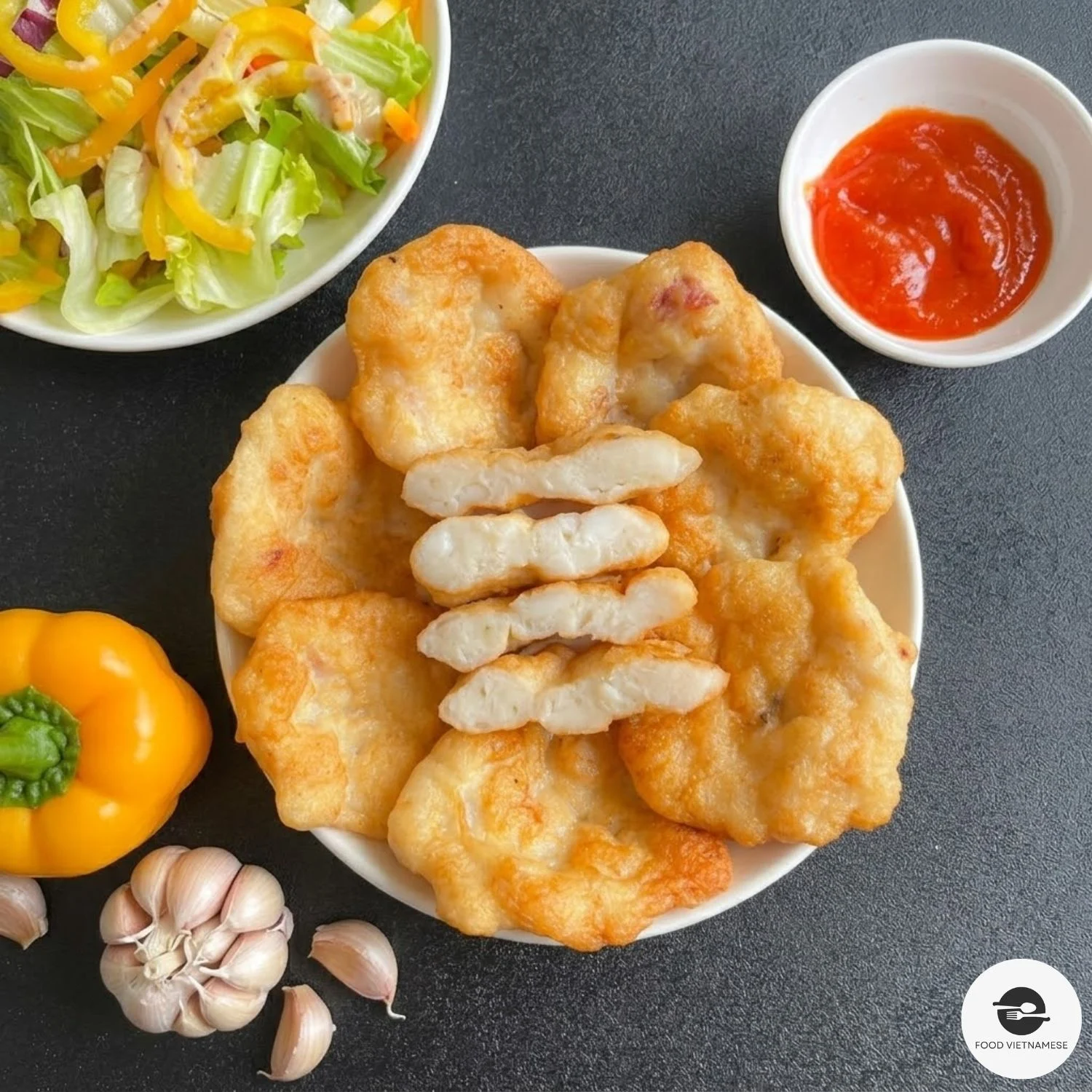
Cha muc is a fried patty made from pounded squid or cuttlefish mixed with seasoning, found in various coastal regions of Vietnam. But cha muc from Ha Long, Quang Ninh, is widely regarded as the definitive version – not because of a complicated recipe, but because of two non-negotiable elements: the specific type of cuttlefish used, and the fact that it is pounded entirely by hand.
| Quick Facts | Details |
|---|---|
| Vietnamese name | Chả mực Quảng Ninh / Chả mực Hạ Long |
| English name | Cha Muc Ha Long – Vietnamese Hand-Pounded Squid (Cuttlefish) Cake |
| Main ingredient | Fresh cuttlefish (muc mai/muc nang), ideally 1.5–2kg |
| Fishing grounds | Ha Long or Van Don waters, Gulf of Tonkin |
| Signature technique | Fully hand-pounded in a stone mortar with a wooden pestle |
| Seasoning | Shallots, garlic, pepper, fish sauce, sometimes pork fat |
| Most famous pairing | Banh cuon cha muc, xoi cha muc, bun cha muc |
| Recognition | Geographical Indication “Ha Long” (12 Dec 2013), Vietnam Top 50 dishes |
| Storage | Refrigerate at 2–8°C, consume within 1 week |
Cuttlefish, Not Just Any Squid
The soul of Ha Long cha muc is decided before the cuttlefish ever touches the mortar. It has to be muc mai (also called muc nang, cuttlefish) – a species with a thick body, firm flesh and distinctive milky-white colour – caught directly from the waters around Ha Long or Van Don in the Gulf of Tonkin. This species thrives in clear seawater with moderate salinity, ideal conditions for developing thick, naturally sweet flesh.
Quảng Ninh’s big cuttlefish, with an average weight of 1.5 to 2kg, is the key ingredient that makes Ha Long cha muc distinct from cha muc made elsewhere. Using other types of squid means producers can’t achieve the necessary stickiness after pounding, and the smell and taste won’t be the same either.
Before pounding, the cuttlefish must be fully cleaned and drained dry. Workers have to make the cuttlefish dry so the cha muc will have the necessary stickiness during the pounding stage – residual moisture makes it difficult to achieve the right texture no matter how thoroughly the pounding is done.
Hand-Pounding – The Technique That Defines the Dish
The phrase repeated most often about Ha Long cha muc is “hand-pounded” (giã tay) – not a marketing slogan but the core technical detail that sets it apart.
When pounding cuttlefish by hand in a heavy stone mortar, the worker uses steady but controlled force – not pounding to the point where the muscle fibres are completely destroyed. This is the critical balance: enough pounding to bind the flesh into a cohesive mass, but not so much that all texture is lost. The hand-pounding method helps retain the characteristic crispness and chewiness that machine-made patties cannot match.
Unlike many industrially ground seafood cakes, traditional Ha Long cha muc stands out specifically for its hand-pounding step. The squid, after cleaning, is pounded in a mortar and seasoned with onion, garlic, pepper, fish sauce and other seasonings to taste. Hand-pounding helps the flesh bind together while still leaving small pieces intact, creating the crunchy, chewy sensation when bitten into.
Once the flesh reaches the right consistency, it’s mixed with minced shallots, garlic, ground pepper and good fish sauce – some family recipes also add a small amount of pork fat for extra richness. One notable detail: many traditional hand-pounding producers deliberately leave out dill from the mixture, preferring to preserve the pure, natural flavour of the fresh cuttlefish rather than let dill’s aroma dominate.
A vendor on Ha Long’s cha muc street told me while still pounding at a steady rhythm: “A grinder looks fast, but hand-pounding is what gives you a patty with ‘skin and meat’ – you bite in and can tell exactly where the strands of squid are and where it’s bound together. A machine turns the flesh to paste, and you stop feeling like you’re eating squid at all.” He kept pounding as he spoke, unbroken, nearly thirty minutes in.
— Kelly Thuy, field notes, Ha Long, Quang Ninh
Full Ingredient List
| Ingredient | Role |
|---|---|
| Fresh cuttlefish (muc mai/muc nang) | The main ingredient – ideally 1.5–2kg, thick body and firm flesh; cannot be substituted with other squid |
| Dried shallots, garlic | Minced, mixed into the pounded flesh for base aroma |
| Ground pepper | Mild heat and characteristic fragrance |
| Good-quality fish sauce | Seasoned to taste, adding savoury depth without masking the squid – see fish sauce vs oyster sauce vs soy sauce if substituting |
| Pork fat (some recipes) | Adds richness; retained in some traditional family recipes |
| Cooking oil | For deep-frying or shallow-frying until golden on both sides |
How It’s Made
Step 1 – Clean the cuttlefish
Clean the cuttlefish thoroughly (remove innards, ink sac, membrane), rinse well, and drain completely dry. Moisture level directly affects how well the flesh binds after pounding.
Step 2 – Hand-pound
Place the cuttlefish in a stone mortar and pound steadily with a wooden pestle until the flesh binds into a cohesive mass while still retaining small unbroken pieces. This is the most labour- and time-intensive step, requiring experience to know exactly when to stop.
Step 3 – Season
Mix the pounded flesh evenly with minced shallots, garlic, ground pepper, fish sauce (and pork fat if following a traditional family recipe). Season to taste without letting the seasoning overpower the cuttlefish’s natural sweetness.
Step 4 – Shape and fry
Shape the mixture into flat round patties of eating size. Deep-fry in hot oil until golden on both sides – crispy outside, still retaining the chewy, springy texture of hand-pounded cuttlefish inside.
Flavour and Texture Profile
| Layer | Description | Source |
|---|---|---|
| Golden crispy exterior | A crunchy fried crust, appealing golden-brown colour | Deep-frying in hot oil |
| Chewy, springy interior | The defining texture – biting in reveals clear strands of cuttlefish flesh alongside softer bound portions | Hand-pounding in a stone mortar |
| Natural cuttlefish sweetness | A clean, mild sweetness typical of fresh cuttlefish, without fishiness | High-quality cuttlefish from Ha Long/Van Don waters |
| Aromatic shallot-garlic-pepper base | Supports rather than overpowers the squid flavour | Shallots, garlic, ground pepper |
| Balanced savouriness | Fish sauce seasoning that rounds out the flavour without excess salt | Good-quality fish sauce, seasoned carefully |
The Geographical Indication Story
On 12 December 2013, Vietnam’s National Office of Intellectual Property granted geographical indication protection under the name “Ha Long” for cha muc – a stronger form of protection than a standard trademark, confirming that the product’s distinctive quality is inherently tied to its specific geographic origin (the waters of Ha Long) and cannot be separated from the natural conditions there.
On the question of when the dish first took its current form, local records commonly cite 1946 as the year the dish emerged with its modern processing method, though other accounts place the tradition of squid-cake making among Quang Ninh’s coastal and mining communities back to the early 20th century, when life was still tough and cuttlefish was an abundant, easily accessible source of food along the coast.
Ha Long cha muc is now ranked among Vietnam’s Top 50 most delicious dishes – recognition not just of flavour but of the dish’s cultural weight tied to the daily lives of fishing communities around the heritage bay.
How to Eat It the Ha Long Way
- Banh cuon cha muc – the most famous pairing: thin, soft steamed rice rolls served with hot, crispy cha muc, dipped in a light fish-sauce dressing
- Xoi cha muc – a quick, filling breakfast: warm sticky rice paired with the crispy edge and savoury seafood flavour of the fried patty
- Bun cha muc – sliced cha muc served with rice vermicelli and dipping sauce or broth
- Straight with plain rice – dipped in peppered fish sauce or chili sauce, to taste
- Eat it hot, right after frying – the crispy exterior and chewy interior are best enjoyed while still warm
Where to Buy Authentic Cha Muc Ha Long
In Ha Long
- The area near Bach Dang Theater, Bach Dang ward, Ha Long City – informally dubbed “Cuttlefish Cake Street” by locals due to its concentration of long-established vendors, some run for three generations.
- Ha Long Market – multiple stalls selling fresh cha muc and vacuum-packed versions for takeaway.
Buying online or as a souvenir
- Look for producers with proper food safety certification and clear traceability labelling.
- Check colour, smell and texture before buying – quality cha muc has a natural ivory-white colour with no off-putting odour.
- Refrigerate at 2–8°C and consume within 1 week for best quality.
- Be wary of prices that seem unusually low relative to the market – this can signal poor-quality squid blends or machine-ground product marketed as hand-pounded.
Price Reference
Current reference prices, subject to seasonal variation and raw cuttlefish costs.
| Type | Approximate price | Notes |
|---|---|---|
| Hand-pounded cha muc in Ha Long | ~350,000–500,000 VND/kg | Significantly pricier than machine-ground due to labour intensity |
| Machine-ground cha muc (mass market) | ~200,000–300,000 VND/kg | Cheaper but lacks the texture and flavour of hand-pounded versions |
| Banh cuon cha muc (restaurant serving) | ~40,000–70,000 VND per portion | Varies by shop and amount of squid cake included |
Frequently Asked Questions
What is cha muc?
A Quang Ninh specialty made from fresh cuttlefish, hand-pounded entirely in a stone mortar, mixed with shallots, garlic, pepper and fish sauce, then shaped and deep-fried golden. Geographical Indication “Ha Long” since 2013, Vietnam Top 50 dishes.
Why hand-pound instead of machine-grind?
Hand-pounding leaves small unbroken pieces within a bound mass, producing a springy, chewy, crunchy texture. Machine grinding pulverises the flesh evenly and generates heat, losing both texture and natural freshness.
What type of squid is used?
Cuttlefish (muc mai/muc nang), ideally 1.5–2kg, caught around Ha Long or Van Don. Smaller squid or other varieties fail to achieve the necessary stickiness and produce a different flavour.
Best way to eat it?
Banh cuon cha muc is the most famous pairing. Also served over sticky rice (xoi cha muc), in noodle soup (bun cha muc), or directly with rice and dipping sauce.
Where to buy authentic cha muc?
The area near Bach Dang Theater in Ha Long City, known as “Cuttlefish Cake Street.” Prioritise producers with food safety certification and clear traceability.
Conclusion
Cha muc Ha Long isn’t complicated in its recipe – shallots, garlic, pepper, fish sauce, that’s essentially it. What sets it apart comes down to two non-negotiable choices: selecting cuttlefish large enough to matter, and pounding it by hand long enough to preserve the crunch that no machine has ever managed to reproduce.
If you find yourself in Ha Long, head to the street near Bach Dang Theater in the morning, while the shops are still pounding. Listen to the wooden pestle hitting stone before you eat your first patty. That’s the clearest way to understand why this dish earned a geographical indication naming it after the heritage bay itself. The same hand-crafted patience defines seafood cooking further down this coastline too – the crab-and-tamarind broth of Hai Phong’s banh da cua, or the twenty-ingredient complexity behind Hung Yen’s bun thang luon.

Related articles
Banh Khot: Vung Tau’s Crispy-Edged Answer to Banh Xeo
Banh Khot is a Vietnamese mini savory pancake from the coastal city of Vung Tau — a rice…
Cao Lau: The Hoi An Noodle Dish That Cannot Be Made Anywhere Else
Cao Lau is a noodle dish found exclusively in Hoi An, Central Vietnam — thick, chewy rice noodles…
Ga Nuong Song Cau – Where Ordering Chicken Means Pointing at One in the Yard
Ga nuong Song Cau is a specialty of Song Cau town, Phu Yen province: free-range chicken (ideally young,…