Table of contents
- What Is Chao Canh Quang Binh?
- Wheat-Flour Noodles – The Core Difference
- The Broth – Flexibility From Shop to Shop
- Ram – The Inseparable Companion
- Full Ingredient List
- How It’s Made
- Flavour and Texture Profile
- Chao Canh vs Other Vietnamese Noodle-in-Broth Dishes
- How to Eat It the Quang Binh Way
- Where to Eat Chao Canh in Dong Hoi
- Price Reference
- Nutritional Value
- Frequently Asked Questions
- Conclusion
I – Kelly Thuy – sat at Me Luoc shop on Ba Trieu Street in Dong Hoi one drizzly winter morning. The owner, in her seventies, was still rolling wheat dough into thin sheets and cutting flat strands by hand — no machine. I asked why it’s called “chao” (porridge) when the bowl in front of me looked nothing like porridge. She laughed: “That’s just the name. This is Quang Binh’s own banh canh. Once you’re used to it, you stop asking.” My first spoonful of broth was clean and sweet from the bones, with a hint of snakehead fish underneath. I bit into the crisp ram beside it and understood immediately why people in Quang Binh treat this simple bowl the way Hanoians treat pho.
— Kelly Thuy
What Is Chao Canh Quang Binh?
Chao canh is the most common breakfast dish in Quang Binh, the North Central Coast province best known internationally for the Phong Nha-Ke Bang cave system. The first question anyone hears the name asks: why call it “chao” (porridge) when the bowl clearly contains distinct noodle strands, nothing like a smooth rice porridge?
| Quick Facts | Details |
|---|---|
| Vietnamese name | Cháo canh |
| English name | Chao Canh Quang Binh – Vietnamese Flat Noodle Soup That Isn’t Actually Porridge |
| Other names | Banh canh, chao mi, chao vat giuong |
| Region | North Central Coast (Bắc Trung Bộ) – Quang Binh province, most concentrated in Dong Hoi City |
| Noodle base | Primarily wheat flour, some recipes blend in rice flour or tapioca starch |
| Broth | Pork bones simmered 1–2 hours, combined with snakehead fish, shrimp, crab or ribs |
| Signature accompaniments | Chopped green mustard greens, crispy fried ram (most famous: ram Ba Don) |
| Recognition | Chao canh ca loc — Vietnam Top 100 Specialty Dishes (2021–2022) |
| Price reference | ~15,000–30,000 VND per bowl |
Wheat-Flour Noodles – The Core Difference
Line chao canh up against Vietnam’s other regional banh canh dishes and the biggest difference shows up immediately in the noodle itself. Southern Vietnamese banh canh commonly uses tapioca starch, producing translucent, round, intensely chewy noodles. Mekong Delta-style banh canh uses pure rice flour. Chao canh Quang Binh, by contrast, uses wheat flour as its primary base — some family recipes blend in a little rice flour or tapioca starch — hand-rolled thin and cut into flat, not round, strands, noticeably smaller and thinner than Southern banh canh, though slightly thicker than pho noodles.
Because it’s made from wheat flour, the finished noodle holds a natural chewy softness with a mild nuttiness, and it absorbs the broth’s sweetness fully without turning mushy or falling apart.
Not all of Quang Binh uses wheat flour, however. In the Bo Trach and Le Thuy districts, some traditional noodle-flour producers — including the Kinh Huong brand, which achieved OCOP 3-star certification — use 100% local rice, with no preservatives. This means chao canh Quang Binh actually runs on two parallel traditions: a wheat-flour version most common in Dong Hoi, and a traditional rice-flour version found in the surrounding districts.
The Broth – Flexibility From Shop to Shop
There’s no single fixed broth recipe for chao canh — this variation is part of what gives the dish its range. The base broth is pork bones simmered 1–2 hours for a clean sweetness, and from there each shop adds its own signature: some are known for snakehead fish, others for fresh shrimp, some combine field crab or small brackish crab for extra depth, and some specialise in oysters (particularly near the town of Quan Hau).
Quang Binh diners tend to favour a richer flavour and a more visually striking colour, so some shops add a touch of turmeric or chili powder for a warmer golden hue. This is why, glancing into a bowl of chao canh, the pale golden colour is immediately recognisable — quite different from the clear broth of pho or the cloudy reddish broth of bun rieu.
The owner at Me Luoc shop told me while still rolling dough: “Good broth comes down to the bones — simmer them long enough, skim the foam evenly, and the broth stays clear but still tastes sweet. The snakehead fish gets boiled separately, and every small bone has to come out carefully so customers can finish the bowl without worry.” That explanation goes a long way toward showing why, despite the simple ingredient list, a properly made bowl of chao canh still takes years of practised skill.
— Kelly Thuy, field notes, Dong Hoi, Quang Binh
Ram – The Inseparable Companion
One of the details that surprises first-time visitors most is the pairing of chao canh with ram — the Central Vietnamese name for crispy fried spring rolls. The two dishes aren’t directly connected in preparation, but the combination has become so ingrained in local food culture that ordering one without the other would seem incomplete.
According to some accounts, this pairing traces back to farmers in areas like My Trach village, who needed a more filling breakfast before a day of physical labour — adding crispy ram alongside a bowl of chao canh that was nutritious but not always substantial enough on its own. The most famous variety served alongside is ram Ba Don — small, tightly rolled, fried in hot oil until the exterior turns shatteringly crisp while the filling stays soft and flavourful.
The typical eating order: bite into the crisp ram first, then sip a spoonful of hot broth, then move on to the noodles and fish. That alternation of crisp-soft-hot is what local diners describe as eating chao canh “the proper Quang Binh way.”
Full Ingredient List
| Ingredient | Role |
|---|---|
| Wheat flour (sometimes blended with rice flour/tapioca) | Forms the flat, hand-cut noodles — the region-defining ingredient |
| Pork bones | Simmered 1–2 hours for a clean, sweet broth base |
| Snakehead fish | Boiled separately, carefully deboned — the most common topping |
| Fresh shrimp | Adds marine sweetness, used in many shops |
| Field crab or small crab | Optional, deepens the broth’s sweetness at some shops |
| Green mustard greens | Chopped and sprinkled on top — a clear point of difference from other regions’ raw herb plates |
| Ram (Central Vietnamese spring rolls) | Crispy fried, the essential accompaniment — most famously ram Ba Don |
| Spring onion, pepper, chili | Finishing seasoning, adjusted to taste |
How It’s Made
Step 1 – Make the noodles
Knead wheat flour (or a blend with rice flour/tapioca according to family recipe) with warm water until smooth and elastic, roll thin, then cut into flat strands of moderate thickness with a knife.
Step 2 – Blanch the noodles separately
Blanch the cut noodles in a separate pot of boiling water until they float, then drain and rinse in cold water to prevent sticking and preserve chewiness.
Step 3 – Simmer the broth
Clean the pork bones thoroughly, simmer over low heat for 1–2 hours, skimming regularly to keep the broth clear. Boil the snakehead fish separately, debone carefully — the fish head and bones can be added to the simmering pot for extra sweetness.
Step 4 – Assemble and serve
Place the blanched noodles in a bowl, arrange snakehead fish, shrimp or chosen toppings on top, ladle hot broth over. Sprinkle with chopped green mustard greens, spring onion and pepper. Serve with a plate of hot, freshly fried ram on the side.
Flavour and Texture Profile
| Layer | Description | Source |
|---|---|---|
| Chewy-soft noodles | The most distinctive texture — chewy without being tough, holding together while fully absorbing the broth | Hand-rolled wheat-flour noodles |
| Clean sweetness from bone broth | A steady, non-aggressive base flavour that needs little extra seasoning | Pork bones simmered the full duration |
| Natural sweetness of fish or shrimp | A river-and-sea flavour layer blended into the broth, varying by shop | Snakehead fish, fresh shrimp |
| Shattering crunch of ram | The perfect textural counterpoint to the soft noodles and hot broth | Freshly fried ram served alongside |
| Fresh sharpness of mustard greens | A slightly peppery freshness that brightens the overall rich flavour | Chopped green mustard greens |
Chao Canh vs Other Vietnamese Noodle-in-Broth Dishes
| Dish | Noodle base | Noodle shape | Herbs served |
|---|---|---|---|
| Chao canh (Quang Binh) | Primarily wheat flour | Flat, hand-cut, small and thin | Chopped green mustard greens |
| Southern banh canh | Tapioca starch | Round, translucent, very chewy | Bean sprouts, herbs, fried dough sticks |
| Mekong Delta banh canh | Pure rice flour | Round, opaque, soft | Mixed fresh herbs |
| Saigon hu tieu | Rice flour | Thin, flat | Bean sprouts, chives, herbs |
Many first-time tasters mistake chao canh for Saigon-style hu tieu since both feature flat noodles in a clear broth — but the two dishes come from entirely different regions, use different noodle flours, and are served with different accompaniments.
How to Eat It the Quang Binh Way
- Eat it for breakfast — chao canh is a traditional morning dish, playing much the same role for Quang Binh residents that pho plays for Hanoians
- Never skip the ram — ordering a side of crispy fried ram is standard, not optional
- Bite the ram before sipping the broth — this creates the crisp-soft-hot alternation locals consider the proper way to eat it
- Add fresh chili or chili sauce — Quang Binh diners generally prefer a mild heat
- Eat it hot, straight away — the noodles clump and lose their chewy texture as they cool
Where to Eat Chao Canh in Dong Hoi
Most frequently recommended shops
- Chao Canh Hem — 38 Nguyen Trai Street — sweet broth from long-simmered bones, combined with shrimp; small chewy noodles.
- Suong Hong shop — fragrant, mildly spicy, richly flavoured broth; offers both rice-flour and wheat-flour noodles by request.
- Me Luoc shop — 30 Ba Trieu Street — a multi-generation family recipe, everything made entirely by hand.
- Cai Ngo shop — known for a precisely balanced wheat-rice flour blend that stays chewy without turning soggy in the broth.
- 22 Nguyen Tri Phuong shop — specialises in chao canh sat, a variant made from ground rice-flour noodles, usually paired with snakehead fish.
Price Reference
Current reference prices, subject to shop and location.
| Context | Approximate price | Notes |
|---|---|---|
| Local shops in Dong Hoi | ~15,000–25,000 VND per bowl | Most common everyday price, aimed at working locals |
| Full-topping bowl (shrimp, fish, ribs) | ~25,000–35,000 VND per bowl | Larger portion, more toppings |
| Ram side plate | ~10,000–20,000 VND per plate | Varies by quantity |
Nutritional Value
Estimated based on primary ingredients. No independently verified nutritional analysis of chao canh Quang Binh has been published.
| Nutrient | Estimated value / bowl (~400–450ml) |
|---|---|
| Energy | ~350–450 kcal (excluding side ram) |
| Protein | ~18–25g (from fish, shrimp, bone broth) |
| Carbohydrates | ~50–60g (from wheat-flour noodles) |
| Total fat | ~8–12g (from bone broth) |
| From snakehead fish/shrimp | High-quality protein, low fat |
Frequently Asked Questions
What is chao canh Quang Binh?
Quang Binh’s signature breakfast: flat, hand-rolled wheat-flour noodles in a pork bone broth with snakehead fish, shrimp or crab, served with green mustard greens and crispy fried ram. Not an actual porridge, despite the name. Chao canh ca loc made Vietnam’s Top 100 Specialty Dishes 2021–2022.
Why is it called “chao” if it isn’t porridge?
The traditional name is genuinely misleading — the dish itself is closer to noodle soup than to ground rice porridge. Some shops call it “banh canh” or “chao vat giuong” to avoid confusion.
How is the noodle different from Southern banh canh?
Chao canh Quang Binh uses mainly wheat flour, producing small, thin, flat strands. Southern banh canh uses tapioca starch for round, translucent, chewier noodles. Mekong Delta banh canh uses pure rice flour.
Why is it served with ram?
Traced to farmers in the My Trach area needing a more filling breakfast. Ram Ba Don is the most famous accompanying variety, creating a signature crisp-soft eating experience.
Where’s the best in Dong Hoi?
Chao Canh Hem (Nguyen Trai), Suong Hong, Me Luoc (Ba Trieu), and Cai Ngo are the most frequently recommended addresses.
Conclusion
Chao canh Quang Binh proves that a dish’s name doesn’t always reveal its true character. Not quite porridge, not quite ordinary banh canh, but a distinct recipe shaped by hand-rolled wheat noodles, broth that shifts from shop to shop, and an inseparable pairing with a crackling-crisp fried spring roll.
If you find yourself in Dong Hoi in the morning, don’t let the word “chao” mislead you. Order a full bowl, add a plate of ram on the side, and eat it the way locals have for generations. That’s the clearest way to understand the quiet sophistication behind North Central Vietnam’s simplest-looking dishes — the same regional spirit found in Nghe An’s eel soup or the molasses sweetness of Ha Tinh’s peanut candy, two other specialties from this same stretch of central Vietnam.

Related articles
Banh Khot: Vung Tau’s Crispy-Edged Answer to Banh Xeo
Banh Khot is a Vietnamese mini savory pancake from the coastal city of Vung Tau — a rice…
Cao Lau: The Hoi An Noodle Dish That Cannot Be Made Anywhere Else
Cao Lau is a noodle dish found exclusively in Hoi An, Central Vietnam — thick, chewy rice noodles…
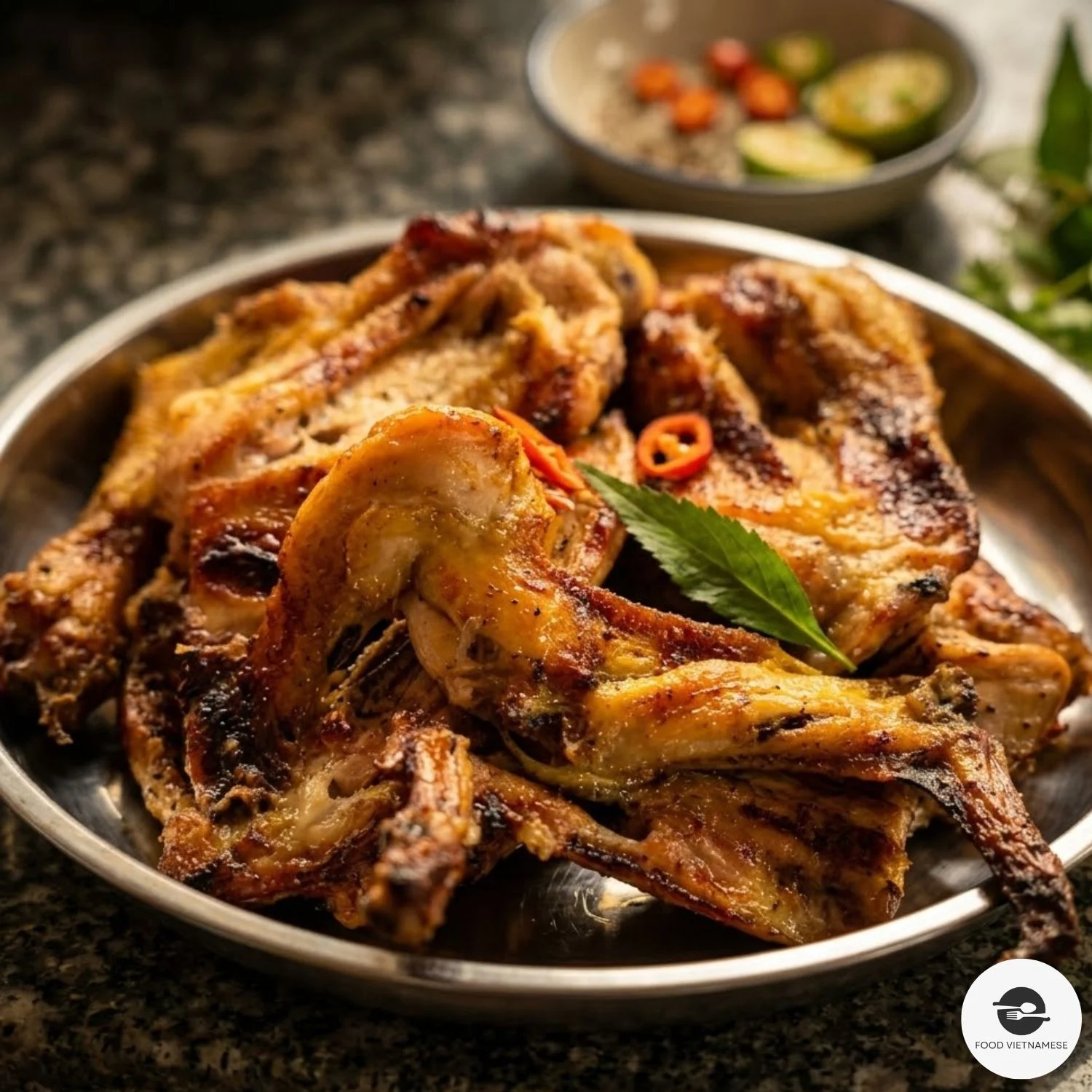
Ga Nuong Song Cau – Where Ordering Chicken Means Pointing at One in the Yard
Ga nuong Song Cau is a specialty of Song Cau town, Phu Yen province: free-range chicken (ideally young,…