Table of contents
Calories per plate: Roughly 500–800 kcal, depending on toppings
Simple version (pork chop only): ~500–565 kcal
Full version (pork chop, pork skin, egg meatloaf): ~750–770 kcal
Protein: Roughly 25–31g, mostly from the grilled pork
Fat: Roughly 18–22g, largely from the pork chop’s marinade and the fried scallion oil on top
Sodium: Often 900–1,200mg, mainly from fish sauce and pickled vegetables
Biggest calorie driver: The grilled pork chop and scallion oil, and how many toppings are piled on — not the rice
If you’ve searched this to log a meal, the honest answer depends entirely on which cơm tấm you ordered, since this is really a build-your-own-plate dish with a shared base. Here’s what actually moves the number, starting with the part most people assume matters more than it does.
Does “Broken Rice” Actually Mean Fewer Calories?
No, and this trips people up constantly. Cơm tấm means “broken rice” — grains that cracked during milling, once considered lower quality and sold cheaper than whole-grain rice. That history has nothing to do with calories. Broken rice and whole-grain rice come from the same plant and carry essentially the same calorie density gram for gram; the rice being “broken” affects texture and price, not its nutrition. A cup of steamed broken rice runs close to what a cup of any other steamed white rice would.
Where the Calories Actually Come From
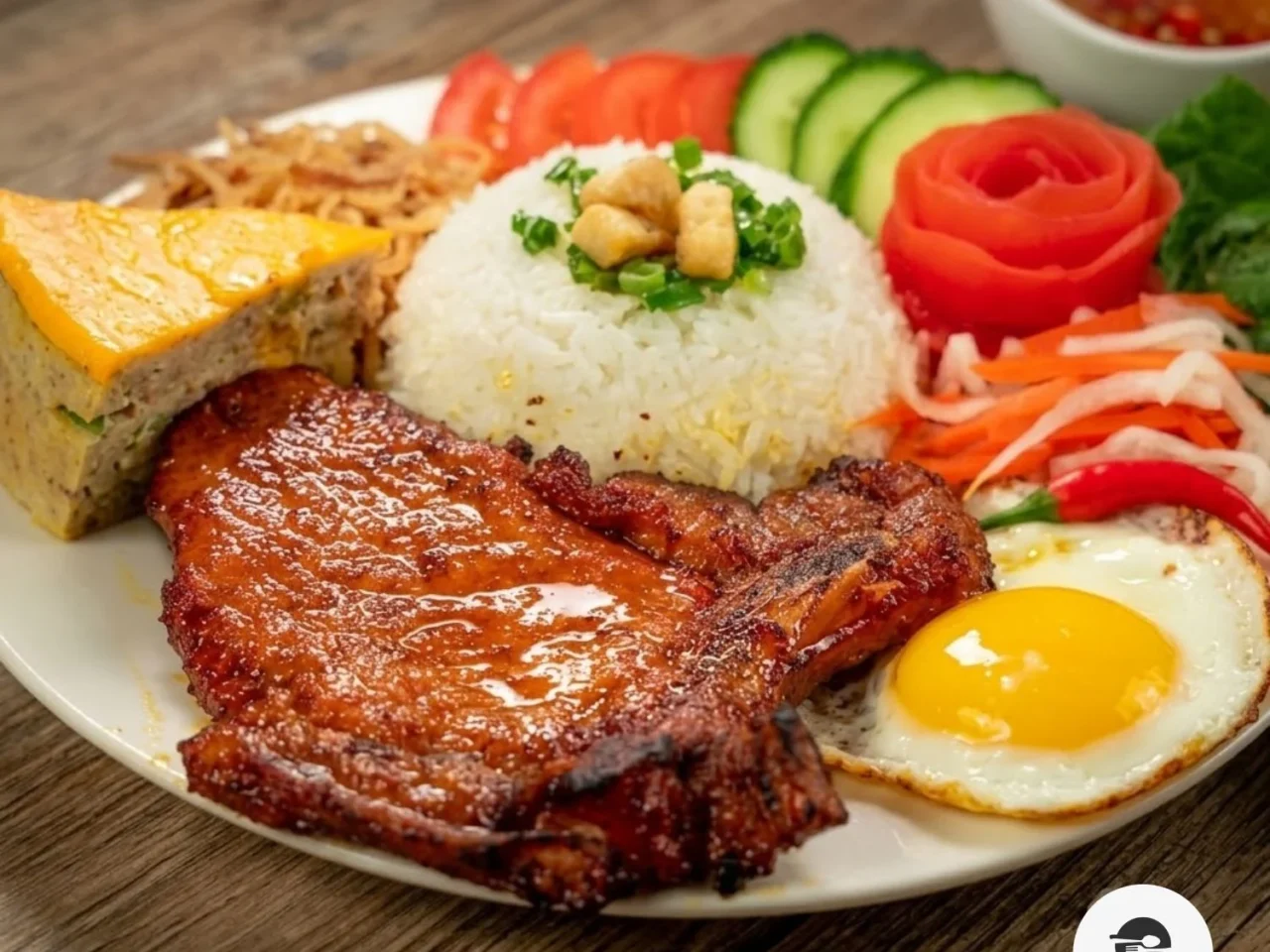
The grilled pork chop (sườn nướng) does most of the heavy lifting. It’s marinated in a mix that typically includes fish sauce, sugar, garlic, and lemongrass, then grilled directly over charcoal until the edges caramelize — that char comes from real sugar and fat rendering down, not just seasoning. On top of the rice and meat, most plates get a spoonful of mỡ hành, scallions cooked down in oil until soft, which is a genuine dollop of fat rather than a garnish. Add a fried egg, a square of pâté, or shredded pork skin (bì), and each one stacks its own calories on top of a base that was already moderate on its own.
Why the Range Is So Wide
Cơm tấm isn’t one fixed plate — it’s closer to a menu of combinations built on the same rice base. Order just the pork chop and you’re at the lower end. Add bì (pork skin mixed with roasted rice powder) or chả (steamed pork-and-egg meatloaf), and the count climbs with each addition. A vegetarian version, built around mock meats and tofu instead of pork, tends to land in a similar range to the meat versions once it’s fried or grilled the same way — going meatless doesn’t automatically mean going lighter here.
| Version | What’s included | Calories (approx.) |
|---|---|---|
| Cơm tấm sườn | Rice, grilled pork chop only | 500–565 kcal |
| Cơm tấm chả trứng | Rice, steamed egg meatloaf | ~415 kcal |
| Cơm tấm bì | Rice, shredded pork skin | ~625 kcal |
| Cơm tấm sườn bì chả | Rice, pork chop, pork skin, egg meatloaf | 750–770 kcal |
The Sodium Is Worth Watching Too
Fish sauce shows up twice on a typical plate: once in the pork marinade, and again as nước mắm drizzled over the whole thing at the table. The pickled carrot and daikon (đồ chua) served alongside add a bit more sodium on top of that. Between the two, a loaded plate can run 900–1,200mg of sodium, a meaningful share of a full day’s recommended intake in one sitting — worth knowing if you’re also watching that number and not just calories.
How This Compares to Other Vietnamese Mains
A simple cơm tấm sườn, at 500–565 calories, sits in a similar range to a loaded bánh mì with pork and pâté, while the full sườn bì chả combo runs noticeably higher than either. That’s not unusual for the cuisine as a whole — Vietnamese food covers a wide range from genuinely light dishes to rich, grilled-and-fried combo plates like this one, and cơm tấm sits toward the heavier end depending on how it’s ordered. If you’re weighing this against other options, this roundup of lighter Vietnamese dishes is a useful reference point.
Lighter Ways to Order It
Sticking with cơm tấm sườn instead of the full sườn-bì-chả combo is the single biggest lever, since each added topping is its own calorie line rather than a small extra. Asking for the mỡ hành on the side, or going light on it, trims a real amount of fat without changing the dish’s character. Skipping the fried egg or pâté when they’re offered as add-ons helps too — neither is essential to what makes cơm tấm cơm tấm, unlike the pork chop itself.
I ordered cơm tấm sườn bì chả at a sidewalk stall near Bàn Cờ market thinking I’d asked for the simple version, and the woman running the grill just laughed and piled on all three anyway, saying that’s what people actually come for. She wasn’t wrong — asking for less at that stall would have gotten me a smaller portion of the same combo, not a genuinely different plate. Some places just don’t sell the stripped-down version, whatever the menu says.
Kelly Thuy — field notes, Ho Chi Minh City
Frequently Asked Questions
Roughly 500 to 800 calories, depending on toppings. A simple pork chop version runs about 500–565 calories, while a full sườn bì chả plate with pork skin and egg meatloaf can reach 750–770.
No. Broken rice and whole-grain rice have essentially the same calorie density — “broken” refers to grains cracked during milling, which affects texture and historical price, not nutrition.
The grilled pork chop and the scallion oil (mỡ hành) drizzled on top contribute the most, along with how many extra toppings — pork skin, egg meatloaf, fried egg, pâté — end up on the plate.
Order cơm tấm sườn on its own rather than the full combo, ask for less mỡ hành, and skip add-ons like a fried egg or pâté if they’re offered separately.

Related articles
Goi Cuon Calories: The Roll Is Light — the Peanut Sauce Isn’t
Goi cuon calories run surprisingly low for the roll itself — a standard shrimp-and-pork gỏi cuốn comes in…

Banh Xeo Calories: One Pancake, Two Very Different Numbers
Banh xeo calories run about 140–155 per 100 grams across most nutrition databases, but the number that actually…
Bun Bo Hue Calories: Why This Bowl Runs Heavier Than Pho
Bun bo hue calories typically fall somewhere between 350 and 550 per bowl, and it’s genuinely hard to…