Table of contents
- What Is Ga Kho Cu Nen Quang Tri?
- Ga Cua – The Tree-Climbing Chicken from a Former Resistance Stronghold
- Cu Nen – A Seasoning That Grows Along One Narrow Strip of Central Vietnam
- How It’s Made – Simple Ingredients, Precise Technique
- Full Ingredient List
- Flavour and Texture Profile
- How to Eat It the Quang Tri Way
- Where to Buy the Ingredients
- Nutritional Value
- Frequently Asked Questions
- Conclusion
I – Kelly Thuy – travelled up to the Cua area of Cam Lo district on a morning when mist still clung to the red basalt hillsides. A chicken farmer there pointed toward a flock scattered across the slopes: “During the day they dig for termites and crickets on their own, and at night they fly up into the trees to sleep — nobody pens them in.” At lunch, I was served a plate of ga kho cu nen made from a bird caught that same morning — the meat firm but never tough, naturally sweet without needing much seasoning, the sharp fragrance of cu nen worked into every fibre. Eating it with a handful of still-warm sticky rice, I understood immediately why a dish this modest-sounding has been kept alive across so many generations in Quang Tri.
— Kelly Thuy
What Is Ga Kho Cu Nen Quang Tri?
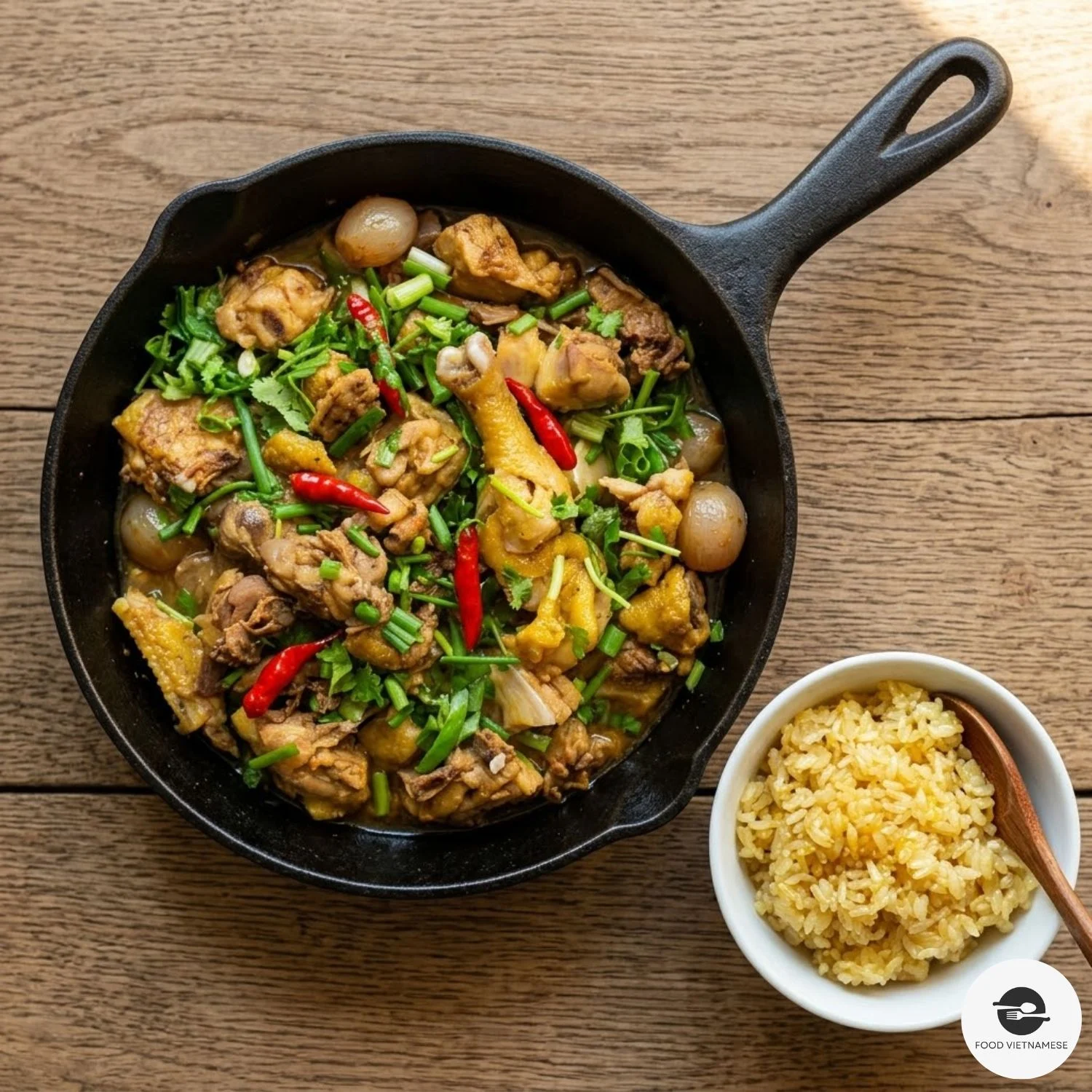
Ga kho cu nen is a rustic dish, but one with a sharply defined regional identity across Quang Tri and neighbouring provinces of the North Central Coast. What sets it apart isn’t complicated technique — the recipe itself is fairly simple — but a single seasoning found almost nowhere else in Vietnam: cu nen.
| Quick Facts | Details |
|---|---|
| Vietnamese name | Gà kho củ nén và xôi |
| English name | Ga Kho Cu Nen Quang Tri – Vietnamese Shallot-Chive Braised Chicken with Sticky Rice |
| Region | North Central Coast (Bắc Trung Bộ) – Quang Tri province, also common in Thua Thien Hue |
| Ideal chicken | Ga Cua — a native breed from Cam Lo district, Quang Tri |
| Signature seasoning | Cu nen (shallot chives) — grown only from Quang Tri to Quang Nam |
| Served with | Glutinous sticky rice or banh uot (steamed rice sheets) |
| Ga Cua breeding area | Cam Chinh, Cam Nghia, Cam Thanh communes, Cam Lo district |
| Recognition | Ga Cua — OCOP-certified product of Cam Lo district |
Ga Cua – The Tree-Climbing Chicken from a Former Resistance Stronghold
Ask anyone in Quang Tri who knows their food well which chicken to use for ga kho cu nen, and they’ll point directly to ga Cua — a native breed from the Cua area, now comprising Cam Chinh, Cam Nghia and Cam Thanh communes in Cam Lo district. This land carries a specific historical weight: over a century ago, Emperor Ham Nghi chose this exact area to build the Tan So citadel, a resistance base during the Can Vuong movement against French colonial rule.
Ga Cua chickens are raised completely free-range across the region’s red basalt hillsides — no pens involved. During the day, the flock digs through the soil for ants, termites and crickets; in the evening, they fly up into garden trees to roost, earning them the local nickname “tree-climbing chicken” (gà leo cây). That constant movement, combined with a natural insect-rich diet, produces distinctly firm meat that’s never tough, rich without being greasy, naturally golden-skinned and low in fat. The birds themselves stay small — mature weight is only around 1–1.5kg after 5–6 months of raising.
Ga Cua has since become an official OCOP specialty product of Cam Lo district, with local farming cooperatives adopting biosecurity practices and working toward traceability and geographical indication documentation — a protective measure against the breed being confused with generic free-range chicken sold under the same name in wider markets.
Cu Nen – A Seasoning That Grows Along One Narrow Strip of Central Vietnam
Cu nen (also called hanh tam or nem) belongs to the allium family — the same broad plant group as garlic, but noticeably smaller in size. Its flavour runs cleaner and milder in heat than garlic, carrying a distinctive fragrance that’s difficult to confuse with any other allium-family seasoning.
What makes cu nen geographically remarkable: due to very specific soil conditions, this bulb grows almost exclusively along the stretch of land running from Quang Tri to Quang Nam — rarely cultivated at any real scale elsewhere in Vietnam. This narrow growing range is why cu nen has become the defining seasoning behind a whole cluster of Central Vietnamese dishes, not just this braised chicken but also mi Quang, cu nen porridge, and cu nen-braised fish.
| Characteristic | Cu nen |
|---|---|
| Other names | Hanh tam, nem |
| Plant family | Allium family — same broad group as garlic |
| Growing region | Stretch of land from Quang Tri to Quang Nam |
| Flavour | Clean, milder heat than garlic, distinctive fragrance |
| Role in the dish | Removes gaminess from the chicken, provides the dominant, irreplaceable aroma |
| Best harvest season | Early lunar new year, when bulbs are firmest and most fragrant |
How It’s Made – Simple Ingredients, Precise Technique
Step 1 – Clean the chicken thoroughly
Clean the chicken well, rub coarse salt over the skin and flesh for a few minutes, or use a vinegar-salt mixture (1:2 ratio) rubbed thoroughly, then rinse several times with clean water. This step matters — it removes the chicken’s natural gaminess before marinating. Cut into eating-sized pieces and drain well.
Step 2 – Prepare the cu nen
Peel the cu nen, trim off the roots, rinse and drain. Lightly crush or pound with a pestle or the flat side of a knife to release its aromatic oils before marinating — an essential step, since whole, unbruised bulbs won’t release enough fragrance.
Step 3 – Marinate the chicken
Marinate the chicken with crushed cu nen, salt, sugar, fish sauce, pepper and fresh sliced chili (if a spicier version is preferred). Mix thoroughly and let sit for 15–20 minutes so the seasoning penetrates deep into each piece before braising.
Step 4 – Braise over low heat
Place the marinated chicken over low heat, braising gently so the meat cooks evenly while absorbing the seasoning from the inside out. After about 15 minutes, a small amount of water can be added to create a glossy braising sauce, adjusted to taste for a thicker or thinner consistency. Continue until the meat is firm and the sauce clings evenly to each piece.
Step 5 – Serve with sticky rice or banh uot
Spoon the braised chicken onto a plate, serve hot alongside glutinous sticky rice or banh uot, depending on family tradition.
Full Ingredient List
| Ingredient | Role |
|---|---|
| Free-range chicken (ideally ga Cua) | Main ingredient — firm meat, low fat, naturally sweet from free-range raising |
| Cu nen | Region-defining seasoning — crushed and marinated with the chicken for its signature fragrance |
| Fish sauce | Primary seasoning agent, providing depth and savoury saltiness |
| Sugar | Balances the saltiness, produces the amber-brown colour during braising |
| Ground pepper | Mild heat and additional fragrance |
| Fresh chili | Optional, adds the characteristic Central Vietnamese heat |
| Glutinous sticky rice or banh uot | Traditional, essential accompaniment |
Flavour and Texture Profile
| Layer | Description | Source |
|---|---|---|
| Sharp cu nen fragrance | An aroma unmatched by any other allium seasoning, present from the moment it hits the pan | Crushed cu nen marinated into the chicken |
| Firm chicken texture | Especially pronounced with ga Cua — chewy in the right way, never mushy, never overly fatty | Free-range chicken, ideally ga Cua |
| Deep sweet-savoury balance | A glossy sauce clinging evenly to the meat, harmonious rather than sharp | Fish sauce and sugar braised to balance |
| Gentle warming heat | A mild spiciness from pepper and fresh chili, characteristic of Central Vietnamese flavour | Ground pepper and fresh chili |
| Soft, rich sticky rice | A starchy, buttery base that balances the depth of the braised chicken | Glutinous sticky rice served alongside |
How to Eat It the Quang Tri Way
- Pair with sticky rice for a filling breakfast — the most common pairing, practical to pack for work or a long journey
- Pair with banh uot for something lighter — usually served with fresh herbs and a sweet-sour fish sauce dip
- Eat it hot, right after braising — the sauce and cu nen fragrance are strongest while still warm
- Seek out ga Cua if possible — the texture and natural sweetness noticeably outperform standard commercial chicken
- Adjust the heat to taste — add fresh chili for a spicier, more distinctly Central Vietnamese profile
Where to Buy the Ingredients
Ga Cua
- Cam Chinh, Cam Nghia and Cam Thanh communes, Cam Lo district — the concentrated breeding area, available directly from biosecurity-certified farming cooperatives.
- Dong Ha City — several Quang Tri specialty shops sell ga Cua, either pre-processed or ready-cooked.
Cu nen
- Local markets throughout central Vietnam — Quang Tri, Quang Nam and Hue all sell it widely, fresh and inexpensive.
- Online marketplaces — for those outside the region, fresh or dried cu nen can be ordered through Vietnamese e-commerce platforms.
Nutritional Value
Estimated based on primary ingredients. No independently verified nutritional analysis of ga kho cu nen Quang Tri has been published.
| Nutrient | Estimated value / 100g braised chicken (excluding rice) |
|---|---|
| Energy | ~180–220 kcal |
| Protein | ~20–25g (from chicken meat) |
| Total fat | ~8–12g (ga Cua tends to be leaner than commercially farmed chicken) |
| Carbohydrates | ~3–5g (mainly from marinade sugar) |
| From ga Cua | High-quality protein, lower saturated fat than standard farmed chicken |
Frequently Asked Questions
What is ga kho cu nen Quang Tri?
A signature Central Vietnamese braised chicken dish: free-range chicken (ideally ga Cua) marinated with crushed cu nen, fish sauce, pepper and sugar, braised over low heat until firm. Served with sticky rice or banh uot. Cu nen provides the irreplaceable Central Vietnamese aroma.
What is cu nen?
An allium-family seasoning, smaller than garlic, with a clean, mild-heat flavour, grown only from Quang Tri to Quang Nam due to specific soil conditions. Cannot be substituted with ordinary dried shallots or garlic.
What is ga Cua?
A native chicken breed from the Cua area (Cam Chinh, Cam Nghia communes, Cam Lo district, Quang Tri), raised free-range on hillsides, feeding on natural insects, roosting in trees at night — hence “tree-climbing chicken.” Firm, naturally sweet meat; an OCOP-certified product of the district.
Sticky rice or banh uot — which is better?
Both are common depending on preference. Sticky rice suits a filling breakfast; banh uot offers a lighter meal, usually served with fresh herbs and sweet-sour fish sauce.
Where to buy ga Cua and cu nen?
Ga Cua: Cam Chinh, Cam Nghia, Cam Thanh communes (Cam Lo district) or specialty shops in Dong Ha. Cu nen: local markets throughout central Vietnam or Vietnamese online marketplaces.
Conclusion
Ga kho cu nen doesn’t require an elaborate ingredient list or complicated technique — just a quality chicken and a seasoning that only grows on this particular stretch of land. When both come together — ga Cua raised free-range on red basalt hills, cu nen grown on the exact soil running from Quang Tri to Quang Nam — the result is a dish that carries the full identity of a region once home to a century-old resistance stronghold.
If you find yourself in Quang Tri, head to the Cua area in Cam Lo district, order a plate of ga kho cu nen made from a locally raised bird, and eat it alongside a handful of still-warm sticky rice. That’s the closest way to understand why a dish this modest has stayed alive across so many generations of Central Vietnamese families — the same devotion to local ingredients found in Quang Binh’s chao canh or the molasses sweetness of Ha Tinh’s peanut candy, two other specialties from this same stretch of the North Central Coast.

Related articles
Banh Khot: Vung Tau’s Crispy-Edged Answer to Banh Xeo
Banh Khot is a Vietnamese mini savory pancake from the coastal city of Vung Tau — a rice…
Cao Lau: The Hoi An Noodle Dish That Cannot Be Made Anywhere Else
Cao Lau is a noodle dish found exclusively in Hoi An, Central Vietnam — thick, chewy rice noodles…
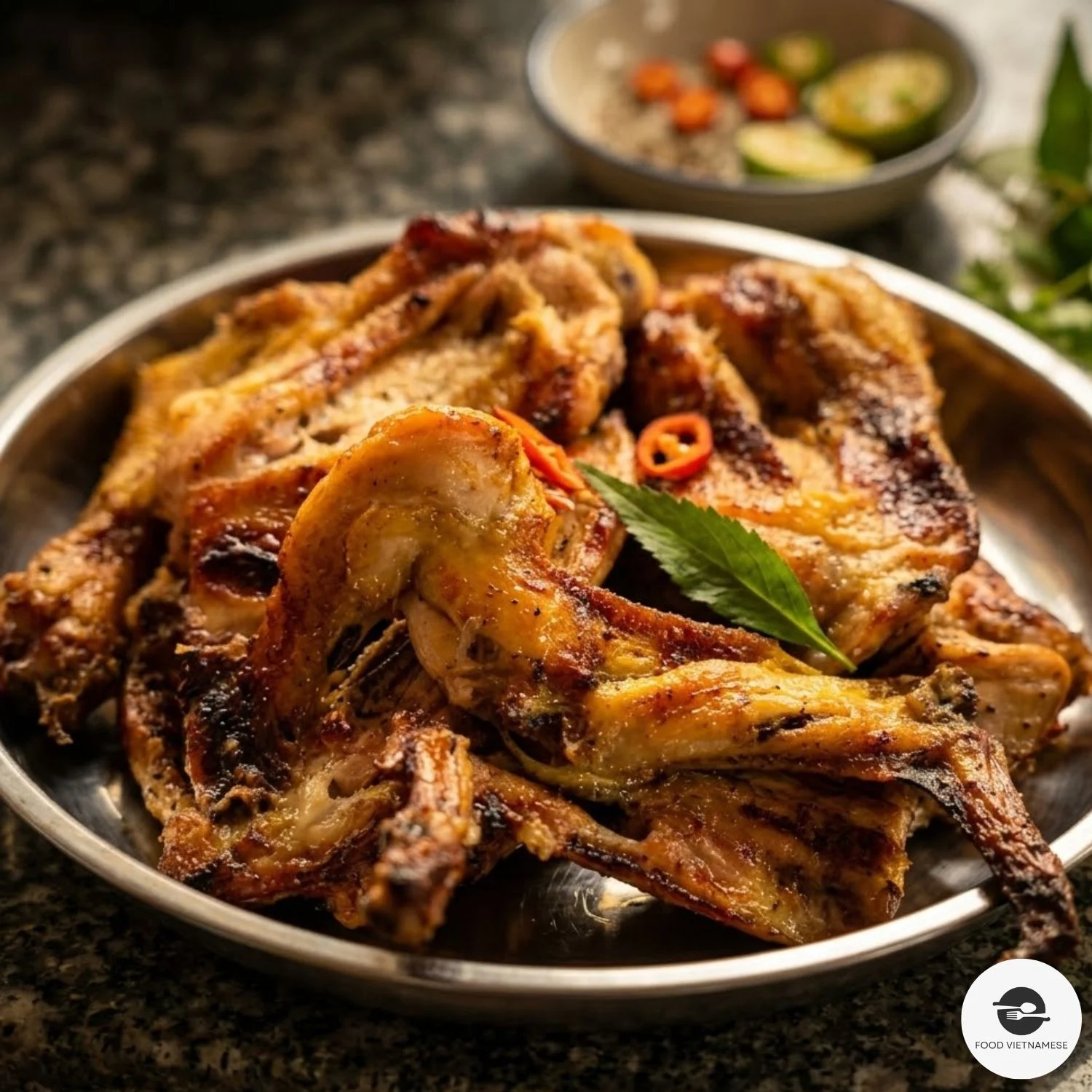
Ga Nuong Song Cau – Where Ordering Chicken Means Pointing at One in the Yard
Ga nuong Song Cau is a specialty of Song Cau town, Phu Yen province: free-range chicken (ideally young,…