
Table of contents
Calories per standard glass: ~140–180 kcal
Sugar: ~15–20g, almost entirely from condensed milk
Fat: ~2–5g, from the condensed milk
Black coffee alone: Close to 0 calories
Condensed milk (2 tbsp): About 90 calories, ~15g sugar
Compared to: Lower than a Starbucks Caramel Macchiato (~250 kcal) or Caffè Mocha (~233 kcal); higher than a plain Vanilla Latte (~127 kcal)
If you’ve ever looked at a small glass of cà phê sữa đá and assumed it couldn’t have that many calories in it, the condensed milk is doing more work than it looks like. This breaks down exactly where the calories come from, how much the amount of milk actually changes things, and how it stacks up against other coffee drinks people track.
Where the Calories Actually Come From
Black Vietnamese coffee — strong robusta, brewed through a phin — is essentially calorie-free, the same as any black coffee. The entire calorie count in cà phê sữa đá comes from the sweetened condensed milk stirred or poured into it. Two tablespoons (about 1 ounce) of condensed milk runs around 90 calories, roughly 15 grams of sugar, and about 2.4 grams of fat. Most café versions use somewhere between two and three tablespoons, which is how you land in that 140–180 calorie range for a full glass.
Why the Amount of Milk Changes the Number So Much
This is the part most calorie counts skip past: cà phê sữa đá isn’t a standardized recipe with one fixed calorie count, because the ratio of milk to coffee varies a lot by café and by how it’s made at home. A lighter pour — closer to one tablespoon — can bring a glass down near 80–100 calories. A heavier, sweeter version with three or four tablespoons can push past 200. If you’re actually trying to track this, the coffee-to-milk ratio matters more than which café you’re at.
How It Compares to Other Coffee Drinks
| Drink | Approx. Calories |
|---|---|
| Black Vietnamese coffee (no milk) | 0–2 kcal |
| Cà phê sữa đá (standard, 2–3 tbsp condensed milk) | 140–180 kcal |
| Starbucks Vanilla Latte (tall) | ~127 kcal |
| Starbucks Caffè Mocha (tall) | ~233 kcal |
| Starbucks Caramel Macchiato (tall) | ~250 kcal |
Vietnamese iced coffee sits in the middle of that range — heavier than a plain latte, lighter than a caramel-and-syrup drink. The main difference is where the calories come from: cà phê sữa đá gets essentially all of it from one ingredient (condensed milk), while a flavored latte spreads it across steamed milk, syrup, and whipped toppings.
Lower-Calorie Ways to Still Enjoy It
Using less condensed milk is the most direct fix, since it’s the only real calorie source in the drink — going from three tablespoons to one roughly cuts the calorie count in half. Some people substitute a splash of evaporated milk or regular milk with a little sugar, which lowers both calories and sugar but changes the texture and flavor noticeably; condensed milk’s thickness is part of what makes the drink what it is. Straight black cà phê đá (iced coffee, no milk) is the zero-calorie option if you just want the caffeine and the strong robusta flavor without the sweetness at all — it’s a completely different drink, but a real one, not a compromise version. On the other end, if the milk itself is what you’re after, egg coffee swaps condensed milk for whipped egg yolk entirely, which changes the calorie math in its own way rather than reducing it.
Does Hot vs. Iced Actually Change the Calorie Count?
Not meaningfully. Cà phê sữa nóng (hot) and cà phê sữa đá (iced) use the same ratio of coffee to condensed milk — the ice is just ice, and it doesn’t add calories. The one real difference is perception: iced versions get diluted as the ice melts, which can make a glass taste less sweet over time even though the total calories poured in were identical from the start. If a café serves the iced version in a noticeably bigger glass with more ice and the same amount of milk, it’ll taste lighter without actually being lower in calories.
I used to watch vendors on the street pour condensed milk by eye, no measuring, and always assumed that meant every glass was roughly the same. It isn’t. One stall’s “regular” cà phê sữa đá can be noticeably lighter than another’s just a block away, purely based on how heavy-handed they are with the milk. If you actually care about the calorie difference, it’s worth just asking for it “ít sữa” — less milk — rather than assuming every glass is built the same.
Kelly Thuy — field notes, Ho Chi Minh City
Frequently Asked Questions
A standard cà phê sữa đá runs about 140–180 calories, almost entirely from the sweetened condensed milk. Black Vietnamese coffee on its own is close to zero calories.
It’s moderate to high, mostly because of the condensed milk. A standard glass has roughly 15–20 grams of sugar, almost all of it from the milk rather than added table sugar.
It depends on the specific drinks being compared. A standard cà phê sữa đá (140–180 kcal) has fewer calories than a Caramel Macchiato (~250 kcal) or Caffè Mocha (~233 kcal), but slightly more than a plain Vanilla Latte (~127 kcal). Sugar content is comparable across most of these.
Use less condensed milk — cutting from three tablespoons to one roughly halves the calorie count — or order it “ít sữa” (less milk) at a café. Straight black cà phê đá, with no milk at all, is close to zero calories.

Related articles
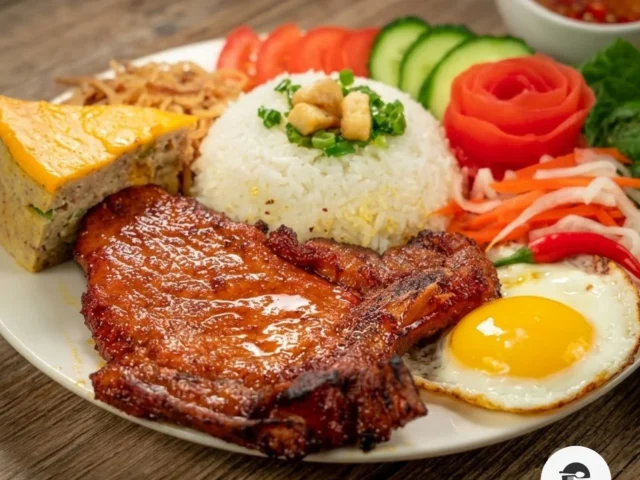
Com Tam Calories: The Rice Isn’t the Problem, the Toppings Are
Com tam calories range from about 500 to 800 per plate, and almost none of that swing comes…

Goi Cuon Calories: The Roll Is Light — the Peanut Sauce Isn’t
Goi cuon calories run surprisingly low for the roll itself — a standard shrimp-and-pork gỏi cuốn comes in…

Banh Xeo Calories: One Pancake, Two Very Different Numbers
Banh xeo calories run about 140–155 per 100 grams across most nutrition databases, but the number that actually…