Table of contents
- The Real Answer: Not Halal by Default, But Not Off-Limits Either
- Pork Is the Real Issue — Fish Sauce Usually Isn’t
- The Bigger Risk Is What Touches the Pork, Not the Pork Itself
- What About MSG?
- Vietnam Already Has Its Own Halal Food Tradition
- Halal-Friendly Dishes to Look For
- Finding Halal Vietnamese Food
- Frequently Asked Questions
Short answer: Not halal by default — pork is widely used, but halal-friendly and halal-certified options exist
Fish sauce: Generally accepted as halal by mainstream scholarship — trace fermentation alcohol falls well below intoxicating levels
Bigger risk than ingredients: Cross-contamination — pork and seafood/beef dishes often share the same cutting boards, pots, and grills
MSG: Mostly halal today (plant-based fermentation), though not fully standardized — some conservative certifiers still flag it
Native halal tradition: Vietnam’s Cham Muslim community (~100,000 people, mainly Mekong Delta and Ninh Thuận) has cooked halal Vietnamese food for generations
Safest dishes to look for: Fresh spring rolls with shrimp, seafood-based sour soup, vegetable stir-fries, and certified halal phở
Most guides to this question stop at “avoid pork,” which is true but incomplete — it skips both the ingredient people worry about unnecessarily and the one that actually deserves the caution.
The Real Answer: Not Halal by Default, But Not Off-Limits Either
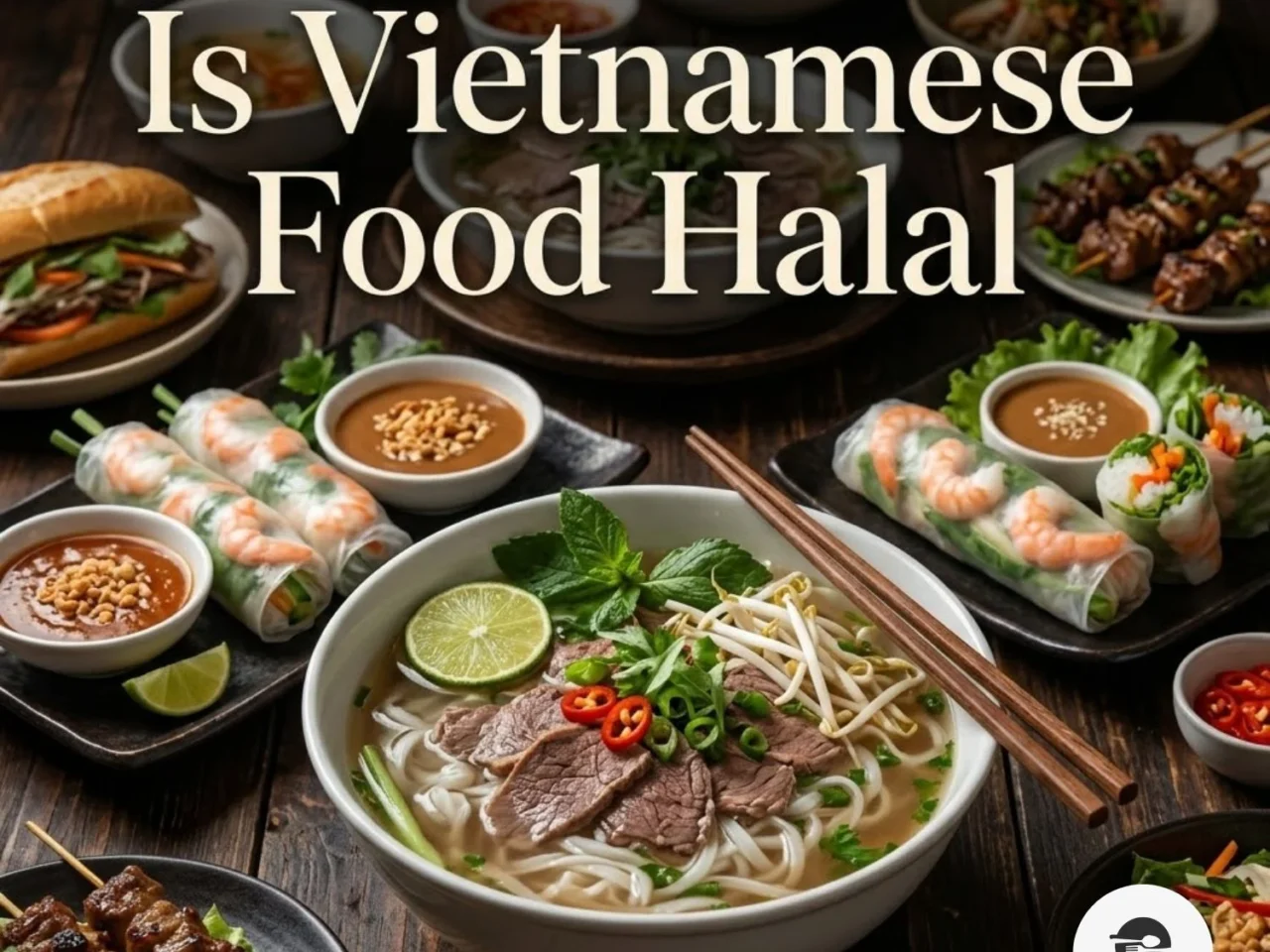
Pork is genuinely everywhere in Vietnamese cooking — ground pork fills spring rolls, pork sausage and pâté go into bánh mì, and dishes like bún chả and cơm tấm are built around grilled pork specifically. That makes a blanket “yes” impossible. But a blanket “no” isn’t right either — beef, chicken, shrimp, and vegetable dishes make up a large share of the cuisine too, and at a restaurant that doesn’t cook pork at all, or a verified halal kitchen, most of what’s on the menu is genuinely fine.
Pork Is the Real Issue — Fish Sauce Usually Isn’t
Fish sauce (nước mắm) gets flagged constantly because it’s fermented, and fermentation raises an automatic red flag for a lot of people. In practice, it’s made from just fish and salt, fermented over months, and the trace alcohol this process produces typically measures well under 0.5% — far below what any scholarly standard treats as intoxicating, since the substrate has nowhere near enough sugar for the kind of fermentation that produces meaningful ethanol. The mainstream scholarly position, including from halal authorities across Malaysia and Indonesia where fish sauce is also a kitchen staple, treats it as halal on that basis. If a dish’s only concern is the fish sauce in it, it’s very likely fine — the ingredient that actually needs scrutiny is almost always the meat, not the seasoning.
The Bigger Risk Is What Touches the Pork, Not the Pork Itself
This is the part most quick answers skip. At a typical Vietnamese kitchen that isn’t halal-certified, pork and non-pork dishes are cooked with the same tools — the same cutting boards, the same simmering pots, the same grill grates, sometimes the same frying oil. A bowl of phở bò (beef noodle soup) can be entirely pork-free by ingredient list and still have touched pork somewhere in its preparation. This is a bigger practical risk than any single ingredient, and it’s exactly why a restaurant’s own pork usage matters more than scanning a menu for the word “pork.” A kitchen that simply doesn’t cook pork at all removes this risk far more reliably than one that just leaves it out of a specific dish.
What About MSG?
MSG (bột ngọt) shows up in a lot of Vietnamese cooking, and its halal status is genuinely more nuanced than most food guides let on. Modern MSG from major manufacturers is typically produced through fermentation of plant-based feedstock like corn starch or sugarcane, which most halal certifiers accept without issue. It isn’t universal, though — a 1996 case involving a pork-derived fermentation medium at one manufacturer’s Indonesian plant left lasting caution around the ingredient, even though that company was later reformulated and certified. For most travelers this isn’t a dealbreaker, but it’s worth knowing MSG sits in a “generally fine, not absolutely settled” category rather than a clean yes.
Vietnam Already Has Its Own Halal Food Tradition
This is the part almost no “is it halal” guide for Vietnamese food mentions, and it’s the most useful fact in this entire topic: Vietnam has an indigenous Muslim community, the Cham people, numbering roughly 100,000, concentrated in the Mekong Delta and Ninh Thuận province. Cham communities have cooked halal Vietnamese food for generations, not as an adaptation for tourists but as their own everyday cuisine. Around Châu Đốc in the Mekong Delta, halal Cham restaurants serve dishes like grilled beef with turmeric alongside coconut rice — built on the same techniques and flavor logic as the rest of Vietnamese cooking, just never built around pork to begin with. This isn’t a workaround bolted onto the cuisine; it’s a parallel tradition that’s existed inside Vietnamese food the whole time.
Halal-Friendly Dishes to Look For
Gỏi cuốn made with shrimp or vegetables rather than pork is one of the safer default orders, since the filling is visible and easy to confirm before ordering. Canh chua, a sour seafood-based soup, and most vegetable stir-fries are naturally pork-free by recipe. Vegetarian “chay” dishes, common around Buddhist temples and increasingly on regular menus, are also a reliable starting point as long as no alcohol-based cooking wine has been added. None of these guarantee a kitchen is free of cross-contamination, but they remove the most common ingredient risk from the table.
| Dish | Halal risk | Why |
|---|---|---|
| Bún chả, cơm tấm | High | Built directly around grilled pork |
| Bánh mì (standard) | High | Pork pâté and cold cuts are the default filling |
| Phở bò (uncertified) | Moderate | Beef-based, but cross-contamination risk in shared kitchens |
| Gỏi cuốn with shrimp | Low | Visible filling, no pork by default |
| Canh chua, vegetable stir-fry | Low | Naturally pork-free by recipe |
| Cham-cooked dishes, certified halal | None | Never prepared with pork or alcohol |
Finding Halal Vietnamese Food
Ho Chi Minh City has Vietnam’s largest Muslim population, concentrated around Districts 1 and 3 near the Jamiul Anwar Mosque, with halal-certified restaurants and grocery stores nearby. Chau Đốc, in the Mekong Delta, is the most reliable spot for Cham-cooked halal food specifically. Outside Vietnam, cities with sizable Vietnamese communities that overlap with Muslim populations — Houston among them — increasingly have halal-certified Vietnamese restaurants too. A simple phrase worth learning either way: “không ăn thịt heo” (I don’t eat pork) gets understood immediately, even by kitchens with no formal certification.
A Malaysian tourist once asked me, half-apologetically, whether it was rude to ask a phở vendor if the broth had any pork in it. I told her it’s one of the most normal questions a vendor hears all day, and watched her ask in halting Vietnamese — the cook just nodded, pointed at the beef bones simmering in a separate pot from his other dishes, and waved her over to sit down. No offense taken, no confusion, just a straight answer.
Kelly Thuy — field notes, Ho Chi Minh City
Frequently Asked Questions
Not by default. Pork is used extensively across the cuisine, and most everyday kitchens aren’t set up to avoid cross-contamination between pork and non-pork dishes. Halal-friendly and halal-certified options do exist, particularly seafood, vegetable dishes, and food cooked by Vietnam’s Cham Muslim community.
Generally, yes. Fish sauce is fermented fish and salt, and the trace alcohol produced during fermentation falls well below intoxicating levels. Mainstream Islamic scholarship, including halal authorities in Malaysia and Indonesia, accepts it as halal on that basis.
Fresh spring rolls with shrimp or vegetables, seafood-based sour soup (canh chua), vegetable stir-fries, and vegetarian “chay” dishes are naturally pork-free by recipe. None of these guarantee a pork-free kitchen, so cross-contamination is still worth asking about.
Yes. Ho Chi Minh City’s Districts 1 and 3 have halal-certified restaurants near the Jamiul Anwar Mosque, and Châu Đốc in the Mekong Delta is known for halal food cooked by Vietnam’s Cham Muslim community, who have prepared halal Vietnamese dishes for generations.

Related articles
Bun Thit Nuong: Vietnam’s Grilled Pork Noodle Salad, Not a Soup
Bun Thit Nuong is a Vietnamese grilled pork noodle salad — cold rice vermicelli piled with lemongrass-marinated grilled…
Best Vietnam Food: 15 Must-Try Dishes
Best Vietnam food is defined by one core principle: maximum flavor from the freshest possible ingredients. Vietnamese cuisine balances…
Vietnamese Hot Pot (Lẩu): Types, How to Eat, Dipping Sauces
Vietnamese hot pot (lẩu) is a pot of seasoned broth kept simmering at the table, where diners cook…