Table of contents
Everyday swap: Fish sauce, double the amount, thinner and milder
Closest texture: Anchovy paste, 1:1, add a splash of fish sauce for funk
Vegan option: Red miso or doenjang, 1:1
In a pinch: Ground dried shrimp, 1:1, less fermented depth
Mắm ruốc: Pinkish-red, milder, the paste behind bún bò Huế’s broth
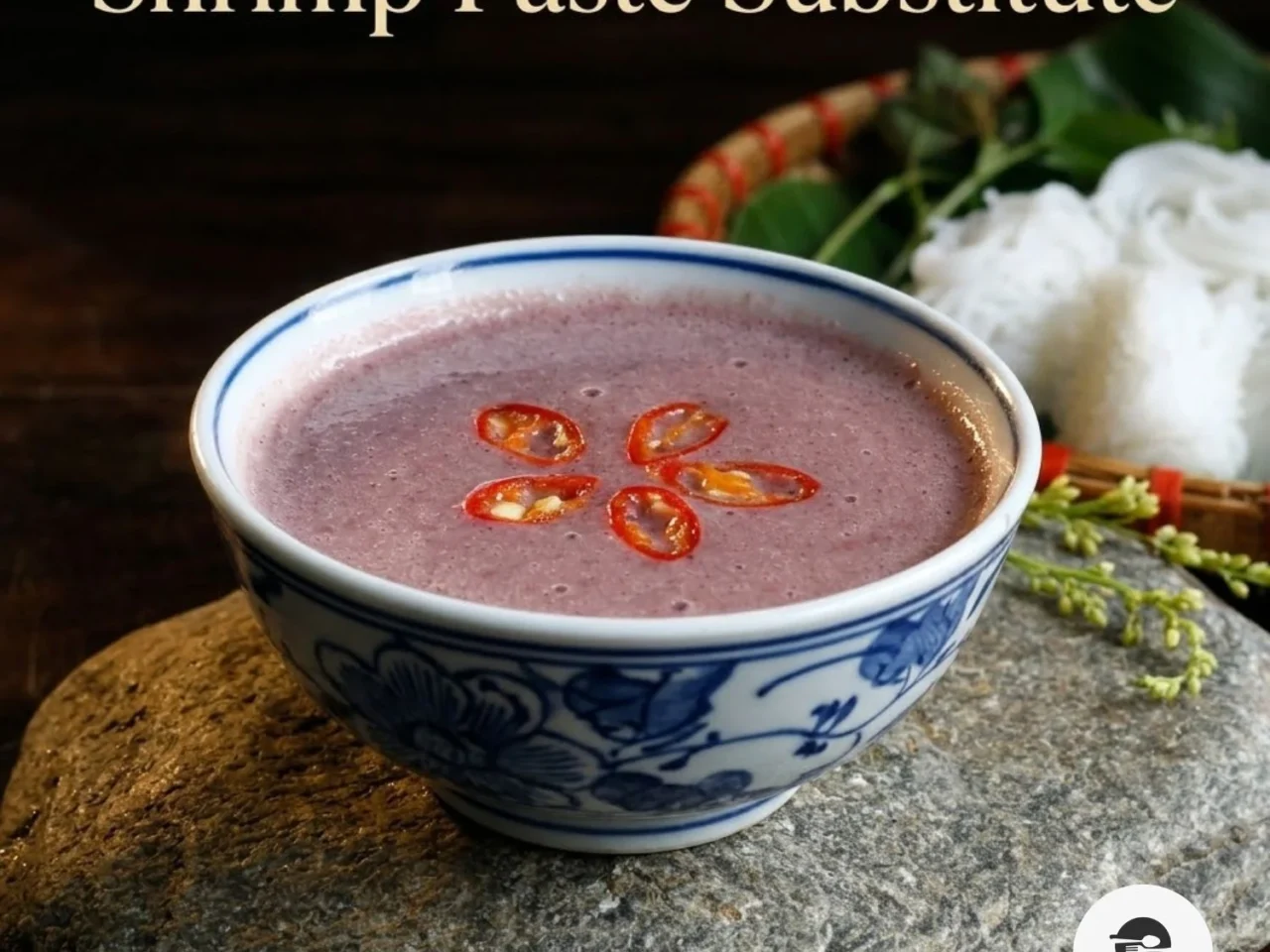
Mắm tôm: Deep purple, sharply pungent, served with bún đậu mắm tôm and stirred into bún riêu — not interchangeable with mắm ruốc
If a recipe just says “shrimp paste” with no other detail, the fix depends on what kind of recipe it is. A Thai curry paste or an Indonesian sambal usually means the dry, blocky belacan-terasi-kapi family. A Vietnamese recipe translated into English could mean either of two different pastes that don’t taste the same and aren’t used the same way. Here’s what covers both situations.
Fish Sauce Is the Fastest Fix
Fish sauce is already in most kitchens that cook Vietnamese or Southeast Asian food regularly, which makes it the substitute worth reaching for first. Use roughly double the amount a recipe calls for in shrimp paste, since fish sauce is thinner and less concentrated. It shares the same fermented, salty backbone — both are built on breaking down seafood with salt over time — but fish sauce won’t add the paste’s thickness, so a curry paste or marinade may come out slightly looser than intended. That’s rarely a problem in a soup or braise; it matters more in something like a dry rub or a paste meant to cling to meat before grilling.
Anchovy Paste Is the Closest in Texture
Anchovy paste is a genuinely good stand-in structurally — it’s already a paste, not a liquid, so it behaves the same way stirred into a curry base or mashed into a dressing. Use it 1:1. What it’s missing is the funk: anchovy paste is salty and fishy but not fermented the way shrimp paste is, so the finished dish reads as flatter and less complex. Stirring in a small splash of fish sauce alongside it closes most of that gap without needing a third ingredient.
Miso or Doenjang for a Vegan Version
Neither of these tastes like shrimp paste on its own, but both bring the same thing shrimp paste is actually there for — deep, fermented umami rather than a specific seafood flavor. Red miso, which is saltier and more aggressive than white miso, is the better match; Korean doenjang works similarly, with a heavier, more earthy edge. Use either at roughly 1:1. This swap works best in curries, braises, and stews where shrimp paste is a background note rather than the headline flavor of a dipping sauce.
Ground Dried Shrimp, When Nothing Else Is Around
Dried shrimp, pounded or blitzed into a coarse paste with a little water or oil, gets you a genuinely shrimp-forward flavor at roughly 1:1. What it can’t replicate is months of fermentation — dried shrimp is preserved, not broken down the way shrimp paste is, so the result tastes more like “ground shrimp” than the deep, almost cheese-like funk shrimp paste carries. It’s a reasonable last resort, not a first choice.
| Substitute | Ratio | Note |
|---|---|---|
| Fish sauce | 2x the amount | Thinner and milder; may loosen a paste-based recipe |
| Anchovy paste | 1:1 | Add a little fish sauce back in for fermented funk |
| Red miso or doenjang | 1:1 | Vegan; best in curries and braises, not dipping sauces |
| Ground dried shrimp | 1:1 | Shrimp-forward but missing fermented depth |
What “Shrimp Paste” Actually Means in Vietnamese Cooking
Most English-language substitute guides are really writing about the dry, block-style paste used across Thai, Malay, and Indonesian cooking — known regionally as belacan, terasi, or kapi. Vietnamese cooking uses something related but distinct, and it isn’t one product. Mắm ruốc and mắm tôm are both commonly translated as “shrimp paste” in English, and both start from the same base of tiny shrimp or krill fermented with salt — but the similarities mostly end there.
Mắm ruốc ferments longer, often several months, and comes out a milder, pinkish-red paste with a fragrant rather than sharp smell. It’s the paste that gives bún bò Huế‘s broth its distinctive depth, stirred in during cooking rather than served raw at the table, and it also shows up in braises and as a dip alongside unripe mango. Mắm tôm, by contrast, is a deep purple, noticeably more pungent paste, usually served closer to raw — whisked with lime juice, sugar, and chili as the dipping sauce that defines bún đậu mắm tôm, and also stirred into bún riêu or served alongside chả cá Lã Vọng.
The two aren’t interchangeable, and this is worth knowing before substituting anything: using mắm tôm in a bún bò Huế broth pushes the dish sharply pungent in a way it isn’t meant to be, and using mắm ruốc in place of mắm tôm as a table dip comes out too mild to do the job. If a recipe just says “Vietnamese shrimp paste” without specifying which, the dish it’s attached to is usually the giveaway — a broth or braise almost always means mắm ruốc, a raw table condiment almost always means mắm tôm.
Where the Substitutes Fall Short
None of the swaps above replicate mắm ruốc or mắm tôm specifically — they get close to “fermented seafood paste” as a category, not to either Vietnamese product’s particular fermentation time, color, or intensity. In a dish where the paste is doing quiet background work, like a curry base, that difference mostly disappears. In a dish where the paste is the point — bún đậu mắm tôm’s dipping sauce most of all — none of these substitutes are worth reaching for. It’s closer to skipping the dish for now than making a convincing version of it. If fish sauce is also out of the pantry, that’s worth checking first, since it’s both an ingredient here and a substitute in its own right.
I once tried making bún bò Huế broth with mắm tôm because it was what I had in the fridge, having just used my mắm ruốc up on a batch of thịt kho the week before. The broth turned sharp and almost soapy in a way that had nothing to do with how much I used — it just wasn’t the right paste for the job, however careful I was with the amount. I ended up adding extra lemongrass and a bit more fish sauce to pull it back toward something recognizable, and it worked, but it wasn’t the broth I was going for that night.
Kelly Thuy — field notes, Hue
Frequently Asked Questions
Fish sauce is the fastest fix, used at about double the amount since it’s thinner. Anchovy paste is the closest texture match at a 1:1 ratio, especially with a small splash of fish sauce added for fermented depth.
No. Both are made from tiny shrimp or krill, but mắm ruốc is milder, pinkish-red, and used in dishes like bún bò Huế, while mắm tôm is deeper purple, more pungent, and used as a dipping sauce for bún đậu mắm tôm. They aren’t interchangeable.
Yes, at roughly double the amount called for, since fish sauce is more liquid and less concentrated than paste. It won’t add the same thickness, which matters more in a rub or marinade than in a soup or braise.
Red miso or Korean doenjang, used at roughly a 1:1 ratio, both bring similar fermented umami without any seafood. They work best in curries and braises where shrimp paste is a background flavor rather than a dish’s main dipping sauce.

Related articles
Perilla Leaf Substitute: Why Vietnamese Tía Tô Isn’t the Korean Kind
Most perilla leaf substitute guides are really answering a Korean cooking question — kkaennip, used whole as a…
Palm Sugar Substitute: What Works, and Why Vietnamese Kitchens Reach for the Real Thing
Palm sugar substitute options are easy to find — light brown sugar, coconut sugar, and jaggery all work…
Thai Basil Substitute: What Works Raw vs. What Works Cooked
Thai basil substitute options actually split into two different answers depending on how you’re using the herb. As…