Table of contents
- The Right Framework: Calories Per Bite, Not “Good” vs “Bad” Dishes
- Broth-Based Soups Are Already Doing the Heavy Lifting
- The Drink Is Usually the Real Problem
- Fried vs. Fresh Isn’t a Small Difference
- Rice Portions Are Already Built to Be Moderate — Don’t Fight the Culture
- Sauce Control Matters More Than People Think
- Frequently Asked Questions
Best framework: Energy density, not “good” vs “bad” dishes — broth-based, high-volume meals fill you up for fewer calories
Biggest overlooked calorie source: Drinks — cà phê sữa đá runs roughly 150–180 calories, almost entirely from condensed milk
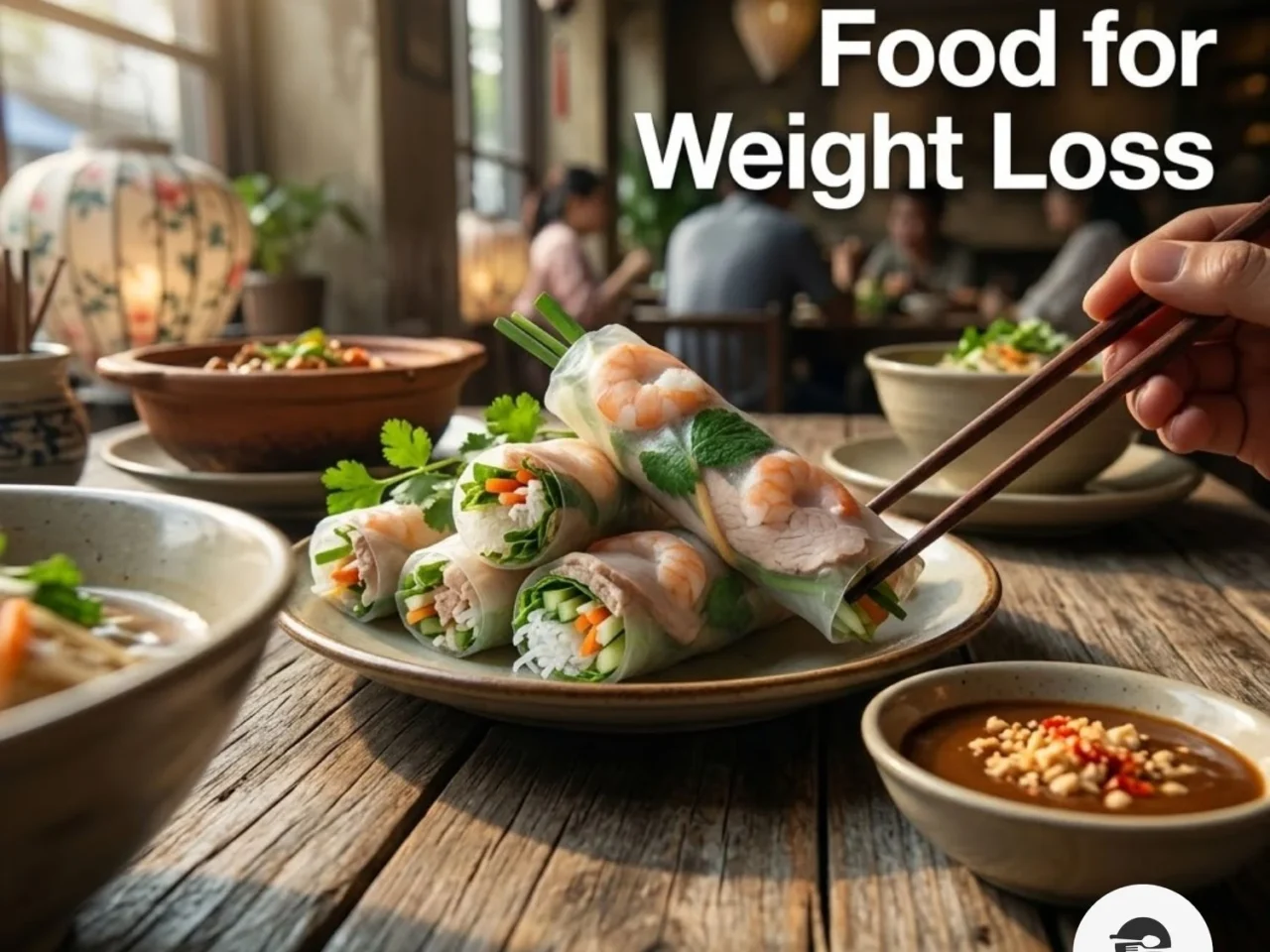
Fried vs. fresh: A fried spring roll runs meaningfully higher in calories than a fresh one of similar size, mostly from the oil
Rice portions: Served in small bowls with refills on request — naturally more moderate than a single oversized Western plate
Sauce control: Dipping vs. pouring nước chấm or hoisin-peanut sauce can be the difference of 100+ calories on the same dish
Best dish type for volume: Broth-based soups like phở and canh chua — mostly water, genuinely filling per calorie
Most “Vietnamese food for weight loss” guides just list dishes under 500 calories and call it done. That’s useful as far as it goes, but it misses where people actually lose the thread — in the parts of a meal that don’t feel like they count.
The Right Framework: Calories Per Bite, Not “Good” vs “Bad” Dishes
Nutrition research on weight management points to energy density — how many calories are packed into a given weight of food — as one of the more reliable levers for eating less without feeling hungrier. Foods with a lot of water and volume relative to their calorie count, like broth, vegetables, and fresh herbs, let you eat a genuinely satisfying amount of food while taking in fewer calories in total. This matters for Vietnamese food specifically because so much of the cuisine already leans this direction by default — the question isn’t really “which dishes are allowed,” it’s which parts of a normal Vietnamese meal are already doing this work, and which parts are quietly working against it.
Broth-Based Soups Are Already Doing the Heavy Lifting
Phở is a near-ideal example of energy density in practice: a large bowl is mostly water-based broth, with the noodles, meat, and herbs contributing the bulk of the actual calories. That volume is what makes a bowl of phở genuinely filling relative to its calorie count, compared to a similarly-sized portion of something drier and more calorie-dense. Canh chua works the same way — a sour, tamarind-based soup built on broth and vegetables rather than a heavy sauce. Neither dish needs modification to fit a weight-loss-focused meal; they’re already built the way volume-focused eating recommends.
The Drink Is Usually the Real Problem
This is the part most weight-loss guides for Vietnamese food skip entirely, and it’s often the biggest lever in the whole meal. Cà phê sữa đá typically runs 150 to 180 calories per glass, and almost all of that comes from the two to three tablespoons of sweetened condensed milk stirred in — the black coffee itself contributes next to nothing. Drink two of those across a day, which is completely normal in Vietnam, and that’s 300-plus calories that never touch a plate and rarely get counted the way food does. Chè, the country’s sweet dessert soups, add another layer of the same problem — built on sugar and often coconut milk, a small cup can add up fast even though it looks modest next to a full meal. Neither drink needs to disappear entirely; the fix is simpler than that — asking for “ít đường, ít sữa” (less sugar, less milk) keeps the coffee ritual while cutting a real chunk of its calorie load.
Fried vs. Fresh Isn’t a Small Difference
A fried spring roll and a fresh one look like variations on the same dish, but the oil changes the math more than people expect — a fried roll runs meaningfully higher in calories than a similarly sized gỏi cuốn, purely from what the wrapper absorbs in the fryer. The same gap shows up between bánh xèo, a crispy pan-fried crêpe, and a dish built on the same filling wrapped fresh in rice paper or lettuce instead. Neither version is off-limits, but treating “spring roll” as one category obscures a real difference — fresh and fried versions of a similar dish aren’t interchangeable once calories are the concern.
Rice Portions Are Already Built to Be Moderate — Don’t Fight the Culture
A Vietnamese meal typically serves rice in a small individual bowl, refilled on request rather than piled onto one large Western-style plate from the start. That format is naturally more moderate by default, since a refill takes a deliberate second decision rather than being pre-loaded onto the plate. The practical move isn’t cutting rice out — it’s letting that existing serving style do its job rather than treating a to-go container or a restaurant’s oversized combo plate as the normal portion, since those formats were built around a different eating culture entirely.
Sauce Control Matters More Than People Think
The gap between dipping and pouring is bigger than it looks on a plate. Nước chấm used as a light dip adds relatively little, but the same sauce poured generously over a full bowl of noodles is a different quantity entirely. Hoisin-peanut sauce, served alongside gỏi cuốn or bánh xèo, is calorie-dense enough on its own that a heavy pour can rival the roll it’s meant to complement. Asking for sauce on the side — “nước chấm để riêng” — keeps the flavor without losing control of how much actually ends up on the food.
| Choice | Lower-calorie option | Why it matters |
|---|---|---|
| Soup style | Phở, canh chua (broth-based) | High volume, mostly water — filling per calorie |
| Spring rolls | Gỏi cuốn over chả giò | Fresh wrapper, no fryer oil absorbed |
| Drink | Black coffee or “ít sữa, ít đường” | Condensed milk carries most of the calories |
| Sauce | Dipped, not poured | Portion stays controllable |
| Rice | Small bowl, refilled on request | Naturally moderate serving culture |
A regular at a phở stall near Bến Thành once told me she’d been “eating healthy for months” but couldn’t figure out why the scale wasn’t moving, and it turned out her two daily cà phê sữa đá were never part of the equation in her head — just a habit, not “food.” Once she switched to asking for half the condensed milk, nothing else about her routine changed, and she noticed the difference within a few weeks. The meal was never really the problem.
Kelly Thuy — field notes, Ho Chi Minh City
Frequently Asked Questions
Much of it is, since dishes like phở and canh chua are broth-based and naturally high in volume relative to their calorie count, which supports feeling full on fewer calories. The bigger risk factors are usually drinks and fried dishes rather than the core dishes themselves.
A typical cà phê sữa đá runs roughly 150 to 180 calories, almost all from the two to three tablespoons of sweetened condensed milk added to it — the black coffee itself contributes very little.
Broth-based soups like phở and canh chua, and fresh (not fried) spring rolls like gỏi cuốn, tend to be the most filling per calorie. Grilled meats without a heavy sauce also work well, since most of the added calories in Vietnamese cooking come from frying oil and sweetened sauces rather than the protein itself.
Not necessarily. Vietnamese meals traditionally serve rice in a small bowl with refills on request, which is a naturally moderate portion style. The bigger opportunity is usually in drinks and sauces rather than cutting rice specifically.

Related articles
Best Vietnamese Comfort Food When You’re Sick: It’s Cháo, Not Phở
The best Vietnamese comfort food when you’re sick is cháo, a plain rice porridge usually made as cháo…
Vietnam Food Poisoning: How to Avoid It and What to Eat if You Get Sick
Vietnam food poisoning in travelers is usually travelers’ diarrhea, and fluids come first: oral rehydration salts (sold in…
Vegetarian Vietnamese Food: What “Chay” Really Means
Vegetarian Vietnamese food has a name most guides translate too loosely: “chay.” It isn’t just the Vietnamese word…